
Summary
- 3i Infrastructure has completed an approximately €263m investment in Lefdal Mine Datacenter.
- The Norwegian underground campus uses predominantly hydroelectric power and cold-fjord cooling.
- 3i manages 90% of the equity, with additional expansion capital already committed.
3i Infrastructure has completed its approximately €263 million investment in Lefdal Mine Datacenter, taking a major position in one of Norway’s more unusual large-scale data centre campuses.
The infrastructure investor completed its initial transaction on 28 August after first announcing the deal in March. A further purchase from an existing minority shareholder completed on 2 September, with third-party investors managed by 3i Investments providing the capital for that additional stake.
Following the transactions, 3i manages 90% of Lefdal Mine Datacenter’s equity. 3i Infrastructure itself holds just over 45%, third-party co-investors hold roughly another 45%, and an existing minority shareholder retains 10%. The listed infrastructure vehicle has also committed a further €19 million to the business, matched by its co-investors.
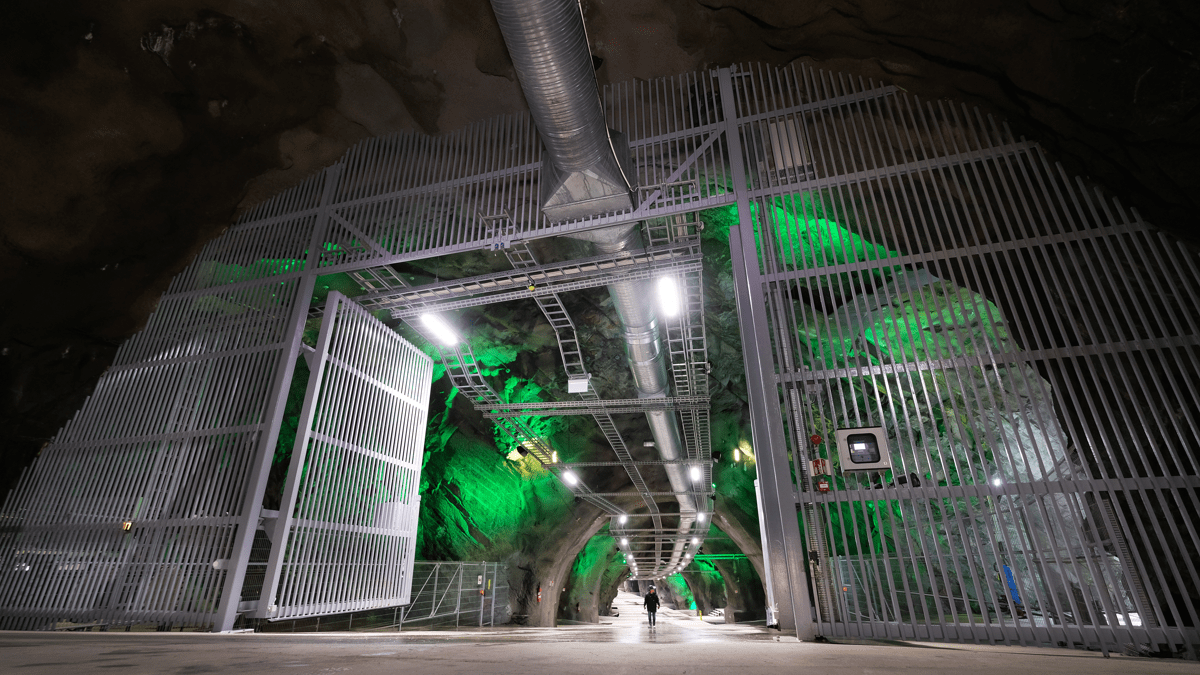
Lefdal is built inside a former mine on Norway’s west coast rather than on a conventional greenfield data centre campus. 3i lists 80MW of capacity at the site, while Lefdal’s own longer-term description of the facility says the underground complex has space for up to 120,000 square metres of white space and potentially 200MW of capacity as it is developed further.
The distinction between installed capacity and ultimate site potential is important. Large European data centre developments increasingly advertise long-term megawatt envelopes, but converting those envelopes into operational capacity still depends on power, fit-out, customer demand, equipment supply, and construction sequencing.
Lefdal’s physical configuration gives it a different set of engineering options from a conventional above-ground facility. The operator uses cold water from the adjacent fjord through heat exchangers and a closed freshwater circuit, reducing reliance on the mechanical refrigeration arrangements commonly found in warmer locations. It says the system supports air-cooled rack densities up to 50kW, alongside direct liquid cooling and immersion options for denser deployments.
Power is another central part of the investment case. The campus has access to Norway’s hydroelectric generation base, while 3i describes the underground site, naturally cold environment, and fjord-based cooling as factors supporting lower operating costs for high-performance and data-intensive workloads.
The structure also provides physical protection that would be expensive to reproduce on a conventional site. Lefdal says its IT spaces extend around 700 metres inside the mountain. That does not remove the need for the usual layers of operational security and resilience, but the surrounding rock changes the physical-security and environmental-risk profile of the facility.
For 3i, the transaction adds exposure to a Nordic market where developers have long used renewable power availability and cooler climates to attract compute-intensive workloads. The economics are increasingly being tested by the scale of proposed AI capacity, however. Cheap energy alone does not guarantee a viable data centre if connection capacity, transmission infrastructure, equipment lead times, or customer commitments do not arrive at the same pace.
Lefdal’s advantage is that a substantial part of the physical shell already exists underground. Expansion still requires electrical and mechanical infrastructure, but the underlying real estate is not being created from scratch. That is one reason the campus can present a much larger ultimate capacity figure than its currently stated operating capacity.
The additional €19 million commitments from both 3i Infrastructure and its co-investors indicate that the transaction is not simply a transfer of ownership. Further capital is already being allocated as Lefdal works through its expansion pipeline, placing the emphasis on how much of the site’s considerable theoretical capacity can be converted into contracted, energised data halls.

