
Summary
- Castrol ON PG25 and PG25T have been included within NVIDIA-Validated AI Factory Infrastructure.
- Review criteria included corrosion resistance, thermal stability, water quality, glycol purity, and compatibility with wetted materials.
- Fluid qualification is becoming a reliability issue as direct liquid cooling moves into larger AI deployments.
Castrol has secured NVIDIA validation for two of its direct-to-chip cooling fluids as liquid-cooled AI infrastructure moves towards more tightly specified material and supply-chain requirements.
Castrol ON PG25 and PG25T have been validated for NVIDIA AI factory and data centre infrastructure following a review covering corrosion resistance, thermal stability, dilution-water quality, base-fluid purity, and compatibility with wetted materials.
The assessment also considered Castrol’s business and global supply-chain resilience, adding an availability dimension to what might otherwise look like a straightforward coolant qualification.
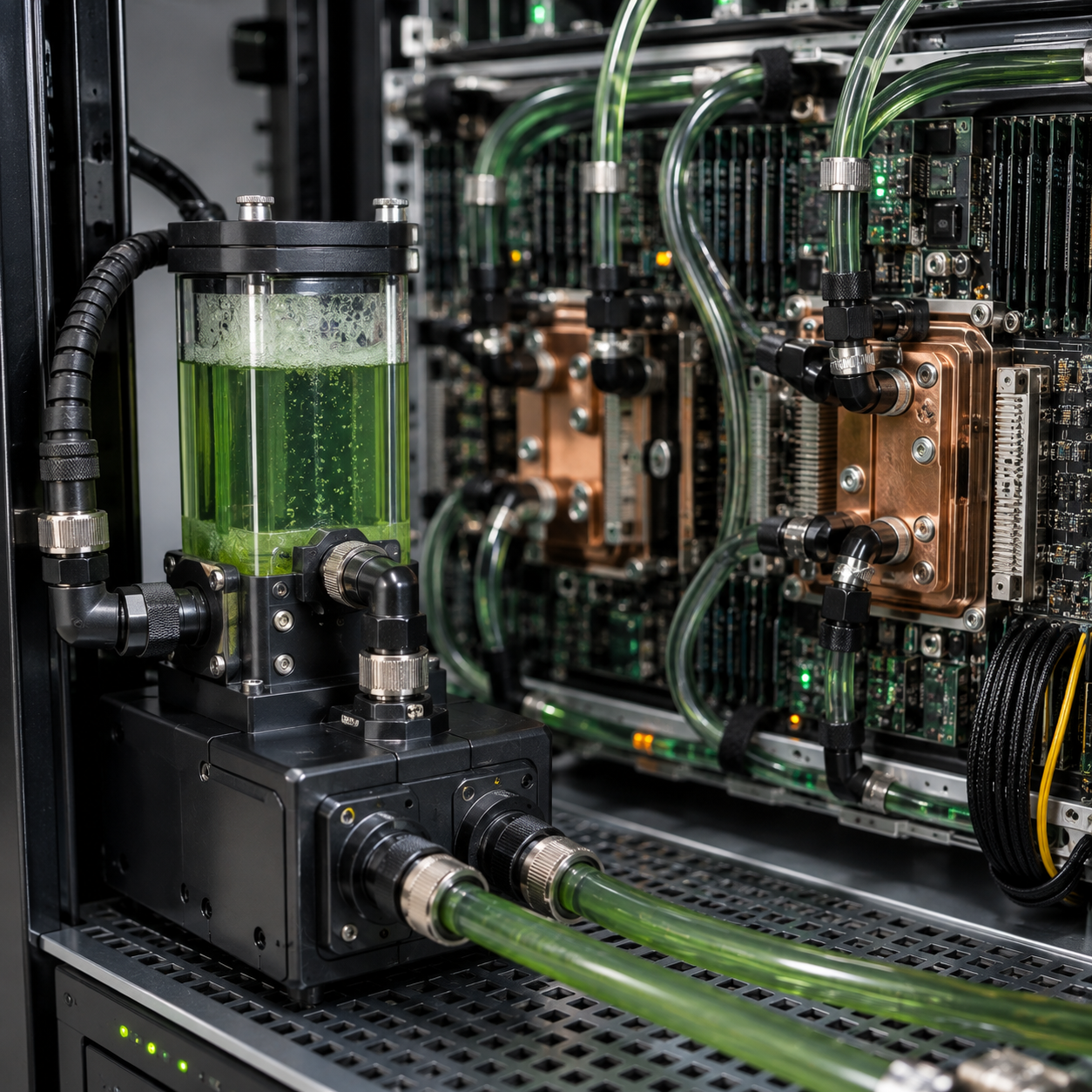
Direct-to-chip cooling circulates liquid through cold plates attached to processors and other high-heat components. That makes the coolant part of the operational environment around increasingly expensive GPU infrastructure rather than a generic consumable hidden inside mechanical plant.
The chemistry has to work with the complete set of metals, plastics, seals, hoses, pumps, manifolds, and heat exchangers it encounters over the system’s operating life. Poor compatibility can cause corrosion, deposits, seal degradation, biological growth, or changes in thermal performance.
Those risks become more important as liquid cooling scales from a handful of experimental racks to large AI clusters. A fluid issue affecting one test loop is inconvenient; an issue repeated across thousands of cold plates and several megawatts of compute can become an operational and warranty problem.
PG25 is based on propylene glycol and is intended for closed-loop direct-to-chip systems. Castrol says continuous circulation without exposure to the atmosphere can reduce evaporative water loss compared with open cooling architectures, although overall water usage still depends on the facility-side heat-rejection system.
The NVIDIA validation does not mean the fluid alone determines cooling performance. Flow rate, cold-plate design, inlet temperature, pressure, pumping energy, coolant distribution units, facility water loops, and heat-rejection equipment all remain part of the thermal chain.
It does, however, reduce one integration variable. As server vendors and operators deploy standardised AI architectures across multiple data centres, validated component and fluid lists can make it easier to control compatibility between the IT equipment and the facility systems connected to it.
That matters because liquid cooling has widened the boundary between server engineering and facility engineering. Operators that once delivered air at an agreed temperature to a server room increasingly have to manage liquid quality, pressure, flow, leak detection, filtration, sampling, and coolant maintenance much closer to the IT hardware.
Castrol’s validation follows its earlier OCP Inspired recognition for the PG25 product, putting the fluid into two different ecosystem qualification routes as the company expands from its traditional lubricants business into data centre thermal management.
The competitive field is also widening. Coolant suppliers, cold-plate developers, CDU manufacturers, monitoring specialists, and established HVAC companies are all building positions around the same AI-density problem.
The important distinction will be lifecycle performance rather than headline heat removal alone. Operators need cooling fluids that remain stable, compatible, available, and measurable through years of operation, because changing chemistry after a large liquid-cooled cluster has been commissioned is considerably harder than changing a product specification during design.

