
Summary
- An outline application has been submitted for a data centre north of the M40 at Denham.
- The scheme covers land on both sides of Denham Court Drive and includes two data centre buildings.
- The project adds to planning pressure around green belt data centre development in Buckinghamshire.
Mulberry Commercial Developments has brought forward plans for a hyperscale data centre on land north of the M40 and on both sides of Denham Court Drive in Buckinghamshire.
The proposal covers approximately 9.25 hectares near Junction 1 of the M40. Public consultation material describes the site as two agricultural field parcels separated by Denham Court Drive, immediately north of the A40 and M40 Denham roundabout.
A planning application has been submitted to Buckinghamshire Council under reference PL/26/04446/OA, following a pre-application public consultation held in April 2026. The project website directs residents and businesses to the council’s statutory consultation process.
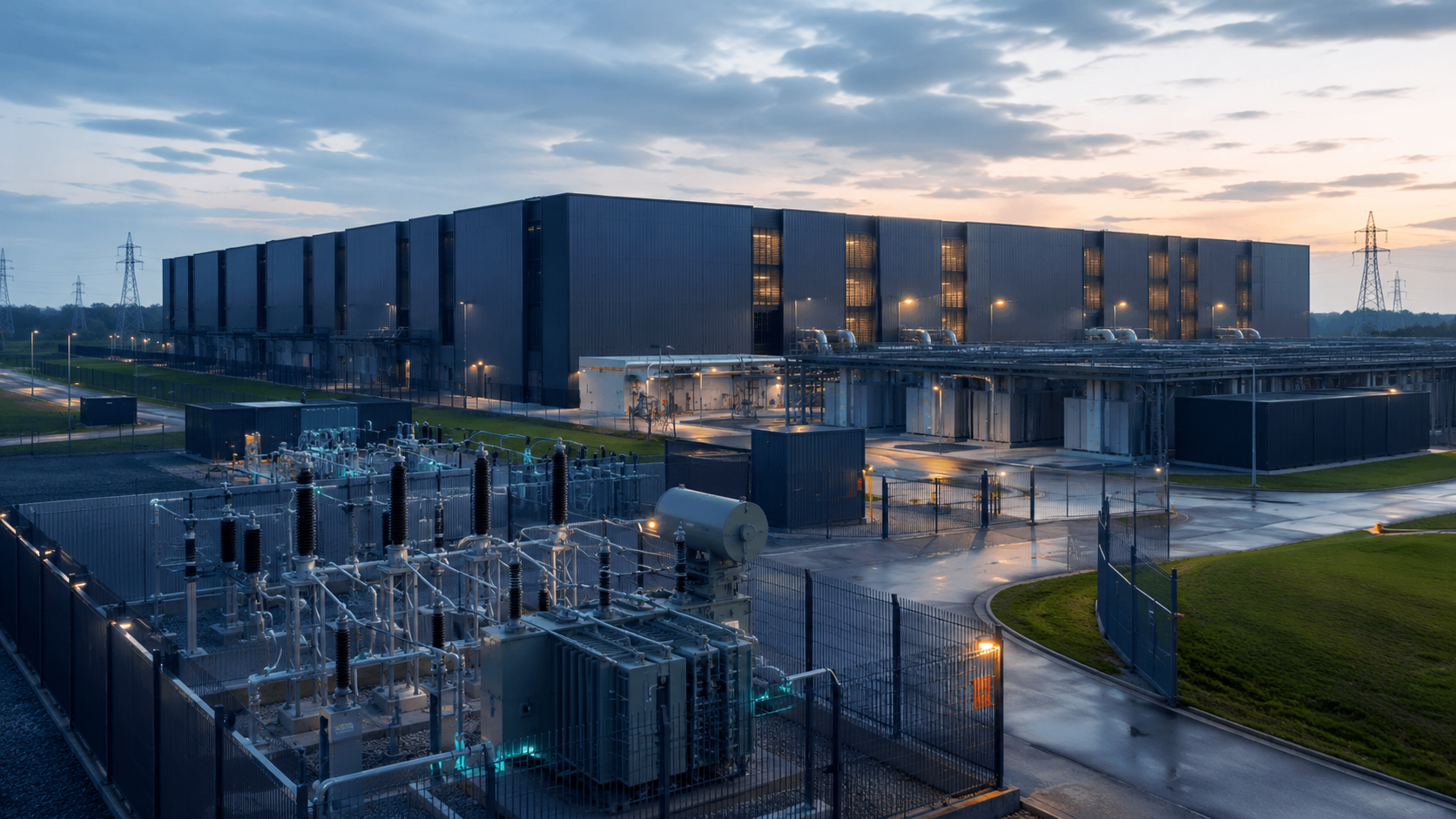
The scheme is described as a hyperscale data centre proposal with two data centre buildings and associated infrastructure, including an electrical substation. Target IT capacity and power demand have not yet been clearly set out in the public material reviewed.
London demand reaches contested land
Data centre growth around London continues to follow the familiar logic of power, fibre, customer proximity, and land availability. The difference is that the next wave is landing in more contested locations. Established clusters remain attractive but constrained, while new schemes increasingly face green belt policy, community concern, and closer scrutiny of utility load.
Denham sits in that tension. Its motorway-edge location has practical development advantages, and its proximity to London’s data centre market gives it commercial appeal. The planning context is harder. Large buildings, secure perimeters, substation infrastructure, backup plant, construction traffic, and cooling equipment all need to be assessed against local landscape, noise, ecology, and green belt policy.
Data centre proposals in sensitive locations now need a more precise public-interest case. Digital infrastructure demand is strong, but planning committees and communities are asking how facilities will be powered, how noise will be managed, what visual mitigation is credible, and whether local benefits are substantial enough to outweigh harm to protected land.
The absence of a clear public capacity figure leaves an important gap. Power demand shapes the scale of grid connection, substation infrastructure, backup generation, emissions profile, and energisation timetable. Without those details, the planning debate is likely to focus heavily on uncertainty as well as land use.
The planning argument is narrowing
The UK has become more supportive of data centre development at national level, including through critical national infrastructure status and policy language that recognises the sector’s economic role. Local planning risk has not disappeared. Developers still have to translate strategic need into site-specific evidence.
In green belt cases, that evidence must address both harm and benefit. A data centre can claim a role in digital resilience and AI capacity, but it is also power-intensive, physically substantial, and operationally sensitive. The more projects move outwards from established industrial zones, the more the sector will have to defend its land-use choices.
Buckinghamshire is already part of that national argument because of its proximity to the London and Slough markets. Sites in the county can look attractive on a map, but they often sit close to residential areas, protected landscapes, transport corridors, or local political opposition.
If consented, the Denham scheme would generate a significant delivery requirement. Two large buildings, a substation, grid works, site access, drainage, landscaping, security systems, backup power, and cooling plant would draw on specialist contractors and long-lead electrical equipment. The construction case will therefore be closely linked to the power case.
The project shows how UK data centre growth is moving from established estates into a more exposed planning environment. Demand for capacity is not in doubt. The harder question is whether developers can show that specific sites are buildable, powerable, and acceptable under local planning rules.

