
Summary
- The Mill is proposed on approximately 230 acres at a former steelworks site.
- Era4’s 1GW and 400,000-GPU figures describe potential full development capacity, not installed equipment.
- The developer is targeting a first operational phase in 2027, with its initial connected load unspecified.
Era4 has set out further plans for a large AI computing campus at the former Liberty Steel complex in Newport, Wales, identifying a long-term electricity ambition of up to 1GW and an initial operational phase targeted for 2027.
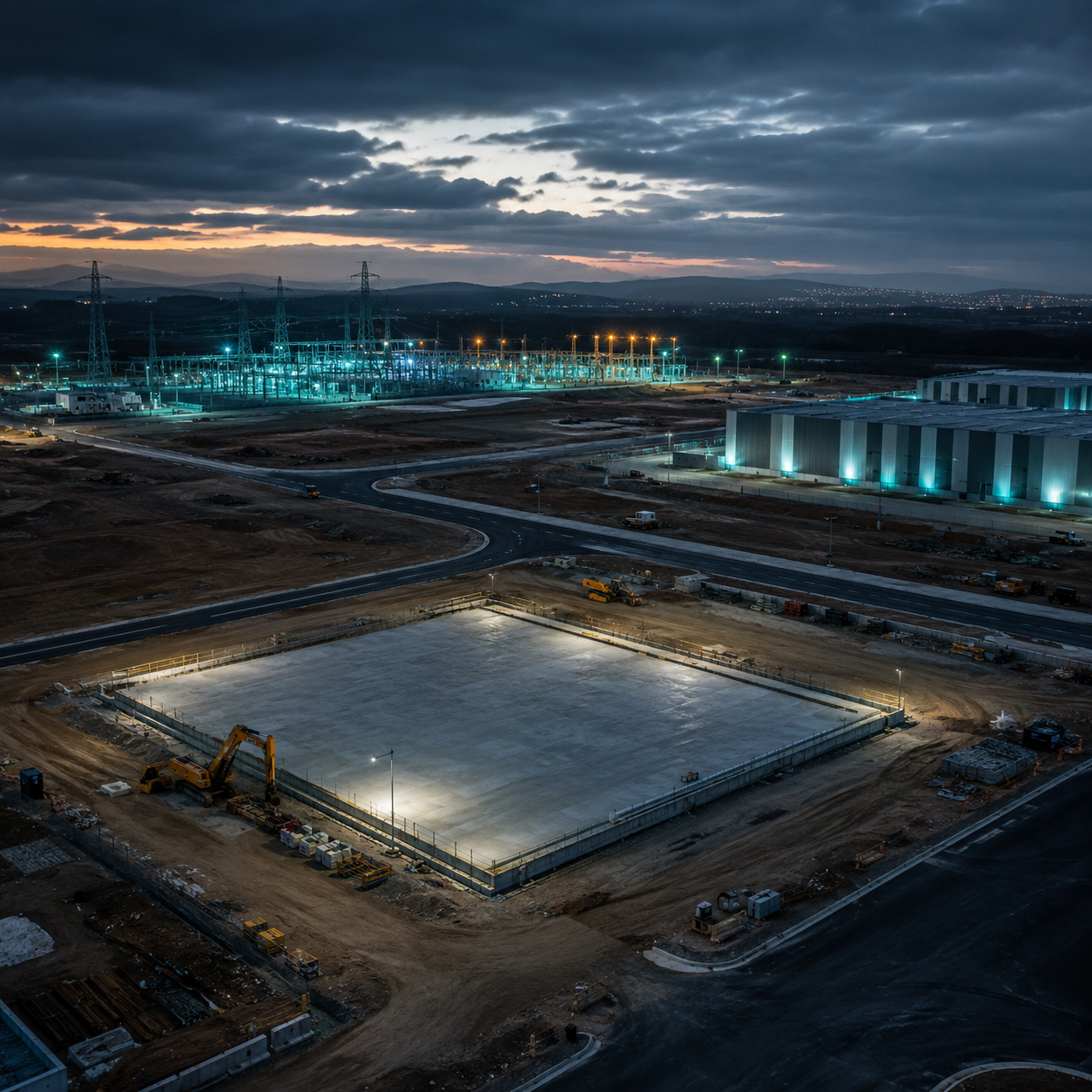
The developer calls the project The Mill. It describes a site covering approximately 230 acres and extending about 1.6 kilometres across a former industrial location, with buildings and land intended for staged reuse as computing infrastructure.
Era4 says the completed development could have space for the equivalent of more than 400,000 NVIDIA VR200 GPUs. Those numbers are a potential configuration at maximum build-out, not processors already ordered, delivered or operating in Newport.
The same distinction applies to power. The proposed 1GW figure describes the scale the developer ultimately wants to serve. Public material does not establish a fully energised connection, network reinforcement plan or allocation of electricity for every stage of the campus.
Earlier reporting in April indicated that Era4 had obtained permission for modular data centre equipment within existing industrial buildings. That should not be treated as evidence that all structures and supporting systems needed for a 1GW programme have obtained every necessary consent.
The latest details describe the broader campus concept, its intended equipment platform and features of the site’s physical redevelopment. According to the developer, the facility will use NVIDIA reference architectures and closed-loop water cooling, with the first phase due to enter operation next year.
Reuse of an industrial site offers some practical advantages. Large buildings and established transport access may reduce certain elements of construction work, and the location has a history of heavy industrial activity. However, a former steelworks does not automatically provide electricity distribution suitable for a continuously operated computing campus.
Modern AI racks can impose high and concentrated electrical loads. Facilities must accommodate transformers, switchgear, uninterrupted power systems, internal distribution and potentially additional substations as new halls or modules are commissioned.
An industrial connection serving an earlier manufacturing process may have a different power demand profile from a proposed AI site. The relevant network operator must assess the specific new requirements, available capacity and any reinforcement needed before the computing equipment can use the intended supply.
The developer has referred to a mix of grid and on-site generation as well as long-term power arrangements. The public information does not specify the installed generation plant, associated fuel supplies, detailed connection agreement or contracted volume of electricity for the full build-out.
Cooling is equally central to equipment density. Closed-loop cooling recirculates fluid between heat sources and heat exchange systems, which can reduce some forms of water consumption. Its overall environmental performance still depends on the means of rejecting heat to the surroundings and the power required by the cooling plant.
Era4 has not published the detailed water balance, operating temperatures or heat rejection equipment for a commissioned phase. Describing the planned system as closed-loop does not establish zero water use or any particular figure for electricity consumed by cooling.
The campus also has a heritage element. The developer intends to retain an original brick chimney as a landmark, preserving part of the former works while adapting the surrounding property for new use.
Liberty Steel still operates part of the broader industrial site, according to reporting, while the building identified for data centre reuse is not currently in use. The redevelopment must therefore be described as involving selected existing facilities rather than the closure or complete conversion of every remaining industrial operation.
Era4 has outlined proposed community facilities and skills initiatives as part of The Mill, including a technical college and sports and leisure provision. Their delivery arrangements have not been described with the same certainty as the existing site characteristics and should remain attributed ambitions.
The 2027 target refers to first-phase operation. It is not a date for completion of the 1GW campus or installation of 400,000 GPUs. The useful measures of delivery will be the electrical capacity actually secured and energised, the computing hardware installed and the reliability of cooling and network systems under live load.
The proposal adds a sizeable ambition to the UK’s AI infrastructure pipeline. Its progression from industrial reuse to operating capacity will depend on coordinated planning, utility connections, equipment procurement and commissioning rather than the maximum scale described in the promotional material.

