
Summary
- The European Commission has launched initiatives covering AI for grids and sustainable data centre integration.
- The work brings together data centre operators, energy companies, public authorities, and industry associations.
- The programme strengthens scrutiny of how digital infrastructure connects to constrained European power systems.
The European Commission has launched two energy-system initiatives that put data centre growth more directly inside the EU’s grid planning and sustainability agenda.
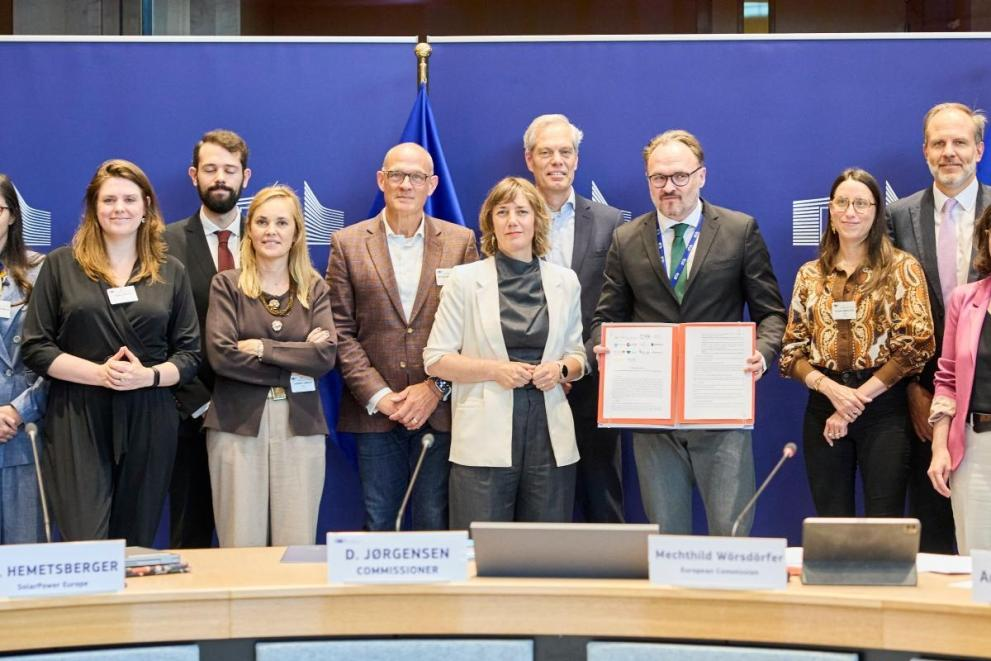
One initiative brings data centre operators, energy companies, public authorities, and industry associations into work on the sustainable integration of data centres into Europe’s energy system. Fourteen European associations have signed a Declaration of Intent, while six companies have signed a Declaration of Support to begin implementation work.
The second initiative, AI.grids, is designed to use artificial intelligence to support the planning, management, and operation of Europe’s electricity networks. The project includes 48 partners, including grid operators and research organisations.
Both measures sit under the Commission’s Strategic Roadmap for Digitalisation and AI in Energy, which addresses the rising electricity demand created by digital infrastructure while also setting out how digital tools could support a cleaner and more flexible energy system.
Large loads move into system design
Data centres are becoming a structural planning issue for European electricity networks. AI training, inference, cloud migration, and sovereign compute programmes are concentrating demand in markets where grid connections, substation capacity, permitting, and public acceptance are already shaping development strategy.
The Commission’s approach does not create a single new permitting rule, but it changes the frame. Data centres are being treated less as isolated large customers and more as electricity-system participants whose growth has to be coordinated with generation, grid reinforcement, flexibility, reporting, and local energy planning.
That shift will be felt most sharply in markets where connection queues are already long. A data centre project can no longer rely on a headline power request and a broad renewable procurement narrative. Developers increasingly need credible energisation timelines, procurement strategies that reflect local grid conditions, and designs that can support future efficiency and reporting obligations.
The sustainability strand of the Commission’s work also sits alongside the EU’s wider data centre efficiency agenda, including reporting requirements for significant facilities under the revised Energy Efficiency Directive. The practical direction is towards a more detailed view of how much power data centres use, when they use it, how that demand interacts with grid constraints, and whether facilities can provide flexibility rather than only add load.
Efficiency is no longer enough
The policy discussion around European data centres is moving beyond PUE. Energy demand, water use, heat reuse, clean power procurement, and local electricity-system impact are now being joined together. A highly efficient facility can still face questions if it lands in a constrained area without a workable grid route or a credible local energy strategy.
AI demand is adding pressure to that calculation. Infrastructure investors and cloud customers are pushing for faster capacity, while grid reinforcement and transmission build-out move on slower cycles. The result is a growing gap between commercially attractive capacity pipelines and the physical pace at which power systems can absorb them.
The Commission’s roadmap attempts to close part of that gap through coordination and digitalisation. AI tools may help grid operators model demand, improve planning, and manage flexibility, while earlier engagement between data centre developers and energy stakeholders could reduce speculative or poorly located connection requests.
The approach still depends on execution. Stakeholder initiatives do not energise substations, shorten transformer lead times, or remove local permitting disputes by themselves. Stronger coordination will help only if it feeds into practical connection rules, clearer locational signals, and faster network investment.
Europe wants more domestic AI and cloud infrastructure, but the next phase of growth will be judged through the power system as much as through digital strategy. Projects that can align capacity with grid readiness, flexible operation, clean procurement, and measurable sustainability performance will sit in a stronger position than schemes that treat power as a procurement formality.

