
Summary
- EUDCA has published a discussion paper defining practical forms of data centre flexibility.
- Options include flexible connections, energy assets, market participation, and limited workload management.
- The association argues flexibility should respond to system needs rather than be imposed as a single technical model.
The European Data Centre Association has published a framework for what data centre flexibility can realistically mean in Europe, as regulators and grid operators look for ways to integrate rapidly growing compute loads into constrained electricity systems.
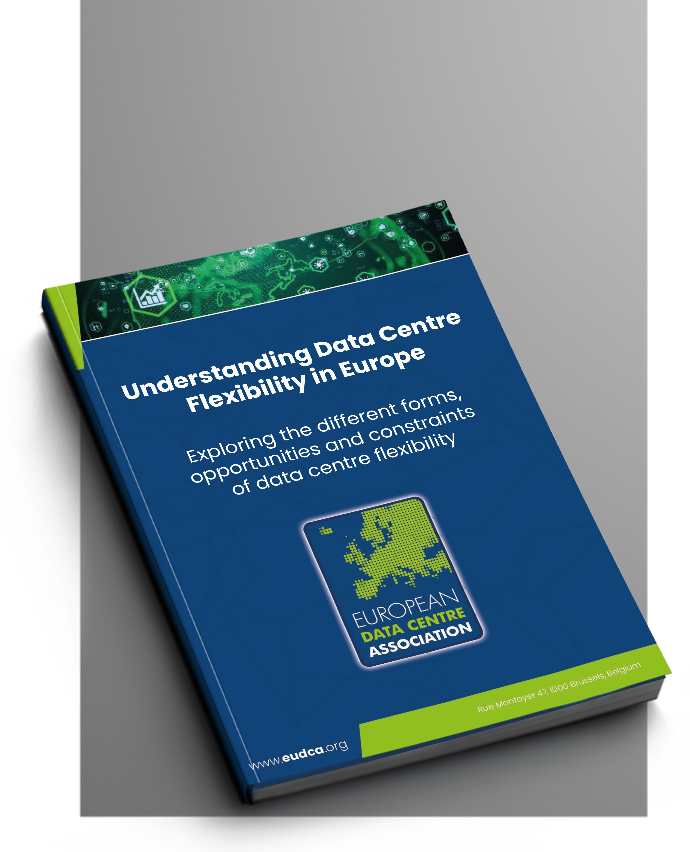
EUDCA said its new discussion paper, Understanding Data Centre Flexibility in Europe, is intended to provide a common reference point for operators, system operators, energy companies, and policymakers.
The paper rejects the idea that flexibility is a single technology. Instead, it separates mechanisms including flexible grid connections, market participation, energy assets such as batteries or generation, and, in some circumstances, workload management.
Its central argument is that flexibility should start with the need of the electricity system rather than with a predetermined solution. That distinction matters because data centres differ widely in workload, redundancy design, customer contracts, backup systems, geography, and tolerance for changes to power availability.
Flexibility cannot mean the same thing everywhere
A hyperscale training workload, an enterprise colocation hall, a financial-services environment, and an edge facility may all have very different operating limits. Some compute tasks can potentially be moved in time or location, while latency-sensitive or regulated workloads may have little scope to shift.
Energy assets present a different option. Batteries and backup systems can in principle support demand management or grid services, but their primary function in a data centre is often resilience. Using those assets commercially requires operators to preserve the state of charge, runtime, maintenance regime, and redundancy needed for an outage.
Flexible connections can also allow developments to connect earlier under arrangements where demand is reduced during defined grid conditions. Such agreements can improve use of existing network capacity, but they transfer part of the system constraint to the customer. The commercial viability depends on how often restrictions occur, how much load can be curtailed, and whether the data centre’s customers accept the operating model.
EUDCA’s intervention comes as the European Commission places greater emphasis on data centre interaction with the energy system. The Commission’s wider 2026 policy work includes a proposed tripartite framework intended to bring operators, public authorities, and energy-sector organisations together around grid planning, PPAs, flexibility, waste heat, and energy performance.
Grid reinforcement still matters
The risk for policymakers is treating flexibility as a substitute for building networks. Flexibility can help make better use of available capacity, but a large new data centre campus still adds substantial long-term electricity demand.
Where network reinforcement is needed, temporary curtailment arrangements or batteries do not remove the requirement for substations, cables, transformers, and generation. They may change the timing or reduce peaks, but the underlying load remains.
That is particularly relevant in Europe’s established data centre hubs, where developers are increasingly being pushed towards sites with earlier grid dates or towards secondary markets. Flexibility can widen the range of sites that are usable, but it cannot turn every constrained location into a viable hyperscale market.
The commercial incentives will also matter. Operators are unlikely to expose customer workloads or resilience systems to additional operating complexity unless the value of doing so is clear. Grid operators, meanwhile, need flexibility that is dependable enough to be incorporated into network planning and system operation.
EUDCA’s paper therefore moves the discussion away from whether data centres should be flexible in principle and towards the more difficult questions: which load can move, which asset can respond, for how long, under whose control, and at what cost.
Those questions will become harder as AI increases rack density and site power requirements. Europe may be able to extract more value from flexible connections and energy assets, but grid access will remain a physical infrastructure problem as well as an operating strategy.

