
Summary
- Bluefield Research forecasts €6.8bn of cumulative European data centre water-related spending by 2036.
- Capital spending is expected to cover cooling systems, treatment, reuse, municipal connections, and pretreatment facilities.
- The forecast places water alongside power, planning, and permitting as a practical constraint on AI-era data centre development.
Bluefield Research expects water-related spending by Europe’s data centre sector to reach €6.8bn by 2036, as AI demand adds pressure to cooling systems, municipal connections, water treatment, reuse infrastructure, and permitting.
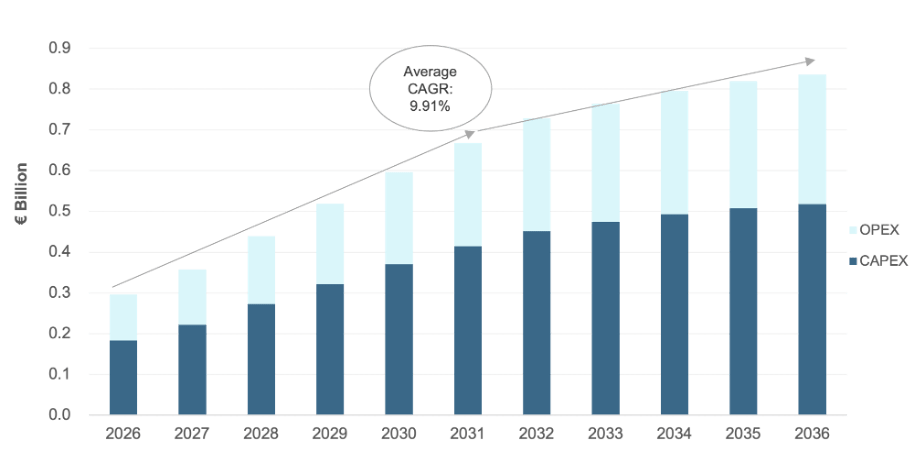
The consultancy’s report, Europe Water for Data Centers: Market Trends, Opportunities, and Forecasts, 2026–2036, forecasts a decade of rising expenditure behind the physical systems that allow digital capacity to operate. Under its baseline scenario, cumulative water-related spending reaches €6.8bn by 2036. A higher-growth AI scenario lifts the figure to €7.1bn, while a slower-growth outlook still reaches €4.7bn.
About 62% of projected spending is expected to go into capital investments, including cooling systems, water treatment and reuse infrastructure, municipal connections, and pretreatment facilities. That puts water much closer to front-end site selection, MEP design, planning negotiations, and local infrastructure assessment.
Water joins the siting equation
European data centre growth is already being held against grid queues, equipment lead times, planning delays, and rising construction costs. Water adds a different physical constraint. Facilities using evaporative or hybrid cooling may need local supply capacity, discharge permissions, treatment equipment, and credible assumptions for peak conditions. Those requirements become harder to satisfy in regions facing drought risk, water stress, or political resistance to large industrial users.
AI changes the cooling profile because high-density compute puts more heat into less space. Liquid cooling can reduce some direct water use, but it does not remove the wider infrastructure question. Heat still has to be rejected, secondary loops still have to be managed, and alternative dry systems may increase power demand. The trade-off can become sharper in hot weather, when cooling loads, electricity demand, and water stress can all rise at the same time.
Bluefield’s forecast points to a market where water infrastructure becomes part of the cost of securing capacity. Developers may need to fund assets that previously sat outside the core data centre budget, or show municipalities that new facilities will not crowd out public supply, housing, agriculture, or other industrial users. Reuse systems, pretreatment, and municipal tie-ins are increasingly part of the delivery chain, sitting beside substations and fibre routes as assets that decide whether a project can proceed.
Regulation is tightening the picture. European reporting requirements for data centre energy and water performance are increasing the visibility of facility-level resource use. Once comparable water-use data becomes more accessible to policymakers, customers, and communities, broad sustainability claims will have to stand against measured operating performance.
Efficiency claims face harder tests
Cooling suppliers, water-treatment companies, engineering consultants, and utilities all stand to see stronger demand as AI facilities move through design and permitting. Operators, however, face a less comfortable task: water strategy has to be engineered into the facility rather than layered onto the project as a planning response.
The most exposed developments are likely to be those combining high-density AI loads with constrained local infrastructure. A project can have enough land for the building and still struggle if the surrounding power, water, wastewater, and permitting systems cannot absorb the facility’s operating profile. That makes early utility engagement and transparent design assumptions more valuable than late-stage mitigation language.
Different European markets will face different versions of the same problem. Germany, the UK, and France are expected to account for a large share of cumulative spending, but Bluefield also points to growth in Spain, Italy, Poland, and the Nordics. Northern climates may offer more free-cooling potential and lower water stress in some areas, while southern markets may offer attractive power and land conditions but face tighter scrutiny over water resilience.
Heat reuse will also affect the water discussion. Where waste heat can be exported into district heating or industrial processes, the cooling strategy may create wider local value. Where there is no credible heat offtaker, developers may face more direct questions about why scarce resources should support a facility whose useful output is mainly digital and whose physical load remains local.
Bluefield’s numbers reinforce a basic constraint behind the AI build-out. Data centre capacity is not only measured in megawatts, racks, and square metres. It also depends on pipes, treatment systems, discharge permissions, local utility capacity, and the ability to show that the facility can operate within a community’s resource limits.

