
Summary
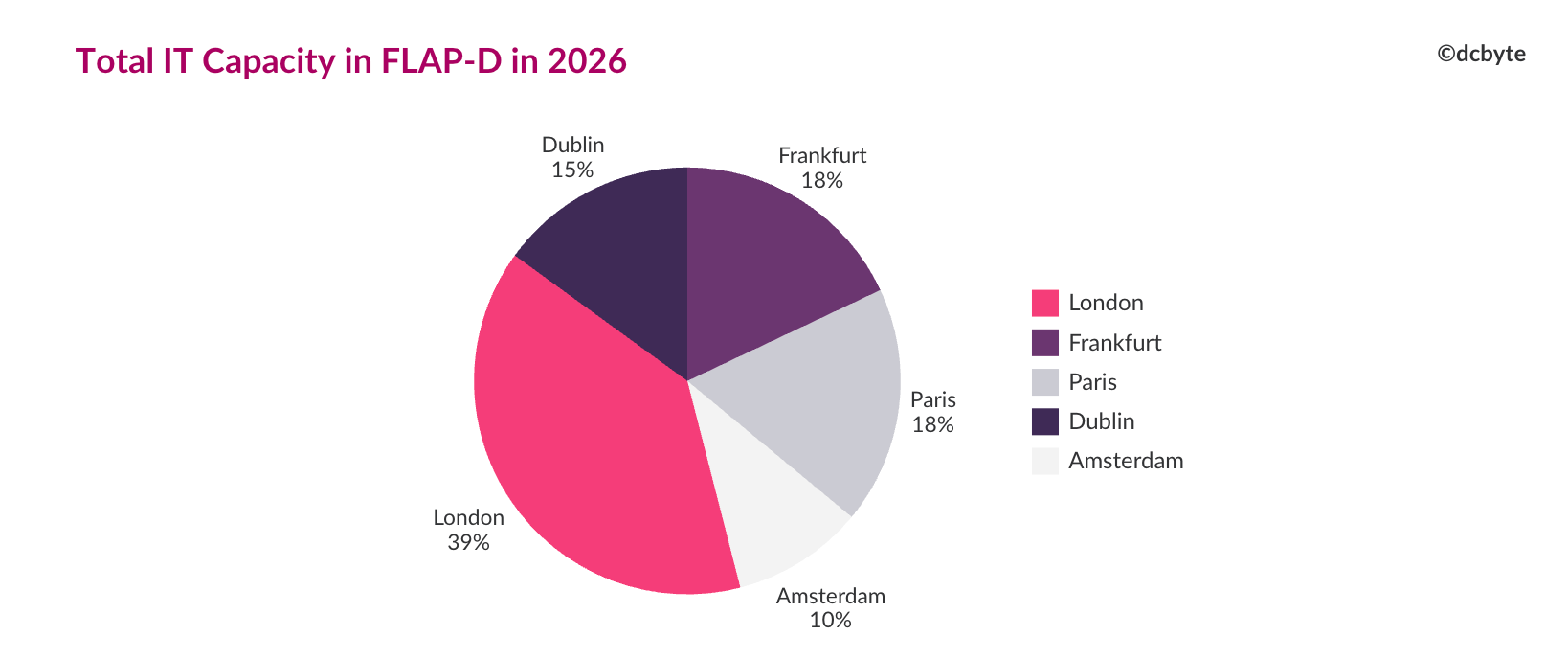
- DC Byte ranks London, Frankfurt, Dublin, Paris, and Amsterdam as EMEA’s leading data centre markets.
- The ranking shows mature European hubs retaining demand depth while facing harder constraints around power, land, planning, and grid delivery.
- London remains top of the EMEA table, but its pipeline depends on substation timing and available electrical capacity.
DC Byte has ranked London, Frankfurt, Dublin, Paris, and Amsterdam as the top five data centre markets in EMEA, leaving Europe’s established hubs ahead of emerging locations even as power, land, and planning constraints tighten.
The ranking forms part of DC Byte’s 2026 Global Data Centre Index and is based on demand, delivery, and market depth. London leads the EMEA table, followed by Frankfurt, Dublin, Paris, and Amsterdam. Each market retains deep customer demand, mature connectivity, and an established development ecosystem.
The result is not a simple endorsement of unconstrained growth. DC Byte points to a London pipeline of about 6.6GW across early-stage, committed, and under-construction projects, while noting that substation delays, grid conditions, and submarket variation are now central to delivery.
The core markets are harder to expand
London’s lead rests on finance, cloud, enterprise, carrier density, and the gravitational pull of an established digital infrastructure base. Yet the west London cluster and surrounding submarkets are increasingly shaped by where electricity can be delivered, whether substations can be expanded, and how new facilities fit into planning and local infrastructure requirements.
Frankfurt remains the main continental financial and cloud hub, with a deep interconnection base and proximity to German enterprise demand. Its expansion route is narrower than its demand profile. Land availability, grid access, power pricing, and local scrutiny have all become defining features of the market.
Dublin continues to rank highly because of its role in cloud infrastructure, tax, technology investment, and transatlantic connectivity. Ireland’s grid debate has also made the market one of Europe’s clearest examples of data centre demand running into national electricity-system tolerance. Capacity is still wanted, but the conditions attached to it have become more demanding.
Paris has gained momentum through hyperscale interest, AI infrastructure ambitions, and France’s broader sovereignty agenda. Nuclear-backed electricity, land opportunities, and government interest give the market a different profile from some of its peers, although local opposition and environmental scrutiny are becoming more visible.
Amsterdam’s position reflects installed depth, connectivity, and colocation maturity rather than an easy development path. Grid congestion, land scarcity, and policy restrictions have already limited the market’s ability to expand at the pace seen in earlier cycles.
Demand and buildability are separating
The FLAP-D markets still matter because data centre geography is sticky. Cloud regions, enterprise ecosystems, network density, operational supply chains, and customer expectations do not move quickly. Secondary markets can relieve pressure, but they do not automatically recreate the latency, connectivity, commercial, and regulatory characteristics of the established hubs.
That creates a more complicated European map. Large users still need capacity near strategic markets, while developers are forced to look harder at power corridors, energy procurement, local planning attitudes, and grid reinforcement. The question is not whether new markets will grow; many will. The question is how much critical capacity can move away from the core without changing customer performance, connectivity, or operating economics.
The ranking also underlines how infrastructure constraints now shape market hierarchy. A location can have excellent demand but limited near-term supply if grid capacity is delayed. Another can have land and energy but lack the customer density or interconnection base that makes a facility commercially valuable.
Investors and developers will increasingly need to distinguish between markets that look attractive on demand and markets that can actually deliver power-backed capacity. That gap is likely to widen as AI requirements push rack densities, electrical load, and cooling design beyond the assumptions used for older facilities.
Europe’s established hubs are not being displaced by constraint. They are becoming more selective. The next phase of growth will reward projects that can prove electricity, planning, and buildability earlier than competitors, not merely those that sit inside a famous data centre postcode.

