
Summary
- Google has introduced Brazos, a rack-mounted, closed-loop liquid-to-air cooling system for existing air-cooled data centres.
- The system supports a nominal 60kW thermal load per rack across three modular cooling units.
- Brazos targets AI and HPC retrofit pressure by avoiding full facility chilled-water replumbing while keeping heat rejection in the hot aisle.
Google Cloud has introduced Brazos, a rack-mounted liquid-to-air cooling system designed to let high-density liquid-cooled equipment operate inside existing air-cooled data centres.
The system is intended for AI and high-performance computing environments where chip thermal design power is moving beyond the practical limits of standard air cooling. Google said next-generation AI and HPC chips now routinely exceed 1,000W TDP, while retrofitting entire facilities with chilled-water loops can require substantial capital and time.
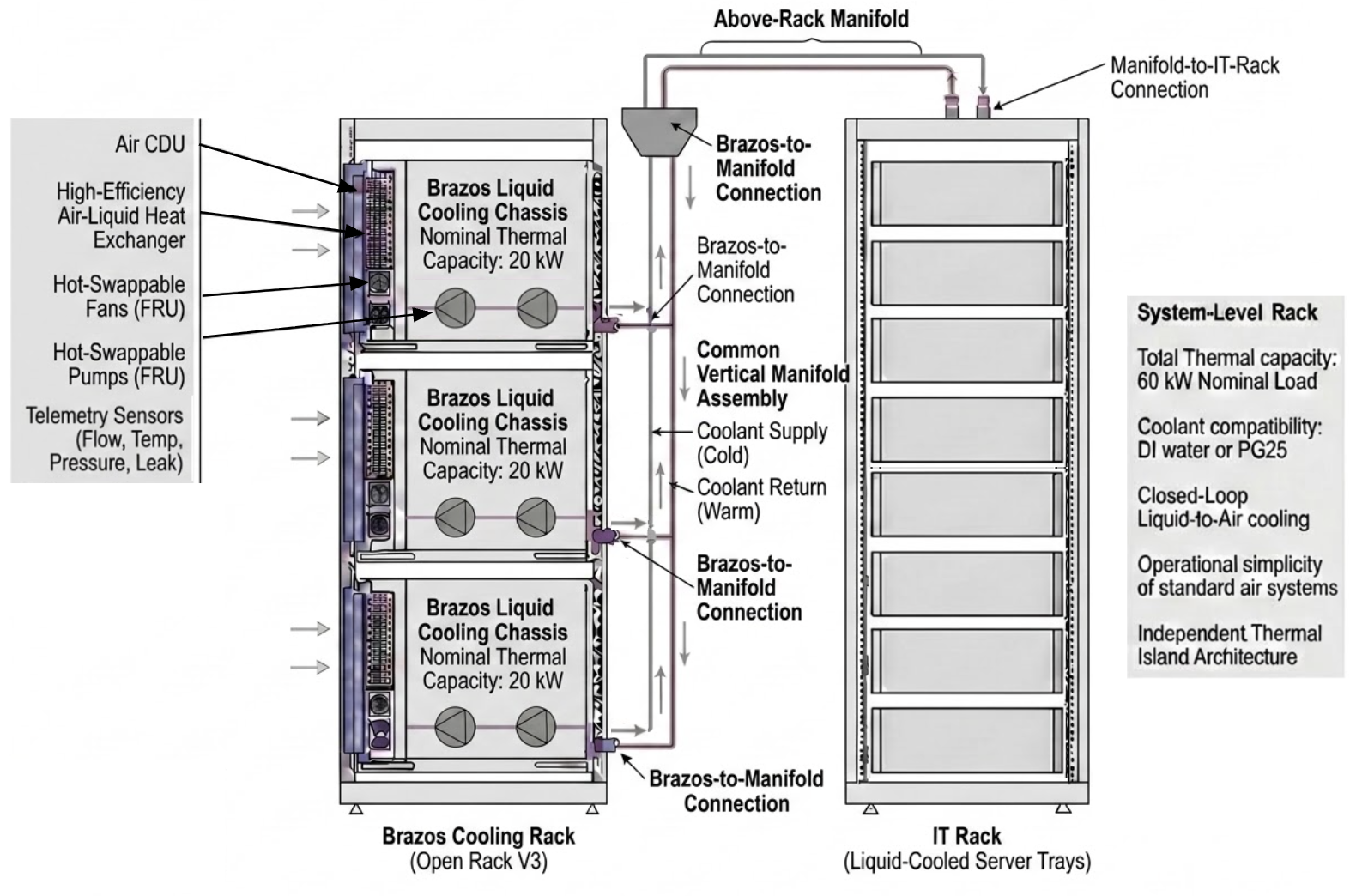
Brazos is described in Google’s technical blog as a rack-mounted, closed-loop, liquid-to-air cooling system that can be installed one rack at a time. It separates the IT liquid loop from the facility water supply, allowing liquid cooling at component level while rejecting heat into the data centre hot aisle through liquid-to-air heat exchangers.
The system is modular. Google says Brazos uses three cooling units and integrated rack manifolds, designed around Open Compute Project ORv3 form-factor racks. Each modular chassis occupies 11 Open Units of rack height. Across three modular units, the system supports a nominal 60kW thermal load per rack. It can run on deionised water or a 25% propylene glycol mixture, operates on 40V to 60V DC input connected to standard rack busbars, and includes leak detection, pressure relief valves, local HMI monitoring, and Modbus over TCP for remote management.
Google says Brazos is generally available and that manufacturing suppliers are ready to engage the wider industry to market and produce the design. The company also plans to open-source technical specifications, design principles, and visual assets through industry forums, including the Open Compute Project.
A retrofit route for AI density
The immediate pressure is practical retrofit. Most existing data centres were not designed around dense liquid-cooled GPU racks. Full facility-level conversion can require new chilled-water distribution, plant upgrades, pipework, commissioning, operating procedures, and risk controls. In live environments, that work is expensive, disruptive, and difficult to schedule.
Brazos takes an incremental approach. Rather than converting the whole building, it creates a rack-level thermal system that captures heat through a liquid loop and rejects it back into an air-cooled environment. The data centre still needs sufficient power and air-handling capacity, but the facility does not need to be replumbed around direct liquid cooling from day one.
That trade-off is important. A liquid-to-air sidecar will not turn every legacy facility into a hyperscale AI hall. The heat still enters the room air and must still be removed by the building’s mechanical systems. Power delivery, floor loading, structural limits, hot-aisle management, and upstream electrical capacity remain hard constraints. For selected racks or phased AI deployments, however, the approach could lower the threshold for using liquid-cooled servers inside existing estates.
European operators are likely to study the design closely. Many established metro facilities were built around conventional air-cooled enterprise or cloud loads. As AI customers push for higher rack densities, those buildings face pressure to accommodate workloads they were not originally engineered to support. A rack-level system could help operators test demand, serve smaller AI clusters, or extend the useful life of existing rooms without committing immediately to full mechanical redesign.
Maintenance will decide adoption
The serviceability features are central to whether Brazos can be used at scale. Google says pumps and fans are hot-swappable field-replaceable units, and the chassis uses low-friction slides for access. Those details matter because maintenance complexity is one of the barriers to liquid cooling adoption. Operators need systems that can be serviced without turning every repair into a specialist intervention.
Leak detection, pressure relief, coolant choice, and separation from facility water systems also address common operational concerns. A closed IT loop reduces some of the perceived risk around bringing liquid into legacy environments, though staff training, spares, fluid management, monitoring, and emergency procedures remain necessary.
Brazos also reflects a broader shift in hyperscale design behaviour. Large operators are no longer only building proprietary systems for internal estates. By open-sourcing parts of the design, Google is trying to influence the wider hardware and cooling ecosystem. If manufacturers adopt the design, the market for rack-level liquid-to-air cooling could become less fragmented.
The system may also sharpen distinctions between AI retrofit strategies. Some sites will move directly to facility water loops and liquid-cooled halls. Others will use rear-door heat exchangers, in-row systems, or CDU-based approaches. Brazos sits in the middle: more advanced than conventional air cooling, less invasive than full building-level liquid conversion.
The constraint remains power. A 60kW rack load is far above what many legacy rooms were designed to support at scale. Even if heat can be managed locally, upstream electrical infrastructure, switchgear, busways, UPS capacity, and backup generation may still limit deployment. Brazos solves a cooling pathway, not the whole AI retrofit problem.
Even so, the design addresses the middle ground now facing the sector. AI demand is arriving faster than many facilities can be rebuilt. A rack-level liquid-to-air system gives operators another option between refusing dense workloads and undertaking full-scale mechanical retrofit. In Europe, where planning, grid access, and live-site constraints can slow new builds, that middle ground is becoming more valuable.

