
Summary
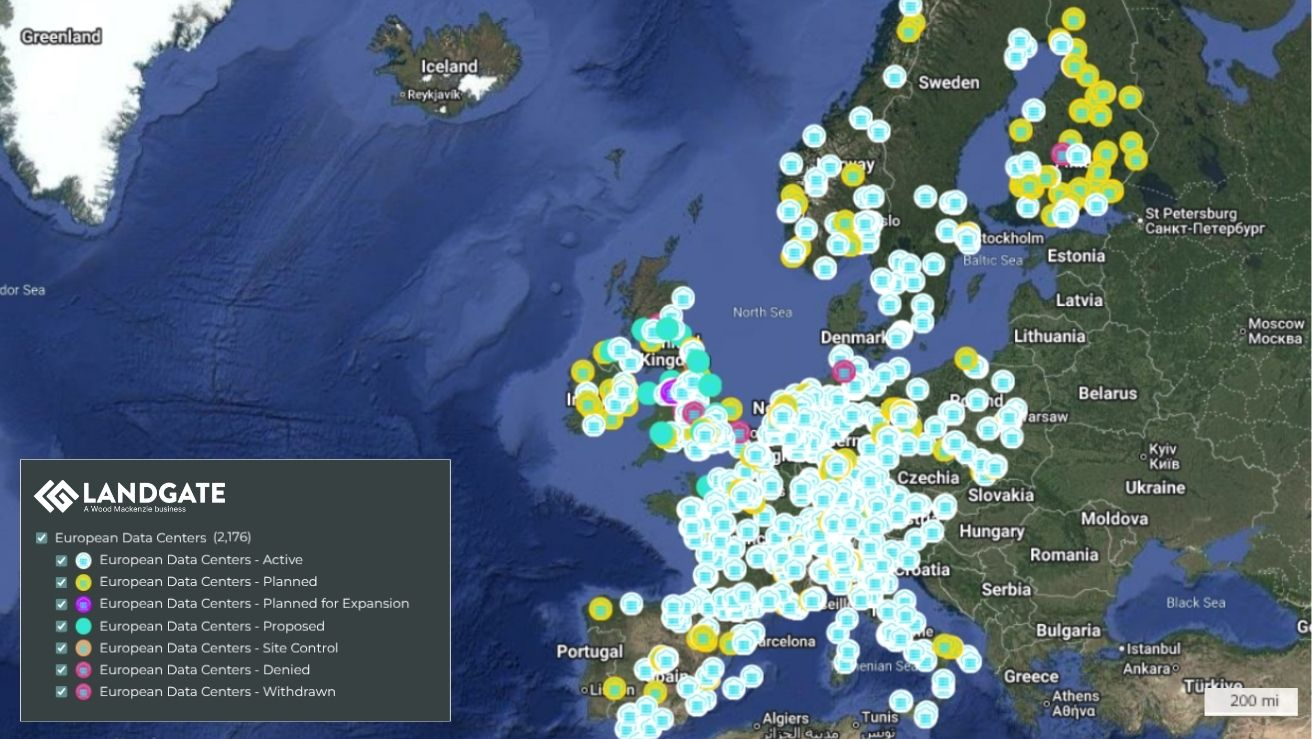
- LandGate's European dataset covers more than 2,100 facilities in ten markets.
- The UK has more than 500 mapped facilities and Germany more than 450.
- The platform combines facility status with spatial, energy, and grid-related information.
LandGate has expanded its infrastructure intelligence platform into Europe with data covering more than 2,100 operating, proposed, planned, expanding, and inactive data centre facilities across ten markets.
The dataset combines spatial information on individual facilities with project status and energy and grid data through LandGate’s GIS platform, API, MCP server, and direct exports.
The UK is the largest market in the company’s current inventory with more than 500 facilities, followed by Germany with more than 450.
France has more than 250 mapped facilities, the Netherlands more than 198, and Italy more than 180. Spain, Ireland, Sweden, Poland, and Switzerland complete the ten country coverage.
The figures are LandGate’s own inventory rather than an official European census.
Counts vary between market databases because providers do not always define facilities in the same way. A campus may be recorded as one site or several buildings, while the inclusion of proposed, inactive, and expanding developments can materially raise the headline total.
LandGate’s expansion combines those project records with electricity and grid information.
Power availability is now influencing site selection earlier in the development process. A parcel can sit close to a transmission line or substation and still face years of delay if firm capacity has already been allocated or upstream reinforcement is required.
Land, fibre, latency, planning policy, and proximity to customers remain important, but none compensates for a connection timetable that misses the required service date.
The constraint becomes more pronounced where several proposed AI facilities seek hundreds of megawatts from the same network area.
Mapping nearby projects can help identify clusters of future demand around individual substations, transmission corridors, or industrial estates.
It cannot establish that a site has an available connection. Grid proximity does not amount to a connection offer, and public datasets cannot capture every network constraint or commercial discussion between a developer and system operator.
The platform is therefore most useful during early screening, before direct electrical studies and utility engagement begin.
LandGate was acquired by Wood Mackenzie in June 2026, bringing the spatial platform into a wider energy and commodities data business.
The European rollout arrives as development expands beyond London, Frankfurt, Amsterdam, Paris, and Dublin.
Established clusters still benefit from customer demand and connectivity, but grid congestion, land prices, and permitting are directing some projects towards secondary markets and peripheral locations where power may be easier to secure.
Development teams increasingly need land, planning, fibre, competing projects, electricity capacity, and reinforcement requirements to be assessed together rather than in separate workstreams.
The value of LandGate’s dataset will depend on how accurately it tracks changing project status and network conditions as proposed facilities move through planning, connection, construction, and commissioning.

