
Summary
- The House of Lords Science and Technology Committee launched its computing infrastructure inquiry on 23 November.
- The first public evidence session is scheduled for 24 November, involving academics and data centre operator CyrusOne.
- The government's Compute Roadmap forecasts a requirement for at least 6GW of AI-capable data centre capacity by 2030.
The House of Lords Science and Technology Committee has launched an inquiry into the UK’s future computing capacity, examining whether electricity infrastructure, planning arrangements, and investment conditions can support the government’s ambitions for domestic artificial intelligence infrastructure.
The investigation, launched on 23 November, will consider the relationship between public and private investment in computing resources, alongside the practical constraints affecting the construction and operation of data centres.
Electricity costs, grid availability, planning restrictions, and public acceptance are among the issues identified for examination.
The first public evidence session is scheduled for 10:15am on 24 November. Witnesses include Professor Michael Wooldridge and Professor Anne Trefethen of the University of Oxford, Professor Maria Savona of the University of Sussex, and Emma Fryer, European public policy director at data centre operator CyrusOne.
The inquiry follows the publication of the government’s Data Centre Covenant on 28 October, alongside its wider programme of electricity connection and planning reforms intended to accelerate domestic infrastructure investment.
The government’s Compute Roadmap, originally published in July 2025, forecasts that Britain will require at least 6GW of AI-capable data centre capacity by 2030, representing approximately three times the country’s existing capacity when the roadmap was published.
Electricity infrastructure constrains development
Delivering that capacity requires electricity network investment alongside the construction of computing facilities and installation of advanced hardware.
Developers can secure land and progress planning applications before receiving definitive electricity connection arrangements. However, the timing of electricity availability frequently determines whether construction expenditure and prospective customer commitments can be aligned.
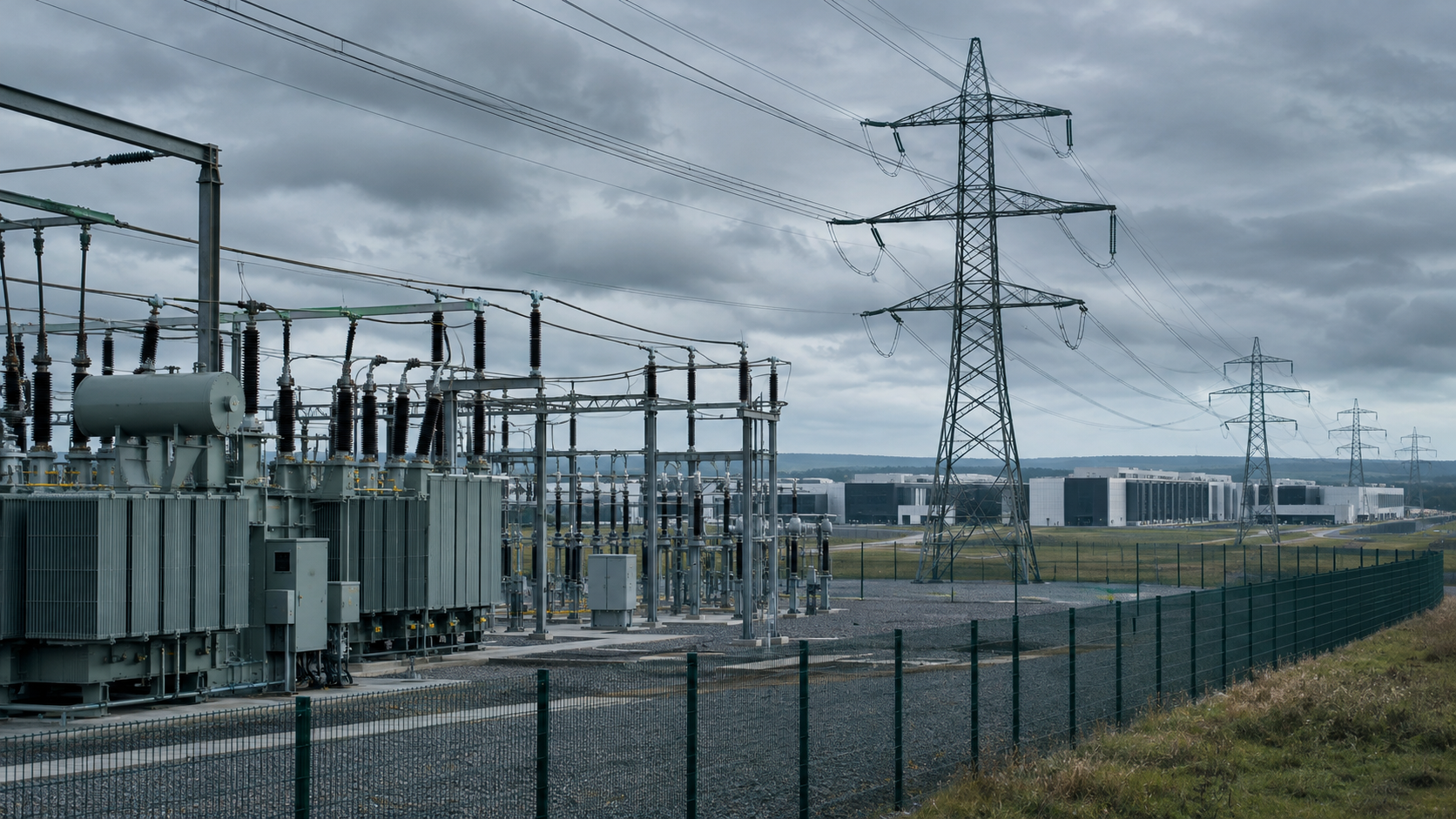
Transmission and distribution network reinforcement can require the construction of substations, installation of new cables, and procurement of transformers, switchgear, and associated protection equipment.
The availability of manufacturing capacity and specialist engineering contractors can affect the delivery timetable even where the necessary electricity connection rights have been secured.
The government intends to allow the National Energy System Operator (NESO) to prioritise strategic demand projects identified by ministers. It also plans to align data centre electricity connections after 2030 with regional infrastructure targets.
Its October covenant identifies additional measures intended to accelerate strategically important connections before 2030, including identifying spare capacity and facilitating the transfer of existing connection contracts where necessary.
These reforms would alter how available electricity capacity is allocated between prospective developments. The implementation of individual measures will nevertheless determine whether developers can obtain sufficiently dependable connection schedules to support investment.
Electricity prices introduce a separate commercial consideration. Computing facilities require substantial quantities of power during operation, meaning differences in energy costs between markets can influence investment decisions.
Workloads that can be located relatively independently of their users may provide developers with greater geographic flexibility than services requiring low-latency connections or compliance with domestic security requirements.
Computing resources and infrastructure ownership
The committee’s examination of public and private investment will also consider the relationship between the physical location of computing infrastructure and the availability of resources to domestic organisations.
A privately financed data centre can accommodate equipment operated by international cloud providers or other commercial customers without necessarily making those resources available to British researchers and businesses on suitable commercial terms.
Public investment can establish computing resources dedicated to scientific research and strategic national applications, while privately financed facilities provide capacity through a variety of commercial arrangements.
The government’s covenant establishes expectations covering national security, operational resilience, electricity system costs, resource efficiency, domestic supply chains, and community benefits.
Strategically important developments must satisfy the relevant conditions to qualify for additional government support, while other operators are encouraged to meet the same expectations.
The policy therefore connects the availability of infrastructure development support with the wider economic and operational contributions expected from individual projects.
Public acceptance remains a consideration where proposed campuses require extensive land, substantial electricity infrastructure, or additional cooling resources. Planning authorities must assess the associated environmental effects alongside the economic and infrastructure benefits identified by developers.
The inquiry will examine whether existing arrangements adequately address those competing requirements as Britain attempts to expand domestic computing capacity.
Changes in computing technology could also affect the country’s longer-term infrastructure needs. Processor efficiency, cooling architecture, computing density, and the balance between AI training and inference may alter the amount and location of electricity required for future workloads.
The committee’s investigation brings these commercial, technical, and regulatory questions into a common parliamentary inquiry. Its evidence programme will provide an opportunity to examine whether the policies intended to expand Britain’s computing resources can be translated into financed, connected, and operational infrastructure.

