
Summary
- VersaBeam Mini uses a 3.5mm by 9mm form factor and supports up to 3,456 fibres in a 1RU panel.
- Molex claims 3× higher density and a 9× smaller service blast radius than its larger VersaBeam configuration.
- Sampling begins in Q4 2026, with general production planned for the first half of 2027.
Molex has introduced a smaller expanded-beam optical connector designed to increase fibre density in AI switches and optical backplanes without forcing operators to service very large fibre groups at once.
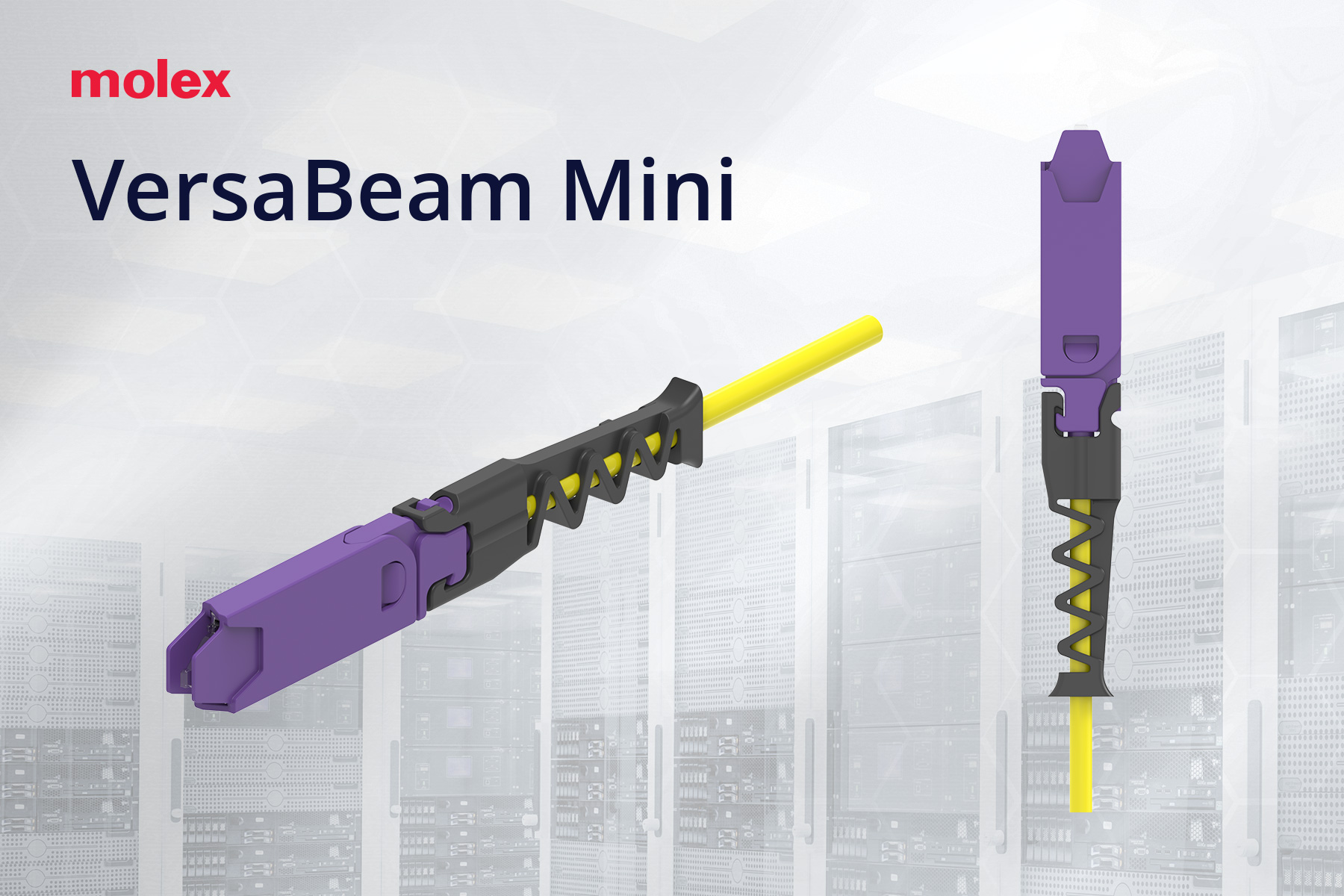
VersaBeam Mini packages 16 fibres into a 3.5mm by 9mm connector. Molex says the format can support as many as 3,456 fibres in a standard 1RU panel, a threefold density increase compared with its VersaBeam 16 product.
The company is targeting front-panel switching, optical backplanes, co-packaged optics, and other environments where high fibre counts compete for limited chassis space.
Molex also claims the 16-fibre granularity reduces the “blast radius” of maintenance by a factor of nine. In practical terms, technicians can isolate a smaller group of channels when rerouting or replacing a connection rather than disturbing a much larger bundle.
An optional mass-insertion mechanism allows nine connectors — 144 fibres — to be engaged in one action during deployment while retaining the smaller service unit once the system is operational.
Fibre becomes a mechanical problem
AI networking is often discussed through bandwidth numbers, but the physical layer creates a less glamorous constraint: every optical lane eventually needs a connector, fibre path, bend radius, identification method, and service route.
As switches move towards higher radix and more optical interfaces, front-panel area becomes scarce. Simply adding more conventional connectors can make cable management difficult long before the theoretical switching capacity is exhausted.
That is one reason very-small-form-factor connectors and co-packaged optical architectures are receiving more attention. The challenge is to increase density without creating a service environment where contamination, cleaning, or a single damaged connector takes an excessive number of channels out of use.
Molex is using expanded-beam optics partly to address contamination. Instead of mating very small exposed fibre cores in the conventional way, the technology expands and collimates the optical beam across the connection, making performance less sensitive to small particles.
The company says its broader VersaBeam technology can cut inspection, cleaning, and deployment overhead by as much as 85%. That is a Molex performance claim rather than independent operating data, but maintenance effort is a genuine concern as fibre counts move into the thousands per rack or panel.
Automation starts before the data centre
VersaBeam Mini also uses the groove-based 3M EBO ferrule without conventional guide pins and holes. Molex says that geometry is intended to support robotic pick-and-place assembly and simplify high-volume cable manufacture.
That factory automation angle is relevant because scaling AI infrastructure requires more than faster silicon. Optical assemblies have to be manufactured, tested, installed, and replaced at volumes high enough to support the compute systems around them.
The connector also incorporates inherent laser eye-safety characteristics, an increasingly practical issue as optical power and fibre counts rise around equipment serviced by general data centre technicians.
None of those features determines whether a particular AI network adopts expanded beam. Insertion loss, optical performance, cost, interoperability, qualification, and OEM architecture will decide where the product fits.
Limited customer sampling is due to begin in the fourth quarter of 2026, with general production planned for the first half of 2027. Molex is showing the technology at ECOC 2026 in Málaga alongside co-packaged optics, optical circuit switching, and external-laser interconnects.
The launch illustrates how AI infrastructure pressure is moving into mechanical details once treated as secondary. More GPUs require more network bandwidth, more bandwidth requires more optics, and more optics eventually turn a bandwidth problem into a question of how many reliable, maintainable fibres can physically fit across the face of a switch.

