
Summary
- The non-binding MoU contemplates an initial pilot delivering up to 800kW of firm compute capacity.
- Exascale and EnergyBank want to integrate floating wind, long-duration storage, cooling, and modular AI infrastructure.
- Any deployment remains subject to feasibility work, finance, definitive agreements, and regulatory approvals.
Exascale Labs and EnergyBank have agreed to study an off-grid AI compute pilot powered by Norway’s Zephyros-One floating wind turbine, proposing an unusual route around the connection delays affecting large new electrical loads.
The companies have signed a non-binding memorandum of understanding covering an initial deployment of up to 800kW of firm compute capacity. Their concept combines floating offshore wind, long-duration energy storage, Exascale’s modular data centre equipment, cooling, and power infrastructure.
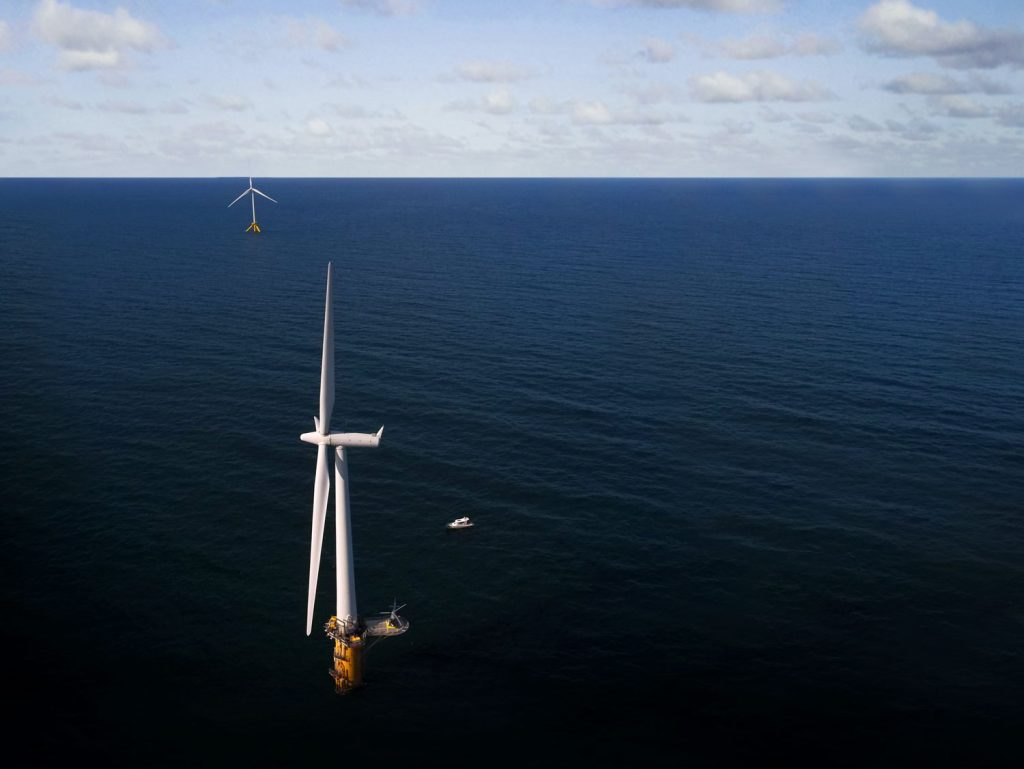
The pilot would use Zephyros-One, formerly known as Hywind Demo, west of Karmøy. The floating turbine has operated since 2009 and was acquired from Equinor by Zephyros in 2019.
Exascale and EnergyBank have set a longer-term ambition of developing a repeatable architecture that could support as much as 10MW of firm compute capacity per turbine. That figure is a development target rather than contracted capacity, and the companies explicitly state that no commercial deployment is guaranteed.
Putting compute behind the generation asset
The proposed architecture reverses the normal sequence for a data centre project. Instead of securing a site and asking the transmission or distribution network to deliver a large new load, the partners want to colocate modular computing infrastructure with generation and storage and operate independently of the conventional grid.
That could address one bottleneck while creating several others. Floating wind is variable, whereas AI infrastructure expects tightly controlled power quality and high availability. Turning intermittent generation into firm compute therefore places heavy demands on storage capacity, power conversion, controls, redundancy, and the operating strategy used when generation falls.
Cooling has to be integrated into the same system. Exascale says its modular platform includes high-density cooling and high-voltage DC power capability, but the pilot’s final equipment configuration has not yet been published.
The offshore environment adds further engineering questions. Salt exposure, access, maintenance, equipment replacement, communications, and weather windows are very different from operating a conventional inland data centre campus. Even if the computing module is installed onshore near the generation connection rather than physically offshore, the energy system still depends on marine infrastructure.
Zephyros-One offers an established test asset rather than an unproven turbine. Its owner says the unit has generated electricity since 2009 and recorded average uptime of 99% during 2022. That operating history gives the partners a real generation platform on which to test the wider integration concept.
A pilot before a power strategy
The project should nevertheless be read as an experiment rather than as a new 10MW data centre development. The MoU does not oblige either company to proceed, and the pilot remains subject to technical evaluation, definitive agreements, financing, and regulatory approvals.
EnergyBank is expected to seek a mixture of private investment and possible public funding for the initial programme. The companies plan to carry out feasibility work, define a reference architecture, and determine whether the model can be scaled to multiple turbines and compute modules.
The attraction comes from the lengthening gap between demand for AI hardware and the time needed to secure electrical infrastructure. Developers across Europe are looking at behind-the-meter generation, batteries, microgrids, and alternative site locations because a large data centre can move through land and construction planning faster than a network connection can sometimes be reinforced.
Off-grid operation does not make the power problem disappear. It transfers responsibility for reliability from the grid and utility onto the project itself. The value of the Norwegian pilot will therefore depend less on the novelty of putting compute next to floating wind and more on whether the partners can demonstrate firm, predictable power at a cost and availability level suitable for high-value AI workloads.
The first threshold is modest compared with hyperscale projects: up to 800kW. If that pilot proceeds, its operational data on generation, storage, cooling, reliability, and maintenance will provide a much stronger basis for judging the proposed 10MW-per-turbine model.

