
Summary
- The new MGX 1.2 work covers rack-scale liquid cooling and power interfaces for high-density computing.
- NVIDIA describes a 5,000A busbar and support for rack deployments up to 250kW.
- OCP publication and vendor participation are not equivalent to certification of every implementation.
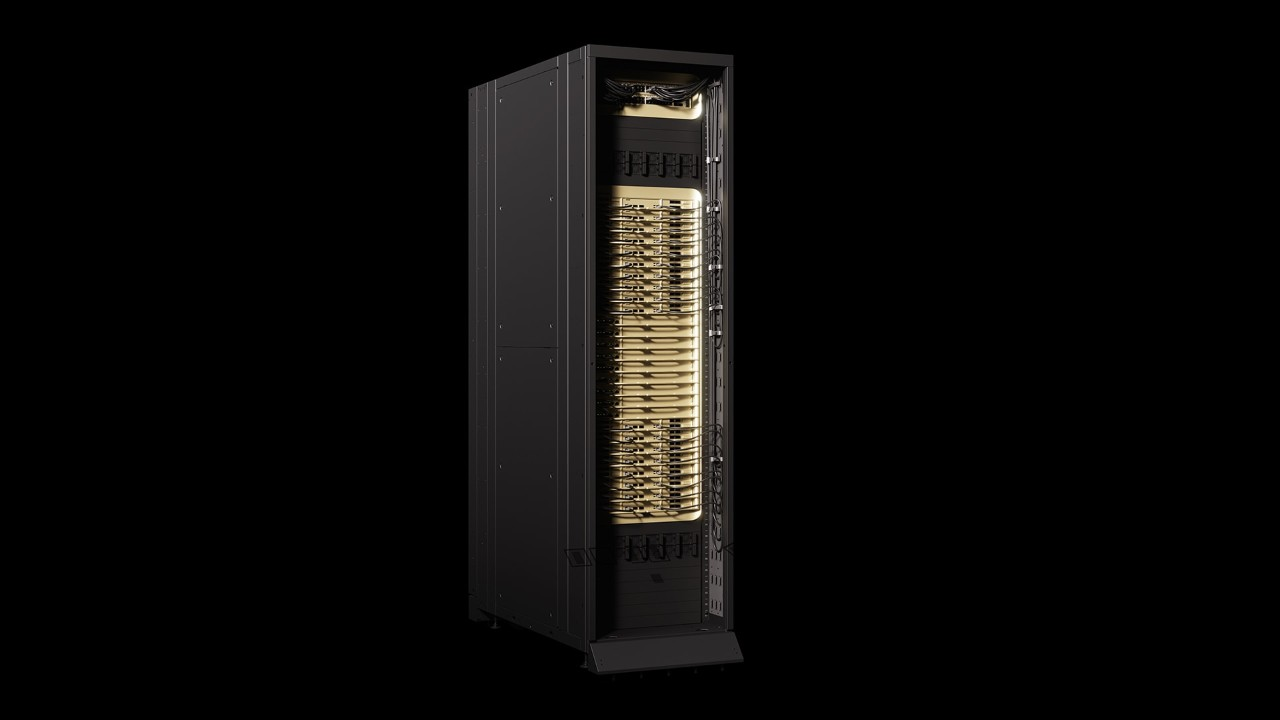
NVIDIA has contributed rack and compute tray designs for its Vera Rubin platform to the Open Compute Project, extending the MGX infrastructure framework used by equipment manufacturers. The October announcement adds common physical interfaces for liquid cooling, electrical distribution, mounting and maintenance. NVIDIA says the updated MGX 1.2 architecture supports deployments up to 250kW per rack and includes a liquid-cooled 5,000A busbar.
The initiative addresses a problem that starts below the computing software layer. High-density accelerators can require substantial electrical power and reject equally significant heat into a relatively small footprint. An individual rack needs a coherent route for incoming power, liquid connections, network interfaces and service access. Small incompatibilities at these boundaries can force site-specific redesign or delay manufacturing and commissioning, even if the computing components themselves are available.
MGX 1.2 introduces blind-mate cooling connections and standardised power and cooling interfaces. Blind-mate hardware is intended to allow equipment to connect as it is inserted, reducing the amount of manual plumbing involved in rack service. That approach creates demanding tolerances for alignment, pressure control and leak prevention. Standardisation can help supply chains, but builders and operators still need a tested bill of materials, coolant specification and maintenance procedure for each deployed configuration.
The published design includes 19-inch equipment support and provisions for higher-density rack layouts, making it relevant to facilities that do not intend to adopt a single proprietary chassis format. NVIDIA is also proposing software components for rack management and bare-metal deployment. These may reduce integration effort between physical hardware and control systems, though the tools should be evaluated under actual service and failure conditions rather than inferred performance claims.
NVIDIA and partners also publicised an Open Data Center Specification and work on grid resilience. The latter considers how large compute loads react to disturbances on the utility system, with an aspiration for rapid recovery of near-full load. A data centre that changes demand abruptly can affect the surrounding network, so ride-through and restoration behaviour cannot be treated solely as internal IT requirements. The actual obligations depend on grid codes, the site connection agreement and the controls installed behind the meter.
The Vera Rubin programme already has equipment partnerships and previously publicised rack deployments. October's distinct development is the contribution of physical specifications to a wider standards process. Open specifications can encourage component substitution and repeatable construction, but they do not mean every participating supplier's product is already certified, interchangeable or operating in the field. The published documentation and adopted revisions will determine which interfaces are genuinely common.
Power distribution becomes a larger reliability issue as rack ratings rise. Even when the total facility demand is unchanged, concentrating it into fewer racks can alter cable routing, current density, thermal hotspots and the failure impact of a single power component. Facility engineers therefore need to examine selective protection and redundancy at the rack level. A standard busbar format can help with dimensional compatibility, but rated current, fault endurance and safe maintenance boundaries must all be validated for a specific electrical system.
The physical standards work has implications for supplier competition. A consistent rack envelope may allow server manufacturers, cooling suppliers and integrators to design around known connection points instead of negotiating bespoke interfaces for each customer. That can reduce the number of engineering variants in manufacturing. Yet open publication alone does not require operators to buy multi-vendor equipment, and incompatible firmware or operational controls can still prevent interchangeability despite matching mechanical parts.
Utilities have an interest in the way large compute campuses respond to disturbances. Rapid load reductions or restorations across thousands of processors can create abrupt changes in electricity demand, affecting network operation. The OCP grid resilience work attempts to frame expected behaviour, but connection compliance is ultimately governed by local requirements and validated plant controls. A published specification cannot establish that an existing campus will ride through a particular event without site-specific testing.
Data centre builders can assess the programme through test reports, electrical protection details, coolant interoperability and fault-recovery demonstrations. These will establish whether the common interfaces reduce installation work without compromising reliability. The new OCP contributions are relevant to facilities preparing for rack power beyond conventional designs, even though the physical performance of individual implementations remains a separate engineering question.

