
Summary
- The Thames Valley Park proposal would replace former office use with a 72MW data centre.
- The project team proposes natural gas fuel cells as an on-site power solution while grid capacity is expanded.
- The site would use air-based cooling and is being consulted on before a planned autumn 2026 planning application.
The proposed Thames Valley Park Data Centre in Reading would use natural gas fuel cells as an on-site power solution while additional grid capacity is brought forward.
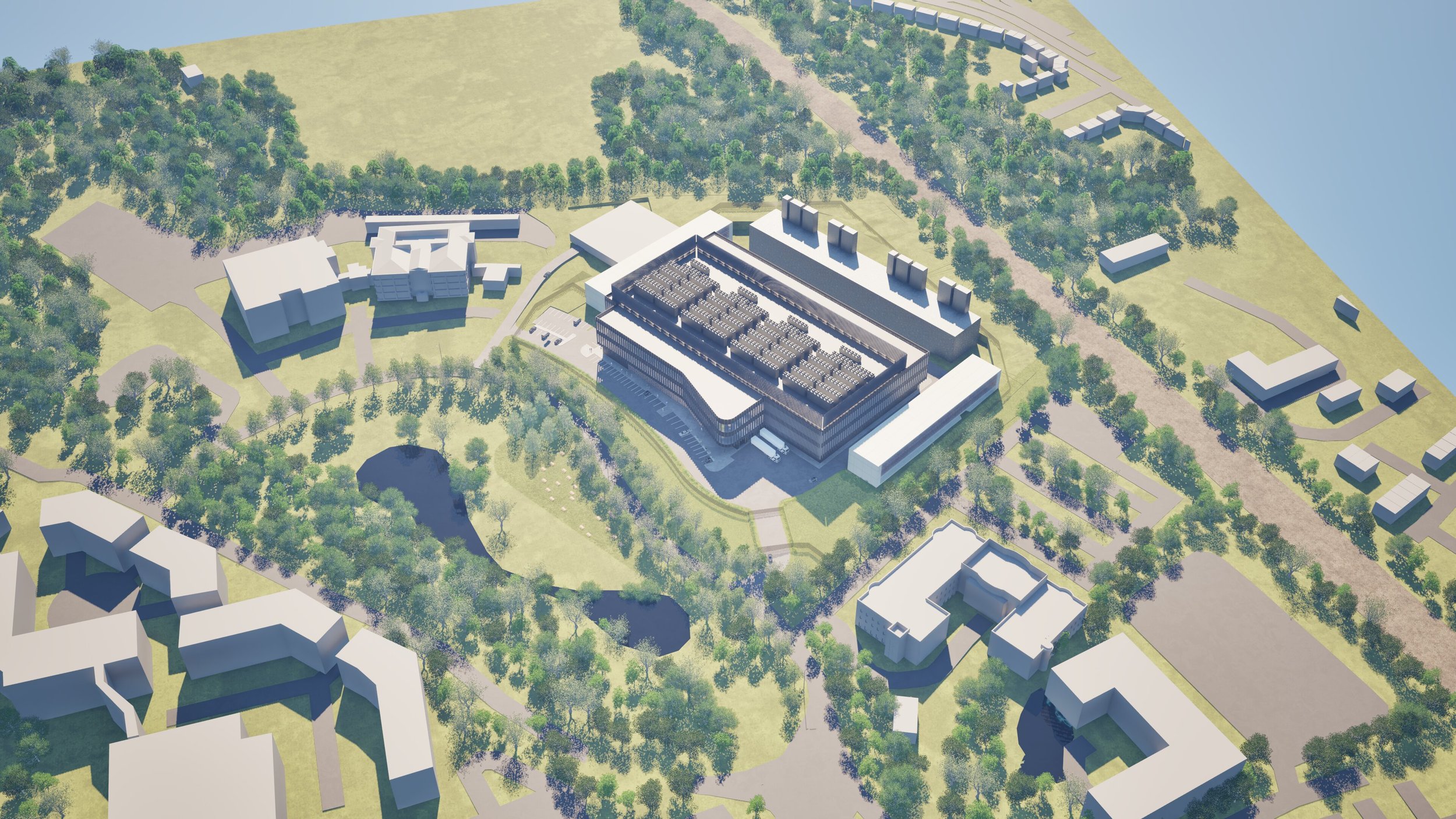
The 72MW scheme is planned for the former Microsoft campus at Thames Valley Park, where falling office demand has opened a route for redevelopment into digital infrastructure. The project team says the site is within an existing business park and would support domestic data capacity and data sovereignty.
The official proposal site says the fuel cells would generate electricity through a chemical reaction rather than conventional combustion. They are described as future-fuel ready, with potential to adapt to biomethane or hydrogen as lower-carbon fuels become more widely available.
Grid delay becomes design strategy
The Reading plan shows how grid constraints are changing UK data centre development. Instead of waiting for full grid capacity before a site can operate, the project proposes on-site generation as a bridge. That brings the scheme forward commercially, but it also changes the planning conversation. A data centre with on-site gas generation is not judged only as a digital infrastructure facility. It also becomes an energy plant, emissions source, and local resilience proposition.
The fuel-cell approach may reduce some emissions compared with conventional combustion, but the use of natural gas will still draw scrutiny. The project team says it will review opportunities to increase the use of grid electricity as capacity becomes available and is exploring carbon-offsetting options, including biogas generation projects. The credibility of that transition pathway will matter when the application is assessed.
The site’s cooling approach also forms part of the pitch. The proposal says the data centre would use air-based cooling rather than water-based cooling, limiting operational water demand, although water would be needed initially to set up the fuel-cell technology. Heat reuse for nearby businesses is also being assessed.
Business park reuse meets public infrastructure
Redeveloping an existing business park site is easier to justify than building on open land, but a 72MW data centre is still a substantial load. Visual impact, noise, air quality, security, access, construction traffic, and backup systems will all need to be tested. Local authorities are also becoming more alert to whether economic benefits are proportionate to the power and land being allocated.
The timeline points to public consultation in July and August 2026, with a planning application expected in autumn 2026 and operation from 2031 onwards. That long horizon underlines the point that UK data centre capacity is not only constrained by demand or capital. It is constrained by grid timing, planning process, and the sequence of enabling works.
Reading is already close to one of the UK’s strongest data centre corridors, with the wider Thames Valley and west London markets facing intense pressure around power availability. A gas-backed proposal at Thames Valley Park will therefore be watched beyond the immediate site. It gives a concrete example of how developers may try to work around grid queues while still satisfying decarbonisation and community expectations.
The central question for the planning process is whether the project’s interim power strategy is seen as pragmatic infrastructure sequencing or as a fossil-gas workaround for a grid that cannot yet support the load. That judgement will matter for other UK schemes facing the same energisation gap.

