
Summary
- RETN has opened a Barcelona PoP and connected it to Milan through the 2Africa submarine cable system.
- The route adds diversity against traditional terrestrial paths and supports Mediterranean network resilience.
- Spain’s role as a subsea, renewable power, and data centre market is becoming more important to Southern European infrastructure planning.
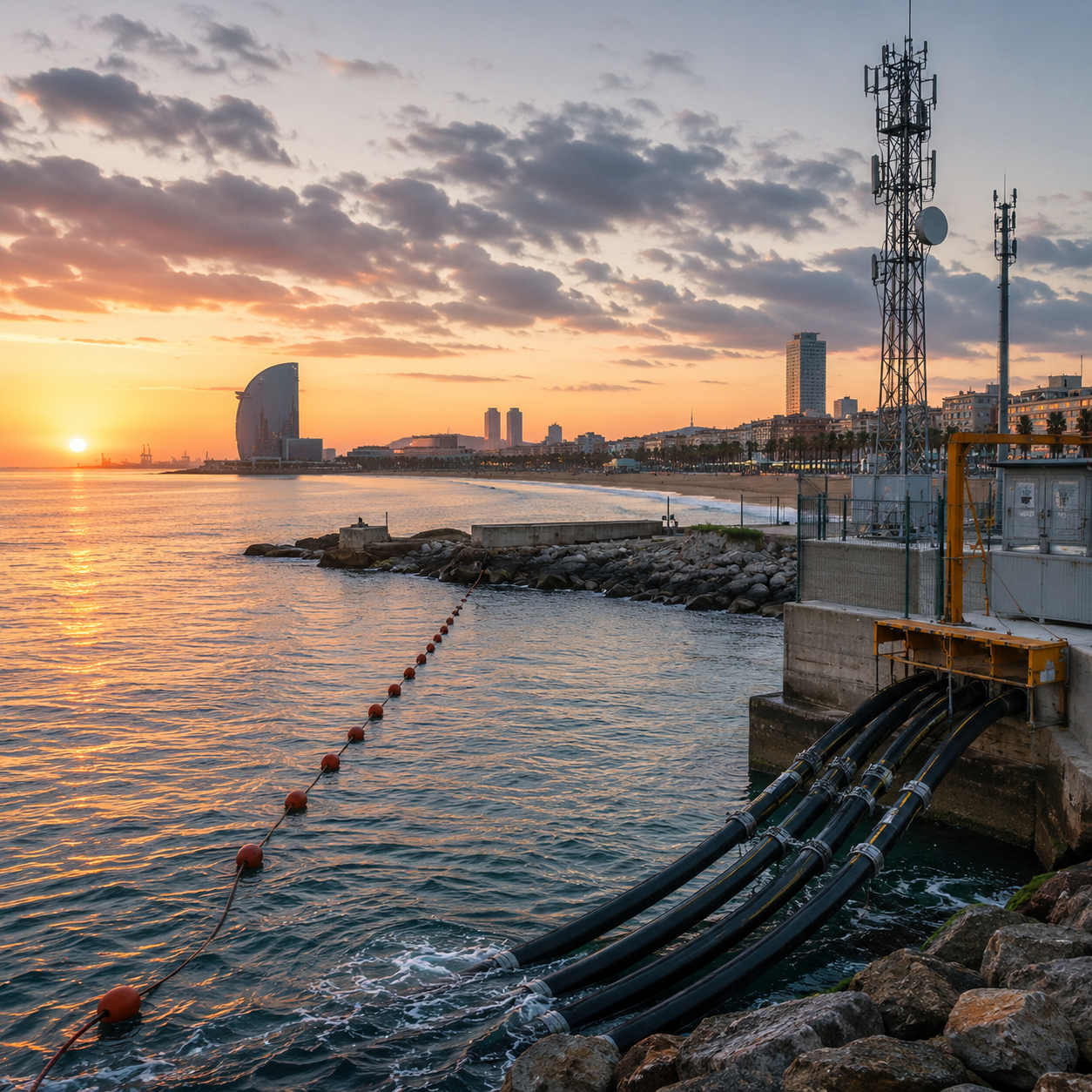
RETN has launched a new point of presence in Barcelona, connecting the city directly to Milan through the 2Africa submarine cable system.
The PoP forms part of RETN’s Mediterranean connectivity strategy and gives the company a more diverse route between Spain and Italy. The company says the Barcelona Milan path offers an alternative to traditional terrestrial connections and improves latency performance.
The Barcelona site is also connected to Madrid through an alternative route using gasoline pipeline infrastructure rather than the conventional highway network. That route design adds redundancy within Spain, where data centre, cloud, and subsea cable investment are developing together.
Southern Europe gains another network path
The expansion is a network development, but it is closely connected to the data centre market. Southern European growth depends on power availability, land, subsea connectivity, cloud demand, and the ability to provide resilient routes into major European hubs.
Spain is drawing more attention because it combines renewable energy potential with improving international connectivity. Its role as a landing point for submarine cables linking Europe with Africa and Latin America gives the country a wider infrastructure function than domestic colocation alone.
The 2Africa cable system adds large scale subsea capacity across the Mediterranean and beyond. RETN’s Barcelona Milan connection gives customers another path between Iberia and Italy, while improving route options across Southern Europe.
Data centre resilience includes more than UPS systems, generators, and cooling redundancy. Customers also need diverse fibre routes into the building, a useful carrier ecosystem inside the facility, and reliable paths to cloud regions, enterprise sites, content networks, and other data centres.
Spain’s connectivity case grows
RETN says it operates a privately owned fibre network spanning more than 142,000km across Europe, Asia, and North America. Its portfolio includes IP transit, Ethernet, wavelength connectivity, and colocation services for carriers, cloud providers, enterprises, and content delivery networks.
The Barcelona PoP gives that backbone a stronger Spanish presence while Iberia draws more data centre investment. Madrid remains the country’s main data centre market, but regional campus proposals, renewable power access, and subsea routes are giving Spain a broader infrastructure role.
Route diversity will become more important as AI and cloud capacity spreads beyond the largest European hubs. Large training clusters, inference deployments, storage platforms, and enterprise applications do not all have the same latency requirements, but the traffic between regions still needs dependable capacity.
The use of gasoline pipeline infrastructure between Barcelona and Madrid is a notable detail because it avoids some conventional highway based fibre corridors. Different physical routes reduce exposure to the same civil works, maintenance events, or localised failures.
RETN’s Barcelona PoP does not create data centre capacity on its own, but it improves one of the conditions needed to host that capacity. A market with renewable energy, land, and subsea cables also needs dense and diverse network paths into the rest of Europe.

