
Summary
- The Security Industry Association has published a reference guide setting out 12 principles for data centre security professionals.
- The guide covers early security engagement, secure-by-design development, defence in depth, least privilege, zero trust, secure operations, and resilience.
- The document underlines the need to integrate physical security, operational resilience, and cyber-adjacent controls before sites are acquired or leased.
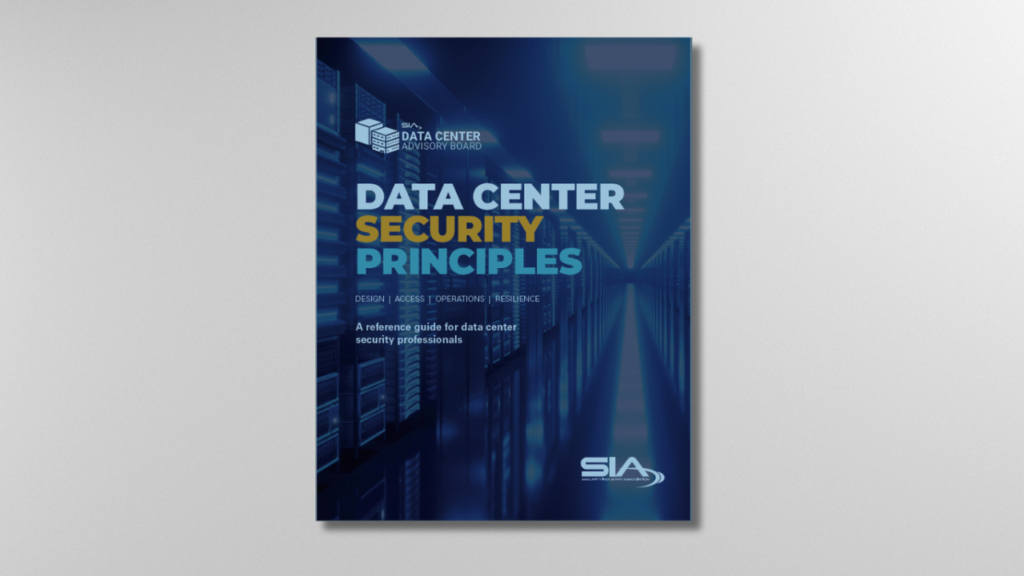
The Security Industry Association has published a data centre security principles guide, setting out 12 principles for the design, access, operations, and resilience of critical digital infrastructure.
The guide was prepared through the association’s Data Center Advisory Board and is aimed at data centre security professionals. It treats data centres as foundational infrastructure supporting communications, finance, healthcare, transport, government services, energy, and other essential functions.
The 12 principles include early security engagement, secure by design, defence in depth, secure by default, least privilege, proportionate security friction, zero trust, secure operations, streamlining, resilience, adaptability, and risk-based controls. One of the document’s strongest practical points is that security should be considered before land is acquired or leases are signed.
Security starts before the site is fixed
Early security engagement changes the way a data centre project is assessed. Site selection is often led by land, power, fibre, water, planning, and commercial timing, yet physical security risk can be difficult or expensive to correct after a site is chosen. Adjacencies, approach routes, boundary conditions, utility access, protest risk, flood exposure, and neighbouring uses can all influence the protection level required.
The guide argues that security stakeholders should be involved before land acquisition, development, or lease execution. That approach reflects how mature mission-critical projects are increasingly delivered. Security is not just a gatehouse, fence, camera network, or access control system. It is part of the design envelope, operating model, customer assurance package, and resilience strategy.
Defence in depth and secure by default also extend beyond traditional physical security. Data centres sit at the boundary between facility operations and digital systems. Access control, building management systems, power monitoring, remote maintenance, visitor management, and operational technology all create attack surfaces. A physical control failure can create cyber exposure, while a cyber weakness can place facility operations at risk.
The inclusion of least privilege and zero trust reflects that convergence. In a data centre, privilege is both physical and logical: who enters the site, who enters a data hall, who accesses a cabinet, who can change a security rule, who can connect to a management network, and who can modify environmental or power systems.
Critical infrastructure scrutiny raises the bar
The principles arrive as data centres are being pulled further into critical infrastructure regulation and resilience policy. In the UK, data centres have been designated as critical national infrastructure, and wider cyber and resilience reforms are increasing attention on digital supply chains. In the EU, NIS2 is raising expectations around security and incident management for essential and important entities, including parts of the digital infrastructure sector.
That regulatory direction increases the commercial importance of physical security guidance. Customers in regulated sectors will expect evidence that facilities have coherent, risk-based controls and that those controls are maintained throughout operation. A high standard at handover is not enough if procedures, staffing, systems, and threats change over time.
The guide’s focus on resilience and adaptability is especially useful for long-life assets. Data centres may operate for decades, while the threat environment changes much faster than the building fabric. Designs that are too rigid can become expensive to upgrade, and systems with too many integrations can create operational weakness. Streamlining can reduce vulnerability by reducing unnecessary complexity.
The guide is not a regulation and does not replace local legal duties, customer standards, or sector-specific requirements. Its value lies in giving the security discussion a practical structure that can be translated into site selection checklists, design requirements, operating procedures, and audit evidence.
As AI demand pushes data centres into larger and more visible campuses, physical security will be harder to separate from resilience, compliance, and planning. Facilities supporting critical workloads need security engineered into the first decisions, not added after the perimeter has already been drawn.

