
Summary
- Vertiv has opened a Johor manufacturing facility to support AI and high-density infrastructure demand across Asia.
- The site will support thermal management, prefabricated power, integrated infrastructure, liquid-cooling validation, and witness testing.
- The expansion shows how data centre capacity now depends on manufacturing scale, test capacity, and supply-chain resilience.
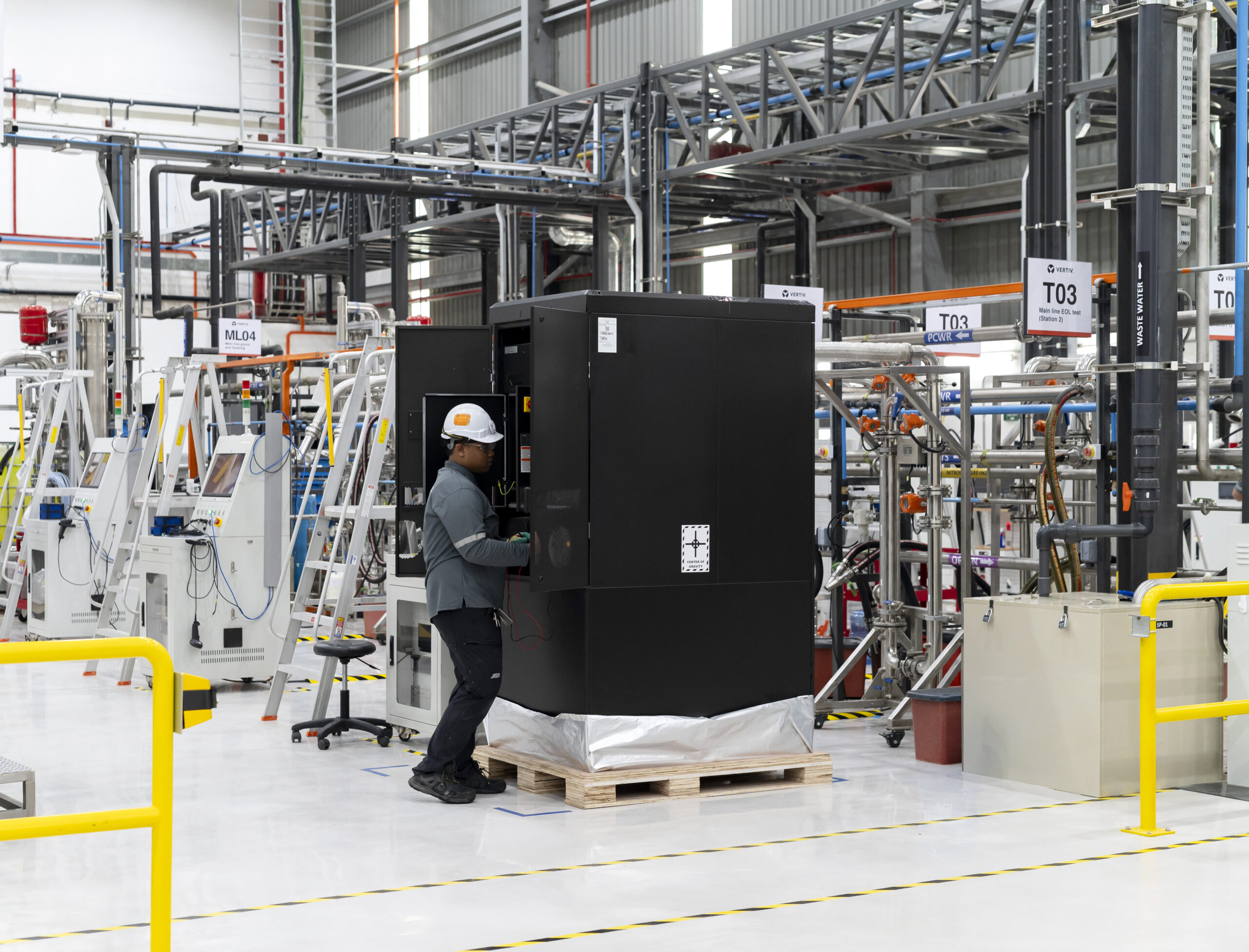
Vertiv has opened a manufacturing facility in Johor, Malaysia, expanding production and testing capacity for the power, cooling, and integrated infrastructure systems used in AI and high-density data centres.
The facility is intended to support demand across Southeast Asia, North Asia, Australia, and New Zealand. Vertiv says the site strengthens regional manufacturing, engineering, logistics, and deployment capabilities for enterprise, cloud, and colocation customers.
The Johor operation will support end-to-end manufacturing, assembly, and full-scale witness testing for advanced thermal and power infrastructure. Product lines include Vertiv CoolChip coolant distribution units, prefabricated power modules and skids, and SmartRun overhead infrastructure for white-space fit-out, including busway, liquid-cooling pipework, networking, and containment.
The supply chain is part of capacity
The facility is Asia-focused, but the lesson is global. Data centre operators can announce campuses faster than suppliers can manufacture, test, ship, and commission the systems required to make them live. AI demand is increasing orders for liquid cooling, prefabricated power, modular electrical infrastructure, skids, busway, CDUs, and integrated white-space systems.
Vertiv’s dedicated testing capability is a central detail. Higher-density facilities carry less tolerance for commissioning uncertainty because the IT load is expensive, the customer commitments are large, and the technical interdependencies are tighter. A cooling distribution issue, skid fault, pipework problem, or integration error can delay revenue and compress contingency.
Factory witness testing can move some of that risk away from the site. Equipment can be validated under defined conditions before it is shipped, reducing the number of unknowns during commissioning. That approach depends on skilled labour, consistent quality control, repeatable processes, and test bays capable of handling increasingly complex integrated systems.
Prefabrication is rising for similar reasons. Vertiv says its prefabricated power systems can speed deployment compared with traditional builds, while its SmartRun system is designed to reduce white-space installation time. The exact gains will vary by project, but the direction is clear: more work is being pushed into controlled manufacturing environments before site constraints slow delivery.
AI changes what suppliers must build
AI infrastructure is altering the factory brief. Direct-to-chip liquid cooling and rear-door heat exchangers require coolant distribution units, cleanliness controls, flushing processes, manifolds, leak management, and maintenance access. High-density racks require more robust power distribution and closer coordination between electrical, mechanical, network, and containment systems.
That moves critical systems suppliers towards integrated delivery. Customers do not only need a CDU or a skid; they need assemblies that fit the facility’s thermal design, electrical topology, white-space layout, commissioning plan, and operating model. Manufacturing facilities able to assemble and test those combinations before deployment become strategic assets.
Johor also has its own infrastructure logic. Malaysia has become an important data centre and technology manufacturing market, supported by proximity to Singapore, regional cloud growth, industrial land, logistics, and established electronics supply chains. The country’s own data centre expansion has created questions around power, water, and grid planning, but it also places suppliers close to fast-growing deployment markets.
European projects compete in the same global equipment market. Supplier capacity added in Asia can support regional demand and ease some pressure, but it also shows how much manufacturing expansion is needed to support the AI build-out. A grid connection is not enough if the critical systems needed to turn that electricity into operating capacity are stuck in the production queue.
The Johor facility is expected to bring hundreds of skilled jobs to the region when fully operationalised in 2027. Its opening places another part of the AI data centre boom on the factory floor. Capacity is being shaped not only by land and power, but by test rigs, assembly lines, logistics, and the suppliers able to make high-density infrastructure repeatable.

