
Summary
- Energy Vault has ordered 275MW of data centre power infrastructure from 2G Energy.
- Systems will be assembled and tested at 2G's Heek factory in Germany before shipment to the US.
- Delivery is tied to Energy Vault's powered-land and powered-shell infrastructure model.
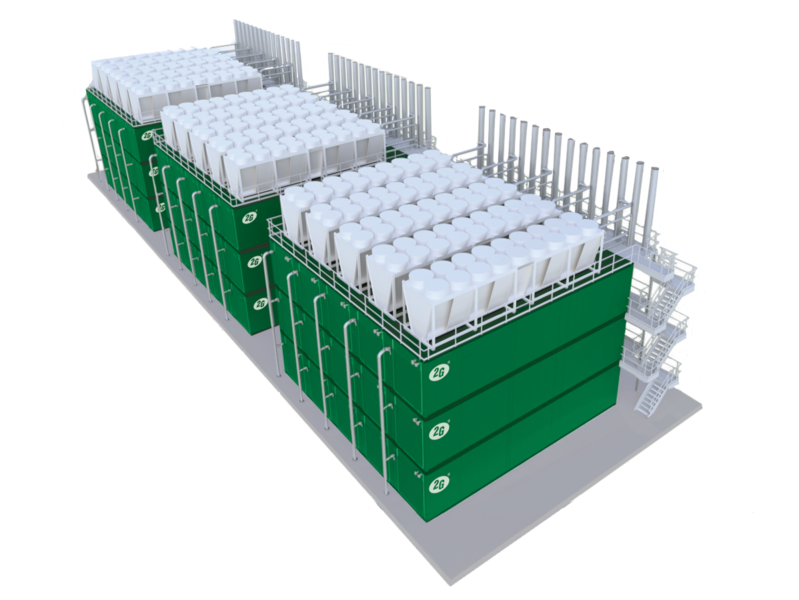
2G Energy has secured a 275MW order from Energy Vault for containerised generation systems intended for AI data centre developments in the United States, with the equipment to be assembled and tested at 2G’s factory in Heek, Germany.
The order supports Energy Vault’s powered-land and powered-shell model, which packages site, electrical, and generation infrastructure ahead of the eventual compute deployment. The German manufacturer will pre-assemble the generation systems before shipment and on-site commissioning in the US.
2G has not disclosed the full contract value in the announcement. Deliveries are expected to extend from the fourth quarter of 2027 through the third quarter of 2028, placing the order within a multi-year data centre infrastructure programme rather than a near-term temporary-power deployment.
The 275MW scale is significant for a manufacturer whose traditional business has focused on decentralised combined heat and power and gas-engine systems. AI campuses are creating a new market for equipment capable of providing large blocks of power before, alongside, or independently of the conventional grid.
Time to power is reshaping generation procurement
Developers increasingly face a mismatch between data centre construction schedules and electricity-network reinforcement. A building can potentially be designed, financed, and constructed faster than a utility can deliver hundreds of megawatts of new transmission capacity.
That gap has created demand for on-site generation, initially as bridge power in some projects and as part of a longer-term operating architecture in others.
Gas-engine systems offer modularity: capacity can be installed in increments, multiple units can operate in parallel, and output can follow changes in site demand. They can also be factory assembled and tested rather than built entirely as bespoke plant on the data centre site.
The trade-off is emissions and fuel dependence. A facility relying materially on gas generation has a different carbon profile, fuel-security requirement, maintenance regime, and permitting exposure from one primarily supplied by a low-carbon electricity grid.
Energy Vault’s powered-land model is designed to reduce uncertainty around one of the hardest parts of a data centre project — obtaining a site that has an executable route to electricity. Generation equipment becomes part of the development package rather than equipment specified only after a tenant has committed.
German manufacturing feeds a US infrastructure boom
Although the eventual plants are destined for the US, the order has a direct European industrial component. 2G says the systems will be assembled and tested at Heek before export, tying American AI infrastructure spending to German manufacturing capacity, engineering, and long-term service work.
The company employs more than 1,000 people across its German headquarters, North America, and other European locations. It reported €398m of revenue for 2025.
2G’s manufacturing route also reflects a wider move towards modular data centre infrastructure. Electrical rooms, generators, UPS systems, cooling plant, and other packages are increasingly being integrated in factories so that site work can progress in parallel.
Factory integration does not eliminate commissioning risk. Multiple generators still have to synchronise with switchgear, controls, protection systems, fuel infrastructure, batteries, UPS equipment, and potentially the public grid. Large data centre loads also create rapid changes in demand that generation controls need to absorb without compromising voltage or frequency.
The order therefore represents more than installed megawatts. It places power generation directly into the industrial supply chain for data centres, with manufacturing slots and equipment delivery becoming part of the critical path.
For European suppliers, that market is likely to remain material even where the largest deployments are being built elsewhere. AI infrastructure is globalising demand for transformers, switchgear, generation, cooling, and modular systems faster than new manufacturing capacity can be established.
2G’s 275MW order is a clear example: the data centres will be American, but a substantial part of their route to power will pass through a factory in North Rhine-Westphalia first.

