
Summary
- Five banks have committed €1.3bn of senior debt to the first 110MW phase of Pure DC’s Seinäjoki campus.
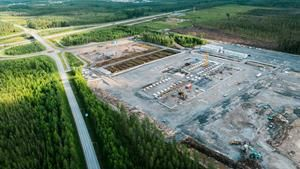
- Phase one is fully leased, carries more than €1.5bn of investment, and has an energised substation.
- The wider campus could exceed 550MW, although later phases still require contracting, finance, permissions, and infrastructure delivery.
Pure Data Centres has secured €1.3bn of committed senior debt for the first 110MW phase of its SJK01 data centre campus in Seinäjoki, Finland.
SMBC, ABN AMRO, Citi, Société Générale, and Natixis CIB are providing the financing, which Pure DC arranged during a six-week process that ran alongside the leasing of the initial development. Three additional mandated lead arrangers joined the lender group as customer commitments and the debt package progressed.
More than €1.5bn will be invested in the fully leased first phase, while the site’s substation has already been constructed and energised. Pure DC said the required planning permissions and power arrangements are secured, and its financing statement describes a campus that could eventually exceed 550MW.
Finance follows physical progress
Large campus proposals are common across Europe, but fewer reach the point where customer demand, grid infrastructure, planning, and debt are moving together. Seinäjoki has crossed several of those thresholds: the first capacity is leased, lenders have committed capital, and the substation has moved from a design drawing into an operating electrical asset.
That combination reduces several risks that have made large-scale data centre finance more selective. A customer commitment limits speculative exposure, while an energised substation provides stronger evidence of deliverable power than a connection application or a place in a grid queue. Planning consent removes another source of delay, although construction, equipment supply, commissioning, and customer fit-out remain ahead.
A 110MW first phase carries an extensive bill of materials beyond the data halls themselves. Transformers, high-voltage switchgear, busways, UPS systems, backup generation, cooling equipment, controls, and network infrastructure all have to arrive in a sequence that supports phased commissioning. Delays to any one of those packages can leave completed buildings without usable IT capacity.
AI infrastructure adds further complexity because denser racks transfer spending into electrical distribution and cooling plant. Direct liquid cooling, cooling distribution units, secondary pipework, heat exchangers, and higher-capacity heat rejection may sit alongside conventional air systems, particularly where a customer deploys several hardware generations during the life of the campus.
Pure DC arranged the debt while leasing the first phase, bringing the commercial and financing processes into the same programme. Capital is therefore being committed against contracted capacity rather than a completely speculative shell, although construction milestones and service dates will carry greater weight once the occupier begins scheduling hardware deliveries.
From 110MW to 550MW
Finland combines cooler ambient conditions with a relatively low-carbon electricity system, large development sites, and a growing base of cloud and high-performance computing infrastructure. Seinäjoki also sits outside the constrained metropolitan markets where land, planning, and grid capacity frequently collide.
None of those advantages removes the pressure on the national power system or the construction supply chain. Expanding SJK01 beyond its first 110MW would require successive additions to the substation, transmission or distribution infrastructure, cooling plant, network capacity, and site services. Each phase would also compete for switchgear, generators, transformers, commissioning engineers, and experienced MEP contractors.
Phasing allows Pure DC to match procurement and construction more closely to contracted demand, while avoiding the cost of delivering every proposed megawatt at once. It also creates interfaces between operating halls and active building sites, which require careful separation of access, dust, noise, temporary power, fire systems, and commissioning activity.
The company has placed the potential investment value of the full campus above €7.5bn. That figure depends on later capacity being leased, financed, permitted, connected, and built, so the 550MW masterplan should not be treated as commissioned supply. The fully funded first phase is the firmest part of the programme.
Pure DC says it has raised more than $4.2bn over the preceding 12 months and has more than 1GW of capacity live or under development. Seinäjoki will show how readily that financial scale can be turned into energised European capacity, particularly once the project moves beyond the first leased halls and into repeated phases of grid and mechanical expansion.
The financing therefore rests on more than Nordic market appetite. It is supported by infrastructure already delivered on the ground, which gives the first 110MW a firmer route to operation than the much larger number attached to the campus masterplan.

