
Summary
- Amber Cable is planned as a 1,500km subsea system linking Finland, Estonia, Latvia, Lithuania, Poland, and Denmark.
- The project combines high-capacity connectivity with distributed acoustic sensing concepts for infrastructure awareness.
- The proposal reflects the Baltic region’s growing focus on route diversity, subsea security, and digital infrastructure resilience.
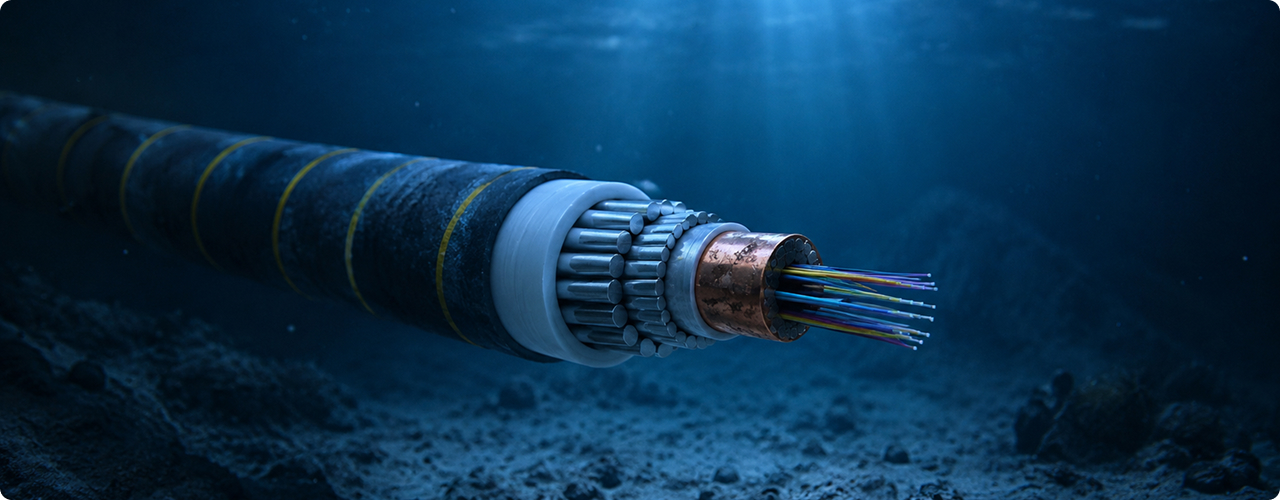
Amber Cable has set out plans for a 1,500km subsea cable system across the Baltic Sea, combining digital connectivity with integrated sensing capabilities for a region where seabed infrastructure has moved sharply up the resilience agenda.
The Latvia-based project would link Finland, Estonia, Latvia, Lithuania, Poland, and Denmark, with nine landing points planned across the system. Amber Cable says the project is moving through early-stage studies and stakeholder coordination, with front-end engineering design, permitting, implementation planning, and deployment readiness still to follow.
The proposal is structured as more than a fibre route. Amber Cable is being designed as a dual-purpose infrastructure platform, using distributed acoustic sensing concepts to improve awareness along subsea corridors and support protection of critical assets.
The cable route becomes a security perimeter
Subsea cables have always been part of data centre infrastructure, even when they sit outside the facility boundary. Cloud regions, colocation clusters, content platforms, financial services, public-sector systems, and sovereign workloads all depend on route diversity and repairable, resilient fibre paths.
The Baltic has made that dependency harder to ignore. Cable damage and wider maritime security concerns have drawn more attention to the physical vulnerability of cross-border digital infrastructure. A data centre campus may have redundant power trains, physical security, and resilient cooling, but those systems do not remove the risk created by concentrated external connectivity routes.
Distributed acoustic sensing would not make a subsea cable invulnerable. It can, however, help operators detect vibration and activity along fibre routes, improving situational awareness and supporting incident investigation. In a region where accidental damage and deliberate interference are both part of the risk model, sensing capability is becoming part of the infrastructure specification rather than a peripheral add-on.
The planned route through Denmark also gives the project a wider European function. Amber Cable describes a direct link via Esbjerg, connecting the Baltic system into European connectivity hubs. That matters for data centre markets trying to expand outside the largest Western European clusters while keeping credible routes into the continent’s main digital corridors.
Connectivity shapes capacity geography
The Nordics, Baltics, and parts of Central and Eastern Europe are already being examined more closely by data centre developers. Power availability, low-carbon energy, cooler climates, and land can all strengthen the case for those regions, particularly for AI training and high-performance compute workloads that do not always need to sit inside the most expensive metropolitan markets.
Connectivity is the counterweight. A market with cheap power but limited route diversity will struggle to attract sensitive workloads, especially where customers need replication, cloud integration, data sovereignty, and reliable international access. New subsea systems can therefore influence data centre development before they are commissioned by changing how investors assess a region’s long-term infrastructure depth.
Amber Cable is still early. Marine surveys, route engineering, landing rights, permits, financing, supply contracts, and operations planning will determine whether the system becomes a bankable route. Cross-border cable projects are technically demanding and politically complex, particularly when the proposed system spans multiple coastal states and infrastructure priorities.
The project’s next milestones will be the practical ones: who backs the system, where the final landing points sit, how sensing is specified, what route is chosen, and how the cable is operated and protected over its service life.
If delivered, Amber Cable would add a physical layer beneath the Baltic region’s digital growth. The project shows how data centre resilience is no longer confined to generators, UPS systems, cyber controls, and facility design. It now extends into the seabed, landing stations, route monitoring, and the political geography of cross-border infrastructure.

