
Summary
- Ark Data Centres is investing at Longcross Park in Surrey to support Nebius expansion.
- Plans include an additional 36MW data centre building and wider supporting infrastructure upgrades.
- The project shows AI cloud demand absorbing powered capacity around London’s constrained data centre market.
Ark Data Centres is expanding its Longcross Park campus in Surrey to support further growth from Nebius, as AI cloud demand continues to absorb powered capacity around London.
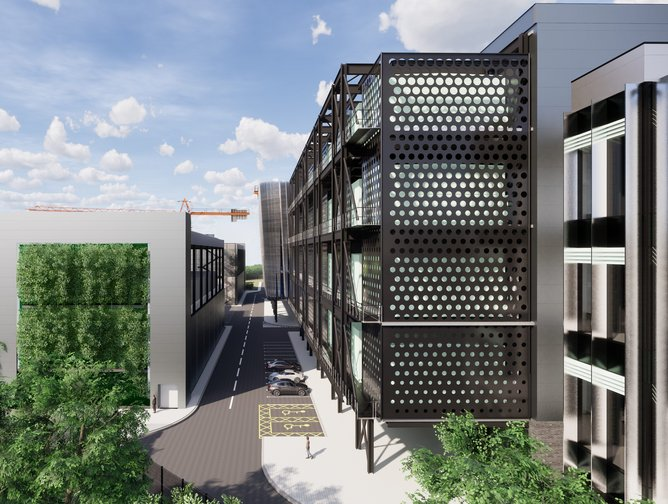
The expansion includes a new 36MW data centre building, LP02, alongside vertical extensions to existing buildings and upgrades to supporting infrastructure across the site. Nebius will lease the existing Longcross facility as part of its wider UK AI infrastructure plan.
Longcross has already become part of Nebius’s UK deployment strategy. The company has launched a London-area GPU cluster at the campus, with initial capacity built around Nvidia Blackwell Ultra infrastructure and designed for high-density AI workloads.
The campus sits outside central London but within reach of the capital’s connectivity, enterprise demand, and specialist construction supply chain. That position is valuable in a market where available powered capacity is tight and grid connections remain one of the main barriers to new development.
AI customers are reshaping campus plans
AI cloud providers use data centre capacity differently from many traditional enterprise customers. Large GPU deployments can require full halls or full buildings, higher power densities, and cooling options that need to be considered before customer fit-out begins. Capacity that once might have been absorbed gradually can be committed quickly when a single customer has a large compute roadmap.
The Longcross expansion reflects that change. A campus operator serving AI demand must coordinate electrical distribution, standby power, cooling plant, floor loading, fibre, containment, and commissioning around more demanding customer profiles. In some cases, the building shell, MEP strategy, and equipment procurement have to move before the full customer ramp is visible.
Ark’s own Longcross material describes the campus as modular and AI-ready, with liquid and air cooling and PUE targets forming part of the site’s proposition. Those details are not decorative. High-density deployments place more pressure on heat rejection, power resilience, and maintenance access, and they reduce the margin for treating cooling upgrades as a later retrofit.
Nebius gains a route to UK capacity without waiting for a completely new campus to move through land acquisition, planning, grid studies, construction, and energisation. Ark gains a large AI customer relationship that can support further investment, provided delivery keeps pace with the commercial commitment.
London demand still runs through power
The UK government has made domestic AI infrastructure a policy priority, but market growth is still governed by substations, transmission and distribution upgrades, equipment lead times, planning consent, and specialist labour.
Sites around the M25 corridor are attractive because they combine customer proximity, connectivity, and established data centre ecosystems. They are also exposed to some of the country’s toughest power and planning constraints. Large-load growth around London now depends on a sequence of physical works that is harder to accelerate than customer demand.
The Ark-Nebius relationship shows why operators with energised sites and expansion land are in a strong position. Customers want near-term deployment, not distant theoretical megawatts. Developers able to show a credible path from signed capacity to commissioned halls can command attention from AI cloud platforms, hyperscalers, and investors.
Execution risk remains high. A 36MW building requires electrical equipment, construction sequencing, cooling design, resilience testing, and commissioning to align with customer rollout. Delays in any of those areas can affect revenue timing and the customer’s own compute plans.
Longcross is therefore part of the practical test of UK AI infrastructure. The country can attract AI cloud investment, but retaining and scaling that demand depends on whether sites can secure power, cool denser systems, satisfy planning conditions, and operate reliably under heavier loads. The Surrey expansion shows AI demand moving quickly from available space into new campus phases, with power and buildability setting the pace.

