
Summary
- Memory shortages have exposed AI infrastructure supply chain constraints, but electricity access could become a more structural bottleneck.
- Higher rack densities are placing new demands on cabling, power distribution, storage, and electrical system design.
- Developers, utilities, and policymakers need to coordinate earlier to deliver reliable power without compromising other industrial demand.
The global shortage of memory chips has become one of the most visible consequences of the artificial intelligence (AI) infrastructure boom. High-bandwidth memory is being absorbed by data-centre projects, prices are rising and businesses in other sectors are finding themselves competing for components that were previously easier to secure.
These pressures are considerable. Gartner expects DRAM prices to increase by 125% during 2026, while Micron has warned that tight market conditions are likely to persist beyond the end of the year. Yet memory represents only one layer of the infrastructure required to expand AI, and its shortage is a warning of what happens when one layer of the AI supply chain scales faster than the infrastructure around it. Electricity could become the next, and potentially more structural, constraint. In the next phase of the AI economy, access to power may matter as much as access to processors.
Every new processor and server must be housed in a data centre, connected to the electricity network and supplied with enormous volumes of power. As AI facilities grow larger and computing becomes more concentrated, the ability to deliver that electricity is becoming one of the defining constraints on further development. Historically, data centres were located close to users. Increasingly, access to power is becoming a determining factor in site selection. The question is no longer only where the users are located, but where electricity can be delivered quickly, reliably and at scale.
AI is not creating the need to modernise power infrastructure on its own. The same networks must already accommodate electric vehicles, electrified industry, heat pumps and renewable generation. AI is accelerating a transformation that was already underway.
Computing has advanced faster than infrastructure
The direction of technological development has been visible for some time. Mobile phones evolved from basic communication devices into powerful computers, and servers have followed a similar path as greater computing capability has been concentrated into smaller spaces. Electric vehicles are a good example of an older technology, like the combustion engine, being transformed into something that needs an entirely new power supply.
What the industry understood less clearly was the scale of the infrastructure that this progress would require. Considerable attention went into developing models, processors and applications, while the physical systems needed to power them received less scrutiny. The energy implications of AI were discussed, but rarely with the same urgency as its commercial potential.
That imbalance is now becoming apparent. According to the International Energy Agency, global data-centre electricity demand increased by 17% in 2025, while electricity consumption from AI-focused facilities rose by 50%. The IEA also expects the power requirements of advanced server racks to continue increasing rapidly as AI workloads become more demanding.
The question facing the industry has therefore moved beyond how many servers can be procured. Developers must establish whether sufficient electricity is available, how quickly a facility can connect to the grid and whether its internal infrastructure can deliver power safely to increasingly dense computing equipment.
These are no longer secondary engineering considerations. They influence whether an AI campus can be built in the proposed location, whether it can open according to schedule and whether it will operate efficiently throughout its lifetime.
Higher power density changes the design of the data centre
Traditional data centres distributed relatively modest amounts of power to individual server racks. AI training and inference require much greater density, with rack requirements already moving beyond 100 kilowatts and technology roadmaps pointing substantially higher. Certain highly synchronised computing operations, particularly during the training of large models, can create rapid variations in power demand. These fluctuations must first be absorbed and smoothed within the data centre so that the grid sees a more stable and predictable load.
The real challenge is no longer simply securing megawatts on paper. It is securing megawatts that can be delivered. This is what we increasingly describe as the “time-to-power”: the time required to transform announced electrical capacity into power that is physically available, commissioned and operational. In many projects, this timeline has become as important as the availability of processors or memory.
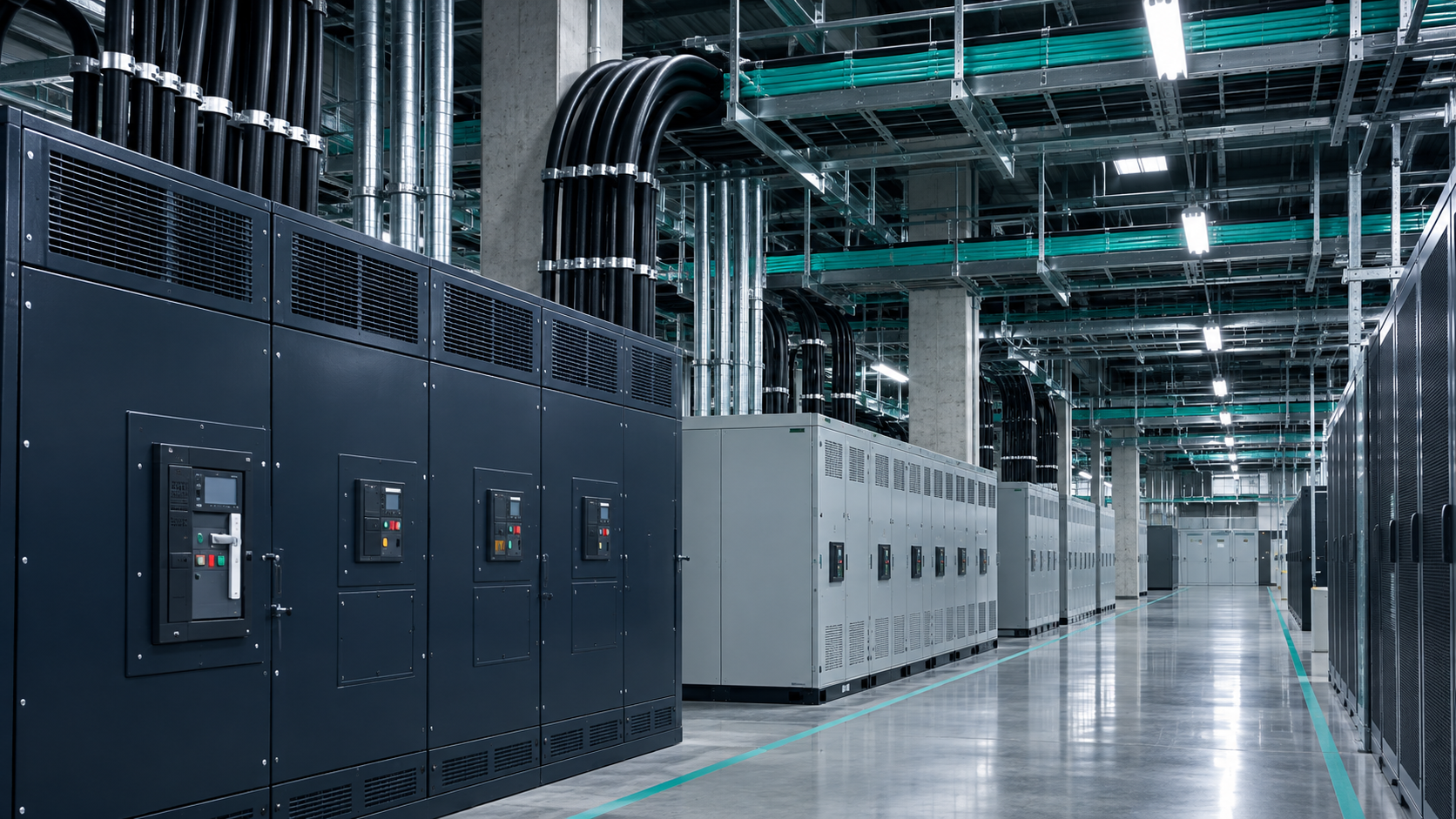
Bringing that volume of electricity into a confined space creates physical and technical complications. Larger cables carry more power, but they are heavier and less flexible. Space for cable routes is limited, particularly when electricity must be moved between floors or delivered through crowded technical areas. Regulations also restrict how many cables can be grouped together.
At this point, cabling can no longer be approached as a standard commodity purchase. It becomes part of the engineering problem. The electrical architecture itself is also evolving. The industry is exploring 800-volt direct-current distribution as a way of reducing conversion stages, electrical losses and the volume of copper required within high-density facilities.
Superconducting cables could eventually provide another option where space is severely constrained, allowing very large amounts of power to be transported through a much smaller physical footprint. Transformers, uninterruptible power supplies and battery systems will also need to evolve alongside cabling.
These changes require collaboration across the electrical ecosystem. No single equipment provider can redesign the infrastructure independently because every component must operate as part of the same system.
Electrical decisions must be made during design
Many of the most expensive data-centre problems can be traced back to choices made before construction begins. Incorrectly sized cables, unsuitable accessories or poorly planned routes may only reveal their consequences during commissioning, when correcting them becomes significantly more disruptive.
Even a cable joint or accessory installed incorrectly can create operational problems within the first months of a facility’s life. For an operator whose business model depends on availability, apparently small components can carry disproportionate risk. After all, many of the largest AI campuses increasingly resemble industrial power facilities as much as traditional data centres.
Cables may account for a relatively limited share of a project’s capital expenditure, but saving money through inadequate specification can expose the entire facility to delays or unplanned shutdowns. Replacing electrical infrastructure after installation is considerably more complex than designing it correctly at the outset.
This is why electrical specialists must be involved earlier. Data-centre developers, engineering consultants, contractors and infrastructure providers need to combine their expertise during the design phase, when architecture can still be adjusted without major cost or disruption.
The growing complexity of AI facilities also means that equipment suppliers must contribute more than products. Customers increasingly need application engineering, installation support and a detailed understanding of how materials behave under direct current, higher temperatures and sustained electrical loads. The broader lesson is that no component can be specified in isolation. Cables, accessories, transformers, power electronics, storage, cooling and protection systems must be designed as one electrical architecture.
Data centres are becoming part of the power system
The challenge extends beyond the walls of the facility. Data centres are becoming large and systemically important electricity users whose behaviour can affect grid stability. It is essential that when they are built, other industrial electricity needs are not compromised.
For example, AI workloads may create sharp peaks in demand. If several high-consumption processes operate simultaneously, they can place considerable stress on the surrounding network. Grid operators must therefore understand when that demand is likely to appear and how it will be managed.
This is encouraging a closer relationship between utilities and data-centre operators. Some projects are incorporating battery storage to reduce peaks or provide flexibility to the grid, while the concept of “bring your own power” is gaining attention in markets where connection capacity is scarce.
This represents an important change in responsibility. A data centre can no longer assume that electricity will simply be available whenever a project is ready. Operators may need to invest in generation or storage, adapt consumption patterns and work with utilities much earlier in the development process.
Governments must also treat grid expansion and connection reform as part of their AI strategies. Funding computing capacity without strengthening the infrastructure that supplies it risks creating advanced facilities that cannot connect quickly enough or operate at their intended scale.
AI ambition must be matched by an electrification strategy
Memory availability will continue to influence the cost and pace of AI deployment. However, the longer-term challenge is ensuring that computing infrastructure can be connected to sufficient electricity and operate without undermining grid resilience or climate objectives.
Addressing that challenge will require a more integrated approach, especially when we consider other industrial electricity needs. Governments need to align AI investment with energy policy and grid development, that takes all types of power demands into account. Utilities need clearer information about future demand, while operators must consider electrical architecture at the earliest stages of each project. Infrastructure providers will need to increase capacity and continue developing technologies suited to much higher power densities.
For the last decade, digital strategy and energy strategy have often been treated as separate conversations. That distinction is becoming impossible to maintain. The countries and companies that will lead the next phase of AI will not simply be those with access to the best processors or the best models. They will be those capable of delivering clean, reliable power where and when it is needed. The future of AI will be written as much in substations, cables and grids as it will be in code.
About the author

Elena Fedotova is Chief Business Development Officer, Data Centre & Grid & Connect Large Projects at Nexans. Elena brings 20 years of professional experience during which she has evolved in diverse roles both at Schneider Electric and Air Liquide. Throughout her career, Elena has had full P&L responsibilities and occupied positions on strategic partnerships, business audit, risk management, strategy and technical sales. From Russian origin, she has worked and lived in Russia, France, the US and Singapore, and has had global responsibilities.

