
Summary
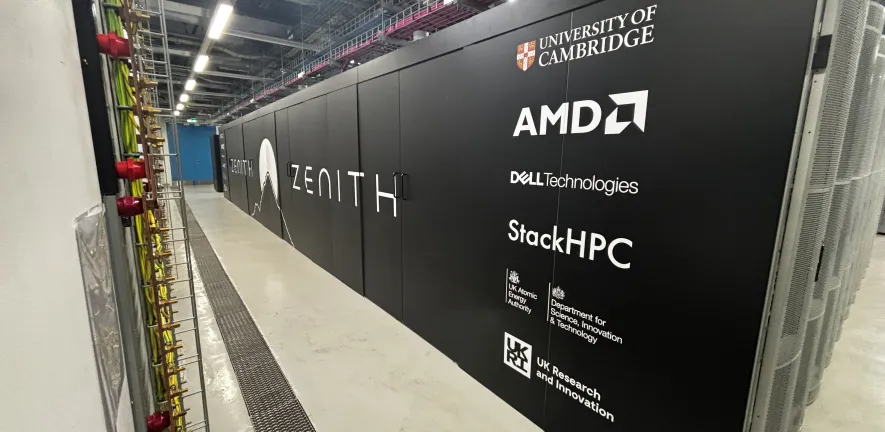
- Zenith is a £36m AI supercomputer hosted at Cambridge’s Ray Dolby Centre and built by Dell and AMD.
- The system will support research workloads across health, weather, clean energy, environmental science, and engineering.
- The launch links UK sovereign AI policy to the physical infrastructure needed to host, power, cool, and operate advanced compute.
The University of Cambridge has launched Zenith, a £36m AI supercomputer for science hosted at the Ray Dolby Centre and built by Dell and AMD.
The system has been funded by the UK government and is intended to support research workloads across cancer research and diagnosis, weather forecasting, clean energy, environmental science, and advanced engineering. Detailed public specifications remain limited, although Cambridge has previously said the system would provide a sixfold boost to its supercomputing capability.
Zenith was launched alongside wider activity around Cambridge’s AI infrastructure programme. The university is also involved in Sunrise, a supercomputing initiative with the UK Atomic Energy Authority focused on fusion energy research, and the Sovereign AI Innovation Lab, a Cambridge-led public-private initiative supported by AMD and Dell.
Although Zenith is not a commercial colocation or hyperscale development, it sits squarely within the infrastructure layer of UK AI policy. National AI capability depends on where advanced compute is hosted, how it is powered and cooled, how it is made available to researchers, and how reliably it can be operated over time.
Sovereign AI needs facility capacity
Government-backed AI infrastructure is often described through models, software, research access, and skills. Zenith brings the physical layer into view: accelerator-rich systems, high-speed interconnects, resilient power, cooling, monitoring, maintenance, and the institutional capability to run high-performance compute at scale.
The Ray Dolby Centre gives the system an important academic setting. Cambridge has deep scientific demand and a strong research base, but a supercomputer only creates sustained value when the supporting facility, user environment, software stack, scheduling model, and operations team keep pace with the workloads. Advanced compute systems are not static assets; they require tuning, refresh cycles, power management, and cooling discipline as demand changes.
The launch also feeds into a wider UK debate over sovereign AI infrastructure. Buying capacity from commercial cloud providers, funding national systems, supporting university-hosted platforms, and creating public-private test environments all produce different outcomes for procurement, governance, resilience, security, energy use, and user access.
At the facility level, research compute and commercial AI infrastructure are moving closer together. Zenith is not the same type of asset as a gigawatt-scale AI campus, but it faces related engineering questions: how dense racks are powered, how heat is removed, how availability is maintained, and how scarce accelerator capacity is allocated among competing workloads.
The UK’s wider AI ambitions still depend on private data centre investment, grid access, planning approvals, skilled operators, and supply chains for electrical and mechanical infrastructure. Publicly funded supercomputers can strengthen domestic research capability, but they sit inside the same physical ecosystem as commercial cloud and AI infrastructure.
Cambridge’s launch gives the UK another visible research compute asset. The next test is whether systems such as Zenith become part of a durable national compute fabric, with enough funding, access, facility capacity, and operational resilience to support the scientific workloads they are designed to serve.

