
Summary
- The Dawn supercomputer was taken offline during a UK heatwave after a reported cooling-related incident at the West Cambridge data centre.
- Cambridge’s HPC documentation shows Dawn available again and notes West Cambridge Data Centre power and cooling capacity at 1.8MW.
- The incident highlights the operational risk created when high-density AI and HPC systems meet hotter weather, ageing plant, and constrained maintenance windows.
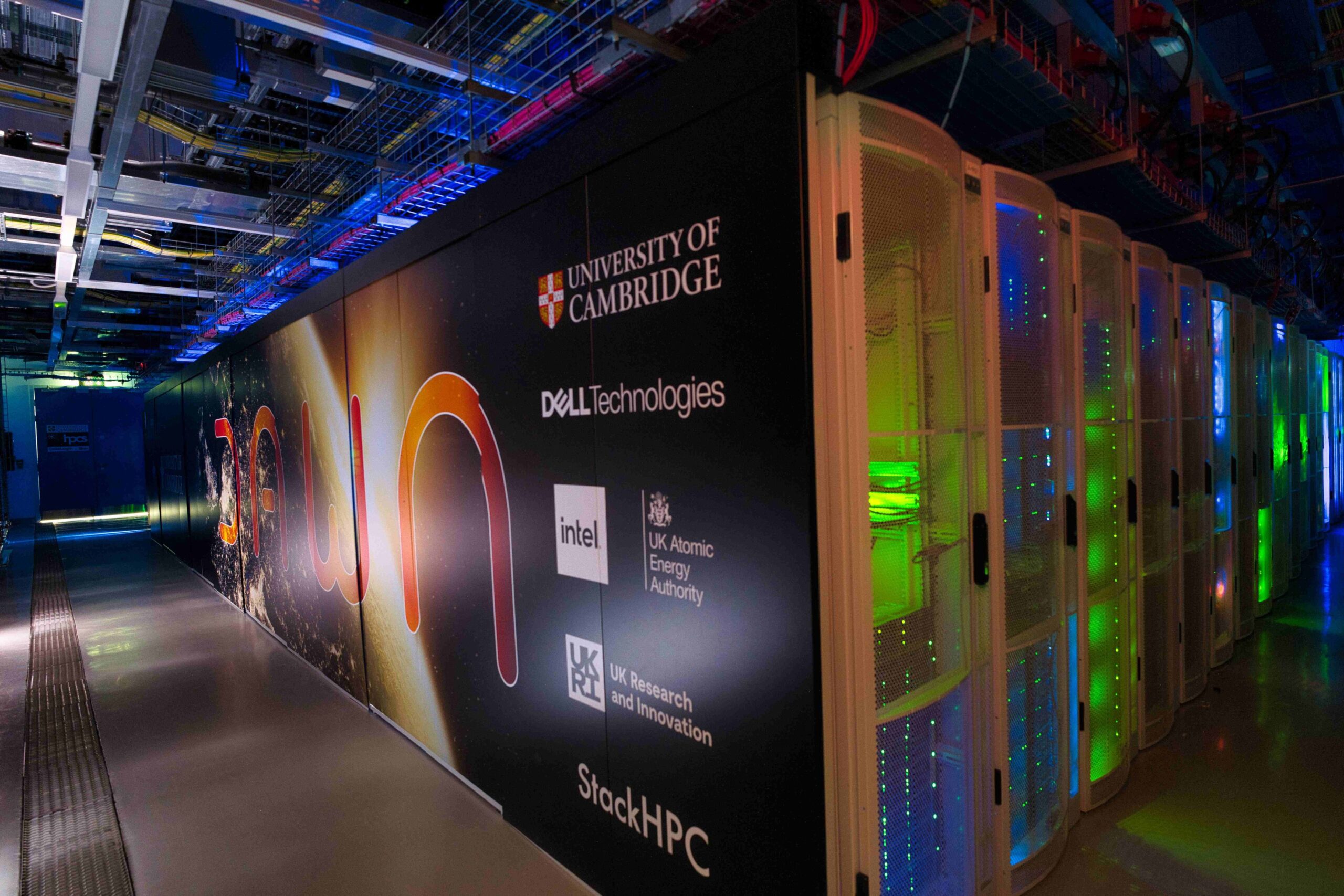
The University of Cambridge’s Dawn supercomputer was taken offline during the UK heatwave after a reported cooling-related incident at the West Cambridge data centre, exposing the operational risk that extreme weather poses to high-density compute.
The University of Cambridge lists Dawn as part of the UK Artificial Intelligence Research Resource, alongside Zenith, providing specialised compute capacity for public researchers, academia, and small and medium-sized organisations. Cambridge’s current HPC status documentation shows Dawn available again and lists West Cambridge Data Centre power and cooling capacity at 1.8MW.
Dawn has become an important UK AI and research computing asset. It supports work across healthcare, climate, clean energy, and advanced simulation, with Cambridge material describing more than a thousand top-end GPUs operating inside its server stacks.
The outage puts a physical edge on the UK’s AI infrastructure ambitions. Public compute capacity may be strategic national infrastructure, but its availability still depends on cooling plant, power distribution, maintenance sequencing, controls, and weather assumptions.
Cooling is now a resilience issue
Data centre cooling has often been discussed through efficiency, PUE, and energy cost. Those metrics still matter, but high-density AI and HPC systems turn cooling into a direct availability risk. If heat cannot be removed reliably, compute capacity has to be throttled, workloads moved, or systems shut down.
That risk is especially important for national research computing. Dawn supports workloads that can include medical research, environmental modelling, fusion work, and AI development. Interruptions may not produce immediate public-facing outages like a bank or hospital IT failure, but they can delay experiments, model training, grant-funded research, and shared national compute access.
Cambridge’s West Cambridge Data Centre has been undergoing upgrade and maintenance work across power and cooling infrastructure. The university’s documentation warns that unexpected service disruptions can occur during the course of the project and provides live status information for affected services. Many high-performance facilities are now being asked to support hotter workloads inside buildings and systems designed for earlier generations of compute.
Modern AI hardware changes the thermal profile. Dense GPU nodes draw far more power per rack than conventional enterprise equipment, and they often require direct liquid cooling, rear-door heat exchangers, or hybrid cooling arrangements. The more concentrated the load, the smaller the margin for cooling failure.
Heatwaves change the design case
The UK has historically benefited from a mild climate in data centre design. That advantage is weakening as heatwaves become more frequent and intense. Higher ambient temperatures reduce the headroom available to air-cooled systems, increase the stress on chillers and heat rejection equipment, and can coincide with wider electricity system pressure.
Operators can design for extreme heat, but the cost appears in plant size, redundancy, energy use, water strategy, and maintenance. Older sites and research facilities face a particular challenge because higher-density loads may be retrofitted into constrained plant rooms, legacy electrical systems, and operating schedules shaped around academic access.
Liquid cooling does not remove the resilience problem. It moves it into pumps, heat exchangers, manifolds, controls, water quality, leak management, and secondary heat rejection. Direct-to-chip and other liquid systems can handle higher densities efficiently, but they require disciplined operations and maintenance.
The Dawn incident also sits within a wider UK pattern. Heat-related data centre disruptions have affected services beyond research computing, including healthcare-linked digital systems. As data centres become part of critical national infrastructure, cooling failures cannot be treated only as site-level engineering events.
UK AI policy has focused heavily on chips, national compute, and research access. Those investments still require data halls that remain online during hot weather, power events, maintenance cycles, and component failures.
That means resilience investment in cooling plant, monitoring, predictive maintenance, heat-rejection capacity, and operational staffing. It also means transparent service communication when incidents occur, especially where public research and national compute programmes depend on shared infrastructure.
Dawn’s return to availability reduces the immediate concern. The larger issue remains: as AI and HPC densities rise, cooling infrastructure becomes one of the UK’s most important compute dependencies. The failure mode is physical, local, and sometimes mundane — which is exactly why it can be underestimated.

