
Summary
- CorScale has appointed McLaren Construction and Phoenix ME under a pre-construction services agreement.
- The planned Court Lane campus would deliver 140MW across two data centre buildings.
- The project includes a dedicated 140MVA substation, enabling works, utility diversions, and remediation.
CorScale has appointed McLaren Construction and Phoenix ME to begin predevelopment work on a planned 140MW data centre campus at Court Lane in Iver, Buckinghamshire.
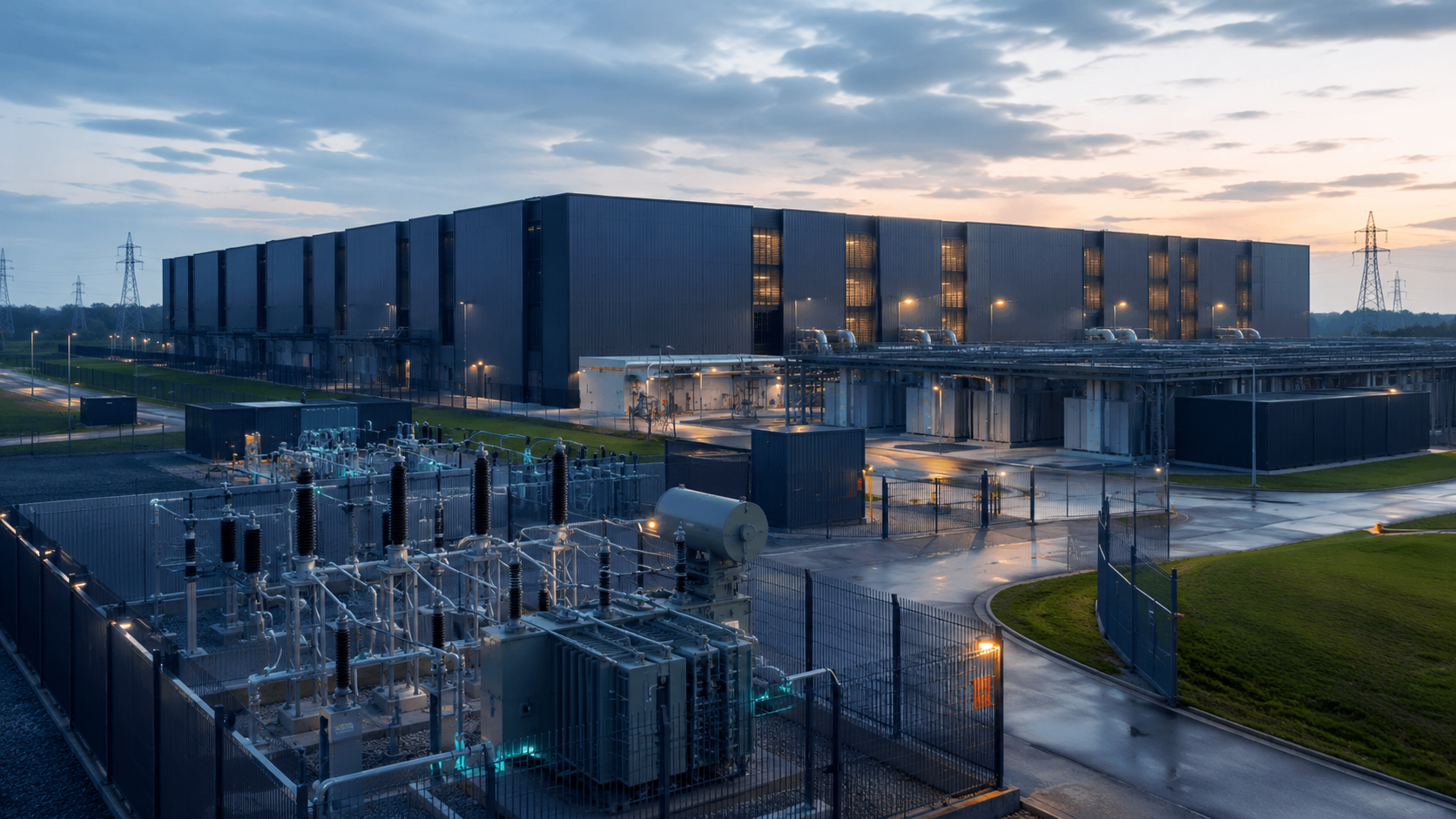
The 14-acre site sits next to the M25 in West London’s core data centre corridor. The proposed campus would include two data centre buildings and a dedicated 140MVA substation, with Gensler responsible for architectural design and Cundall supporting MEP design.
McLaren Construction will act as main contractor, while Phoenix ME will serve as MEP delivery partner. Their pre-construction services agreement covers early work ahead of full delivery, including site clearance, enabling works, utility diversions, and environmental remediation.
The existing site contains a mix of industrial uses, including vehicle storage, waste transfer, recycling, concrete and aggregate storage, and tyre distribution. Early works are expected to include the relocation of two 36-inch water mains used by Affinity Water.
West London capacity moves into delivery
Iver sits near one of the UK’s most important data centre markets. Proximity to Slough, London, fibre routes, customers, and specialist suppliers gives the site strong commercial logic. The same geography also brings pressure on power, land, transport, local infrastructure, and planning tolerance.
A 140MW campus requires a delivery sequence far more complex than a standard industrial redevelopment. The dedicated substation sits at the heart of the scheme, but the project also depends on resilient electrical distribution, cooling plant, standby power, controls, security, commissioning, and phased handover.
The predevelopment stage is therefore a critical filter. Data centre programmes can be delayed by utility conflicts, contamination, drainage, access constraints, and unexpected ground conditions long before fit-out begins. The water-main diversion alone shows how major digital infrastructure projects can depend on utility engineering that sits outside the visible data hall.
The design brief also has to respond to local context. McLaren says the Gensler design includes cladding intended to sit sympathetically beside an adjacent Grade II listed farmhouse, with biodiversity considered in the scheme. Data centres in constrained locations increasingly need to show architectural and environmental mitigation alongside engineering performance.
Buildability joins the power constraint
The UK data centre debate often begins with grid capacity, but construction capacity is becoming a parallel constraint. Large campuses require experienced contractors, specialist MEP labour, transformers, switchgear, generators, chillers, controls, and commissioning teams. Those supply chains are also being pulled by grid reinforcement, industrial electrification, and wider infrastructure demand.
CorScale’s practical completion target of late 2029 indicates the scale of the delivery cycle. Even with a site, project team, and early works route, major capacity in the West London corridor still moves through years of enabling work, grid delivery, building construction, fit-out, testing, and phased commissioning.
Programme risk now sits directly inside commercial risk. A campus may be attractive to AI and cloud customers on paper, but delays in substation delivery, remediation, equipment procurement, or MEP commissioning can shift revenue timing and customer commitments. Investors will be watching the project’s progression from early works into full construction closely.
The Iver scheme also illustrates the redevelopment character of UK data centre growth. Developers are not only building on clean greenfield sites. They are converting complex industrial land into higher-value digital infrastructure, which can support regeneration but brings utility, neighbour, and environmental challenges.
If CorScale moves Court Lane through predevelopment into full construction, the project would add a substantial block of capacity to a market where AI and cloud demand remain strong. Its progress will be measured not only in planned megawatts, but in whether those megawatts can be built, powered, cooled, and commissioned on a credible schedule.

