
Summary
- Infineon and LS Electric have signed an MoU covering high-efficiency DC power infrastructure.
- The work will focus on power conversion systems, solid-state transformers, and solid-state circuit breakers.
- The collaboration reflects rising pressure to rethink data centre power distribution as AI loads increase.
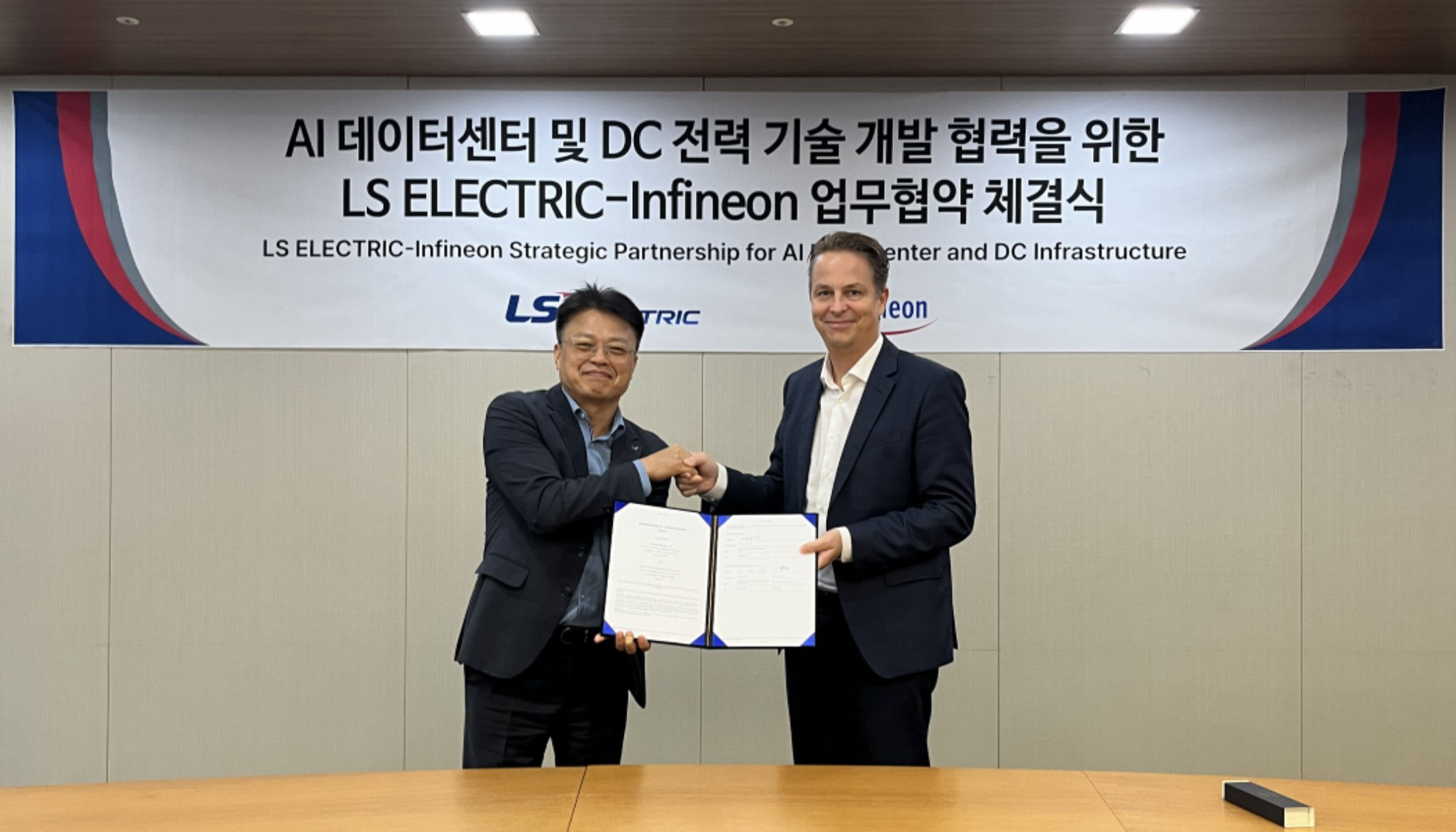
Infineon Technologies and LS Electric have signed a memorandum of understanding to collaborate on high-efficiency direct-current power infrastructure for AI data centres and next-generation power grids.
The collaboration will focus on power conversion systems for energy storage, solid-state transformers, and solid-state circuit breakers. Infineon will contribute power semiconductors, microcontrollers, and power control technology, while LS Electric will bring power-system and industrial automation expertise into system-level integration.
AI data centres are pushing electrical design harder as larger amounts of power are delivered into denser compute environments. Conversion losses, voltage management, protection systems, electrical room space, and the reliability of switching equipment are becoming front-end design questions rather than late-stage specification details.
Fewer losses, faster protection
Most data centres still rely on alternating-current distribution at facility level, with several conversion stages before electricity reaches IT equipment. Each stage adds equipment, cost, heat, and efficiency loss. Higher-density AI infrastructure is forcing suppliers and engineers to revisit whether parts of that electrical path can be simplified, particularly where battery energy storage, renewable generation, and IT loads already involve DC conversion.
DC power systems are not new, and wider data centre adoption is not straightforward. Protection, switching, safety procedures, standards, maintenance, and integration with existing electrical design practice all have to mature. The renewed interest is being driven by load density. AI clusters concentrate demand in ways that increase the value of efficient conversion and faster fault response.
Solid-state transformers form one part of the companies’ focus. Infineon says these semiconductor-based devices can be up to 30% smaller and lighter than conventional copper and iron-based transformers while offering higher efficiency. If those advantages translate into real facility deployments, they could reduce some of the space and weight burden attached to electrical infrastructure.
Solid-state circuit breakers address another problem. Conventional protection equipment relies on mechanical interruption, while semiconductor-based breakers can operate on a microsecond scale. Faster interruption can improve protection against short circuits and overloads in dense electrical environments, although cost, coordination, heat, reliability, and maintenance practice will still have to be proven in production settings.
The facility power train gets strategic
The collaboration also shows how AI demand is changing the industrial supply chain. Semiconductors are no longer only the processors inside servers. Power semiconductors, controls, switching devices, and sensing systems are moving deeper into facility-level infrastructure, alongside UPS systems, switchgear, transformers, batteries, busways, and grid-interconnection equipment.
European developers and operators are already dealing with grid queues, long lead times for electrical equipment, and higher-density workloads that narrow design margins. Any architecture that can reduce losses, improve controllability, or shrink electrical infrastructure will attract attention. Adoption will still depend on reliability, maintainability, safety, standards, and a clear commercial case.
Infineon’s role gives the work a European supply-chain dimension, while LS Electric brings experience from power systems and industrial automation. That combination is important because DC infrastructure is not a single-component market. It requires devices, controls, integration, protection design, standards work, and customer confidence in how the whole electrical path behaves under normal and fault conditions.
Andreas Weisl, executive vice president and chief sales officer of industrial and infrastructure at Infineon, said: “The increasing electricity demand, especially from AI data centers, is reshaping the way power is generated, distributed and consumed.” He said high-efficiency DC architectures would play a key role in addressing increased energy demand while improving system performance and sustainability.
Kil Young Ahn, vice president and head of production and R&BD at LS Electric, said the importance of high-efficiency DC technologies was growing with the expansion of AI data centres and next-generation power grids. The companies will align technology roadmaps and co-development work around next-generation energy infrastructure.
An MoU does not make DC distribution the default architecture for AI data centres. It does show that major electrical and semiconductor suppliers see the load curve changing fast enough to justify deeper development work. The facility power train is becoming one of the places where the AI build-out either gains efficiency or loses it as heat.

