
Summary
- The report moves beyond heat recovery potential to the practical delivery of heat networks.
- Project economics depend on temperature, infrastructure, investment, and contractual responsibilities.
- Direct connections between data centres and large heat users may be simpler than district heating networks.
The Dutch Data Center Association has published new guidance examining the financial, technical, and contractual arrangements needed to deliver heat recovered from data centres to district heating networks and other customers.
The report, Datathermics: Bringing Data Centers and Heat Networks Together, was published on 2 November and builds on earlier guidance issued in September 2026.
It draws on interviews with municipalities, data centre operators, and heat network organisations, reviewing policy developments and the obstacles encountered by projects attempting to connect facilities with local heating demand.
The findings centre on the conditions required to turn available heat into a usable energy supply. Although data centres produce heat throughout their operation, an economically viable customer and suitable delivery infrastructure are needed before that energy can replace conventional heating.
Computing equipment converts most of its electrical consumption into heat. The facility cooling system removes that heat to maintain operating temperatures and ultimately transfers it into the surrounding environment or another system capable of using it.
Heat recovery redirects part of this flow into a useful application, such as heating homes, offices, industrial buildings, or greenhouses.
The temperature at which heat is available influences the design. Many data centre cooling systems provide heat at temperatures below those required by conventional district heating networks, creating a potential need for heat pumps or other equipment to increase the supply temperature.
That additional equipment consumes electricity and requires maintenance. The economic case depends on the source temperature, the destination’s requirements, and the amount of useful energy transferred over time.
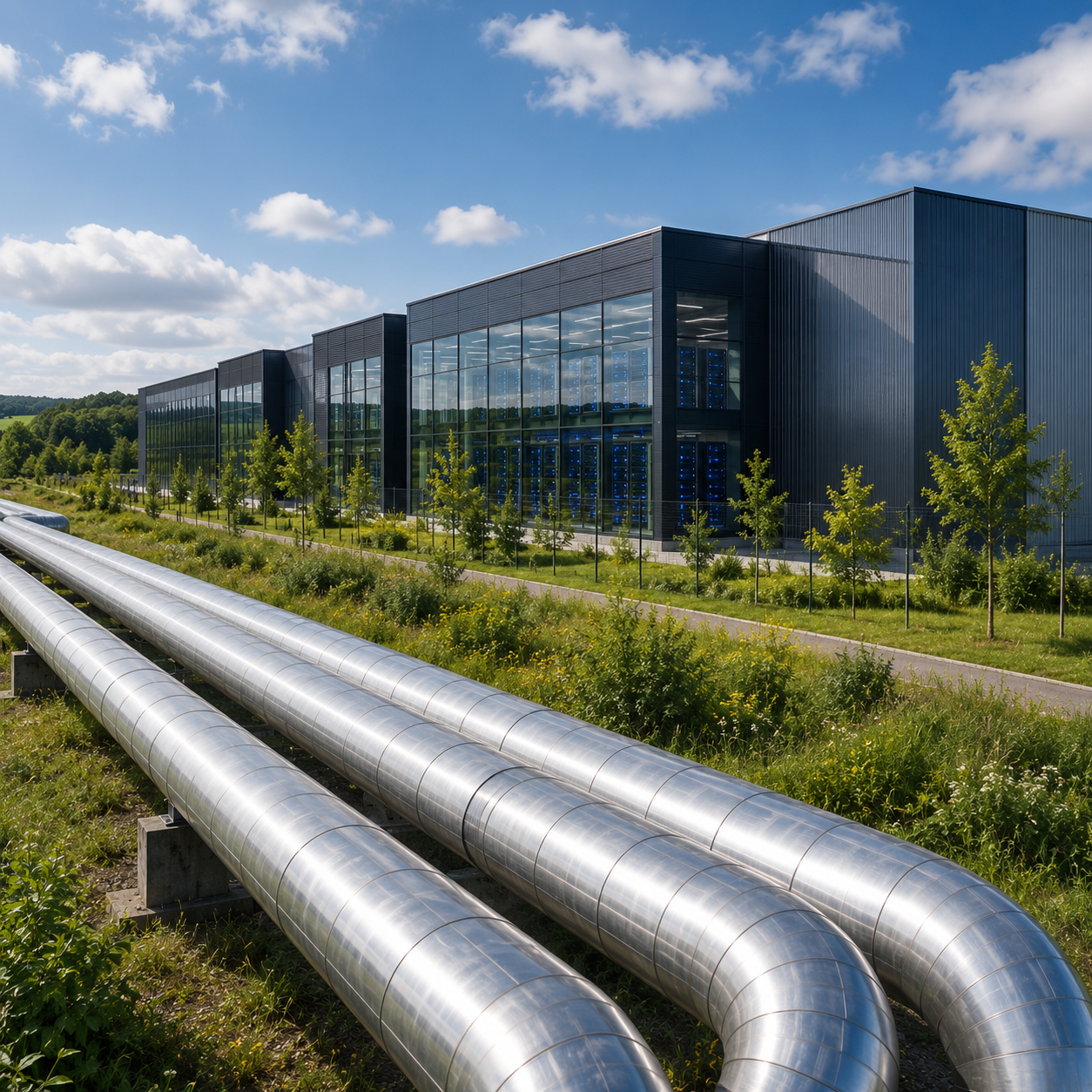
A district heating connection also requires physical infrastructure, including pipework, pumps, heat exchangers, metering, controls, and appropriate arrangements between the data centre and the receiving network.
Where the two facilities are separated by substantial distances, pipe construction and land access can add cost and complexity. Planning permissions, road works, easements, and agreements concerning ownership may also be required.
These practical constraints can prevent theoretically available heat from becoming a commercial energy supply, even where the data centre’s cooling plant is technically capable of providing it.
The report distinguishes connections to district heating networks from direct supply to a nearby business. Offices, greenhouses, and other large users can sometimes be connected through simpler arrangements involving fewer parties.
Such projects may be easier to negotiate where heat supply and demand are located close together. The parties can agree directly on equipment investment, operating responsibilities, expected energy volumes, and the duration of supply.
District heating projects generally involve a wider set of interests, including network operators, municipalities, heat distributors, end users, and potentially separate infrastructure investors.
The commercial arrangements must establish who funds the connection, who maintains the equipment, and how costs and risks are allocated when demand or available heat changes.
Seasonal demand introduces another difficulty. A data centre may produce heat continuously while residential buildings require much less heating during warmer periods.
The system must therefore accommodate periods when only part of the available heat can be used. Storage can sometimes help balance supply and demand, although it introduces additional infrastructure and operating considerations.
Data centre reliability also places constraints on the design. The ability to reject heat must be preserved when a district heating network cannot accept it, when external equipment is unavailable, or when operating conditions change.
The external heat customer may want a dependable supply, but the data centre cannot allow a heat reuse obligation to compromise the cooling needed by critical computing equipment.
Suitable contracts must reconcile those requirements and define the responsibilities of each party during maintenance, outages, and changing operating conditions.
Some arrangements can also improve cooling efficiency when the returning water temperature and hydraulic conditions reduce the work required from facility equipment.
Such benefits depend on the installed system rather than occurring automatically whenever heat reuse is introduced.
The Dutch heat transition is also approaching changes in the legal framework. The report identifies the expected introduction of new collective heating legislation and municipal heat planning requirements in 2027 as factors influencing future project coordination.
DataCentral recently covered the approval of an OVHcloud heat connection in Roubaix, illustrating the infrastructure and consent required to progress from recoverable heat to a functioning supply arrangement.
The Dutch report recommends earlier cooperation among data centre operators, heat network companies, local authorities, and potential customers, supported by realistic technical expectations and clearly allocated responsibilities.
Those arrangements determine whether heat recovered from a data centre becomes a durable commercial service rather than an available resource that continues to be rejected unused.

