
Summary
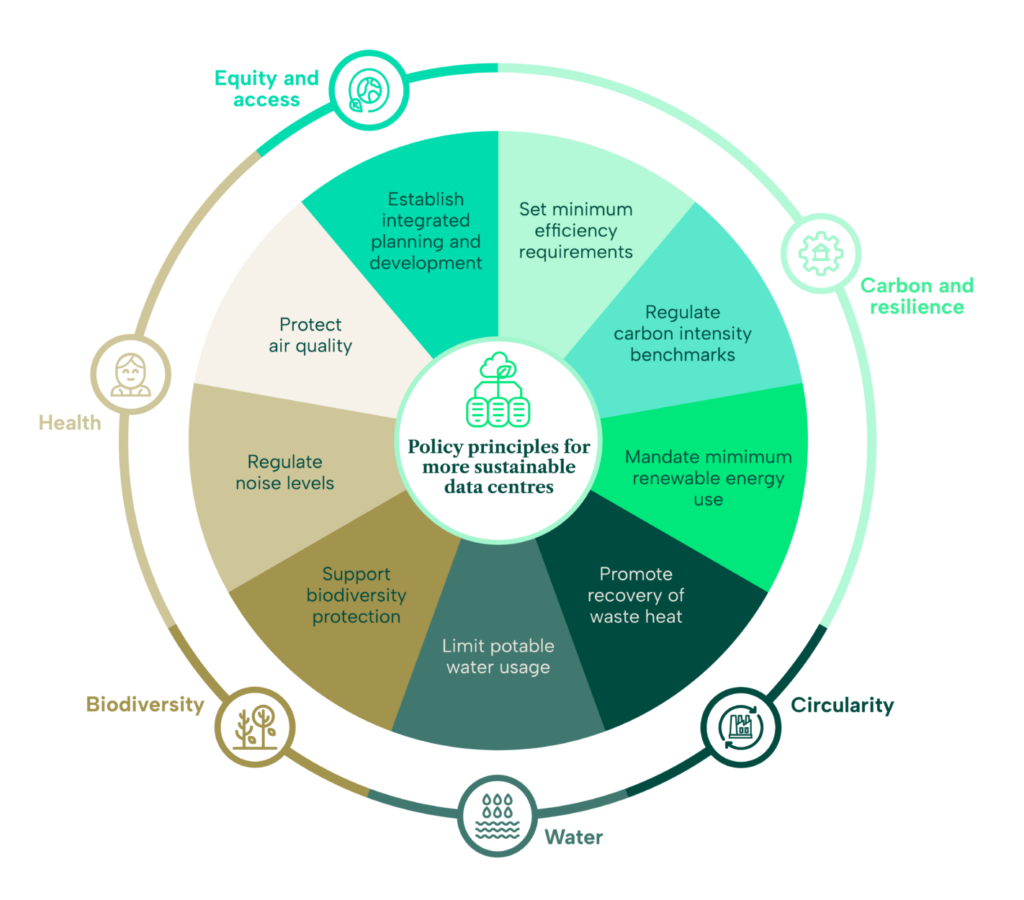
- WorldGBC’s framework proposes nine policy approaches spanning energy, water, heat, biodiversity, noise, air quality, and planning.
- It calls for PUE, WUE, and carbon-efficiency ratios to be disclosed alongside absolute energy and water consumption.
- The non-binding principles reflect the direction of European reporting, heat-reuse, and resource-efficiency regulation.
World Green Building Council has set out nine policy principles for data centres, calling for governments to combine efficiency standards with disclosure of absolute energy and water consumption, renewable-power requirements, heat recovery, environmental safeguards, and integrated infrastructure planning.
The framework covers minimum efficiency requirements, carbon-intensity benchmarks, renewable electricity, waste-heat recovery, potable-water limits, biodiversity, noise, air quality, and coordination between data centre developments and the networks serving them.
Although the principles are non-binding, they reflect a regulatory movement away from judging a facility through a single efficiency ratio. Policymakers increasingly want to know how much electricity, water, land, and infrastructure capacity a project consumes within its local setting.
Ratios can conceal the scale of consumption
Power usage effectiveness remains useful for comparing the energy consumed by IT equipment with the power required by the wider facility. Water usage effectiveness and carbon usage effectiveness provide related measures, but none of those ratios shows total consumption on its own.
A large campus can record an efficient PUE while consuming far more electricity than a smaller, less efficient facility. A low WUE can likewise conceal a substantial annual water requirement or a cooling system whose demand peaks during periods of local scarcity.
WorldGBC therefore calls for absolute consumption to be reported alongside efficiency metrics. Grid planners could then assess the project’s import requirement and operating profile, while water authorities could examine seasonal use, supply resilience, and the effect of hot weather.
The proposal aligns with the European Union’s reporting framework under the recast Energy Efficiency Directive, which requires qualifying data centres to submit energy and water performance information. The European Commission is also developing a rating scheme and examining minimum standards.
Reporting is likely to become more detailed as the framework matures. Annual electricity totals do not show peak import, hourly demand, flexibility, or dependence on backup generation, while annual water figures can hide large seasonal differences between cooling modes.
WorldGBC also proposes renewable-energy requirements, although contractual procurement and physical supply need to be distinguished. Annual certificates can reduce market-based emissions without relieving congestion on the network serving the data centre during its most constrained hours.
Heat and water remain tied to local infrastructure
Waste-heat recovery forms another part of the framework. Data centres reject large quantities of heat, but reuse depends on a nearby customer, suitable temperatures, connecting pipework, commercial agreements, and a stable operating profile.
Germany has already introduced statutory heat-reuse expectations for new data centres through its Energy Efficiency Act. Planning authorities elsewhere in Europe are also asking developers to examine heat networks, even when no viable customer or tariff has been secured.
The framework cites a project in Brescia, Italy, designed to supply around 16GWh of recovered heat annually to the district network, serving the equivalent of approximately 1,350 apartments and avoiding an estimated 3,500 tonnes of carbon dioxide.
Such arrangements depend on the characteristics of both the data centre and the heat network. A reuse obligation can create stranded equipment where there is no customer, while a site beside an established district-heating system may displace boilers or other heat sources for much of the year.
Water presents a similar trade-off. Evaporative cooling can reduce electrical demand under some conditions while increasing water consumption, whereas dry cooling limits on-site water use but may require larger heat-rejection equipment and more fan power during high temperatures.
WorldGBC recommends limits on potable-water use and disclosure of total consumption alongside WUE. In water-stressed markets, planning assessments may also need to consider water quality, reclaimed supplies, discharge arrangements, and the effect of drought restrictions on facility resilience.
Biodiversity, noise, and air quality extend the framework beyond operational efficiency. Large campuses occupy substantial land and contain generators, cooling equipment, transformers, and traffic movements whose effects remain local even when the digital services are delivered internationally.
Integrated planning would assess those factors alongside transmission investment, renewable generation, heat networks, housing, industry, and water supply. Some objectives will still pull in different directions: dry cooling can conserve water while increasing electricity use, and a dense site can reduce land take while concentrating heat rejection and noise.
The nine principles provide a clearer picture of the evidence likely to accompany future planning and reporting regimes. Efficiency claims will carry less weight when they are not supported by absolute resource data, network requirements, and a detailed account of the facility’s effect on its surroundings.

