
Summary
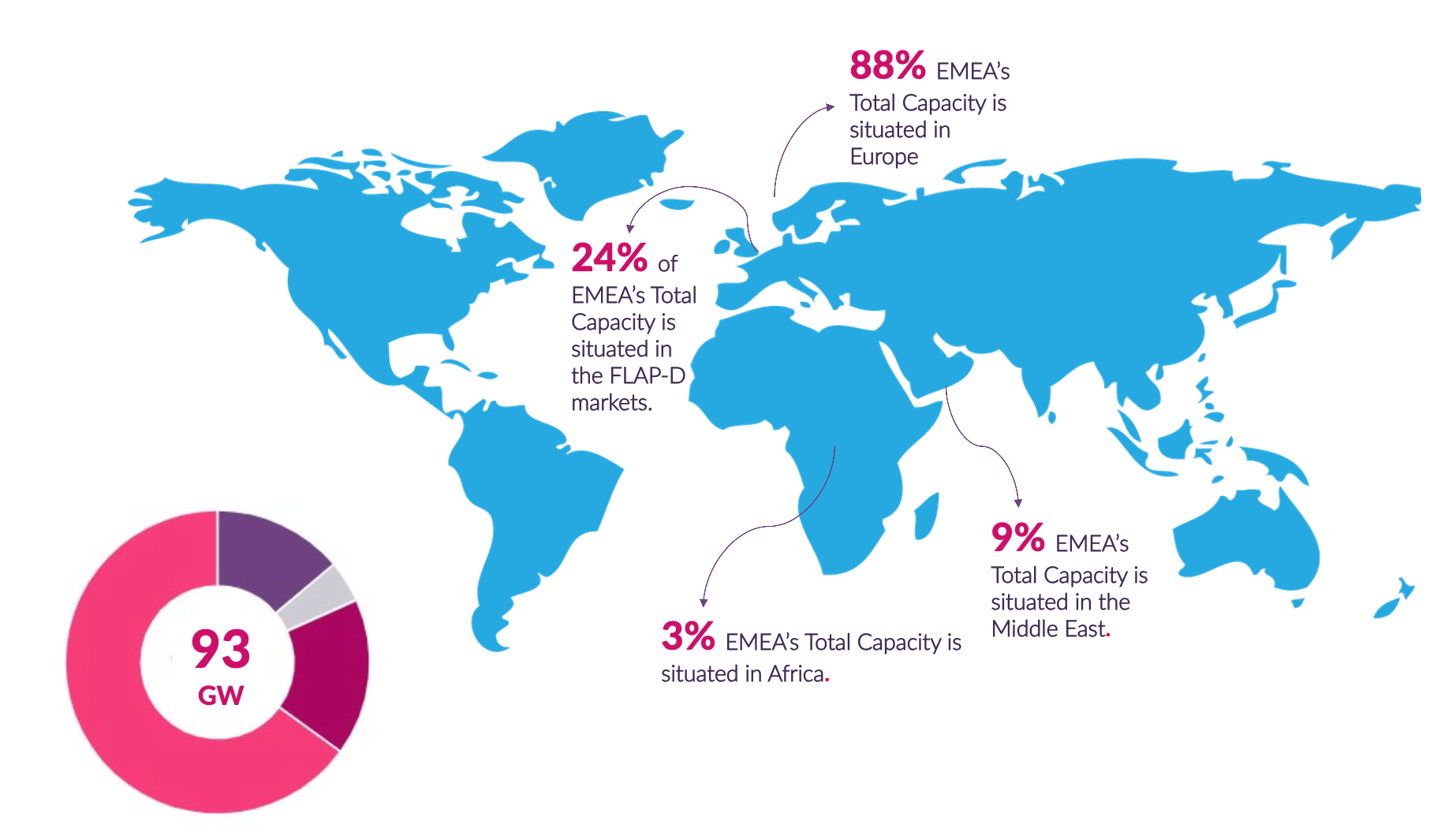
- DC Byte puts total EMEA IT capacity across development stages at 93GW.
- Almost one-quarter remains concentrated in Frankfurt, London, Amsterdam, Paris, and Dublin.
- Power delivery, tenant demand, skills, and project maturity determine how much announced capacity becomes operational.
Data centre capacity across EMEA has reached 93GW when operational facilities, construction, committed projects, and early-stage developments are counted together, according to new analysis from DC Byte.
DC Byte said almost a quarter of the total remains concentrated in Frankfurt, London, Amsterdam, Paris, and Dublin, despite accelerating development in secondary markets.
The scale of the figure is significant, but so is its composition. A megawatt already serving customers is not equivalent to a power application, an early planning concept, or a site that has yet to secure a tenant. DC Byte cautions that the development stages need to be separated when assessing how much new capacity is likely to reach operation.
That distinction has become increasingly important as AI demand produces larger announcements and developers compete for sites with access to power. The size of a market’s theoretical pipeline can grow rapidly without the same increase in deliverable capacity.
Power dates are shaping geography
Established hubs still have advantages that are difficult to reproduce. Dense fibre networks, cloud on-ramps, enterprise customers, specialist contractors, and an existing operator base reduce demand risk. Where power can be secured, those factors can justify higher land and development costs.
The problem is that grid access has become the gating item in many of those locations. DC Byte said connection timing is now central to market selection, particularly where some AI infrastructure customers are seeking ready-for-service dates less than a year away.
That creates an opening for markets that can provide power more quickly. Madrid, Milan, Stockholm, Nordic locations, and other secondary markets are attracting investment for different combinations of available land, electricity prices, renewable generation, policy support, and construction opportunity.
None of those advantages automatically creates a mature data centre market. Training workloads may tolerate more geographical flexibility than latency-sensitive inference or enterprise colocation, while customers with sovereignty requirements may restrict where data can be processed.
A location therefore needs to match the workload. Cheap power in a remote market is less useful if the customer requires dense interconnection, low latency to a major population centre, or a particular national jurisdiction.
The pipeline is not a forecast
DC Byte highlights Milan as one example of why development-stage data needs care: around 70% of the market’s total IT capacity is in early-stage development. That signals strong developer interest, but it does not mean the same proportion will be built.
Large projects may need customer commitments to unlock project finance, while landowners and developers can spend considerable sums on power, planning, surveys, and design before a site is commercially secure.
The same problem applies to large regional totals. Announced gigawatts can include projects competing for the same grid capacity, sites whose construction dates are uncertain, and schemes that will be delivered in phases over many years.
Labour is another constraint. As development spreads beyond established hubs, operators need experienced people to design, build, commission, and run increasingly complex facilities. A market with suitable land and electricity can still face delivery problems if the local engineering and contractor base cannot scale with the pipeline.
Operating economics also become more important after the opening date. Rent escalation, energy prices, maintenance costs, staffing, and the utilisation of completed capacity determine whether a project that looked attractive at planning stage continues to perform.
The 93GW figure therefore shows the scale of ambition across EMEA rather than a near-term supply forecast. The more useful question is how quickly projects progress from early-stage announcements through secured power, planning, financing, construction, commissioning, and contracted demand.
As Europe’s development map broadens, the markets that convert paper capacity into live megawatts will be the ones able to align those steps rather than simply announce the largest pipelines.

