
Summary
- Era4 has filed plans for a 13,000 sq ft data centre at Shelford Farm Estate near Canterbury.
- The project would use private-wire power from a landfill methane generation station, plus rooftop solar.
- The proposal ties brownfield land, behind-the-meter power, liquid cooling, and local planning risk into one small project.
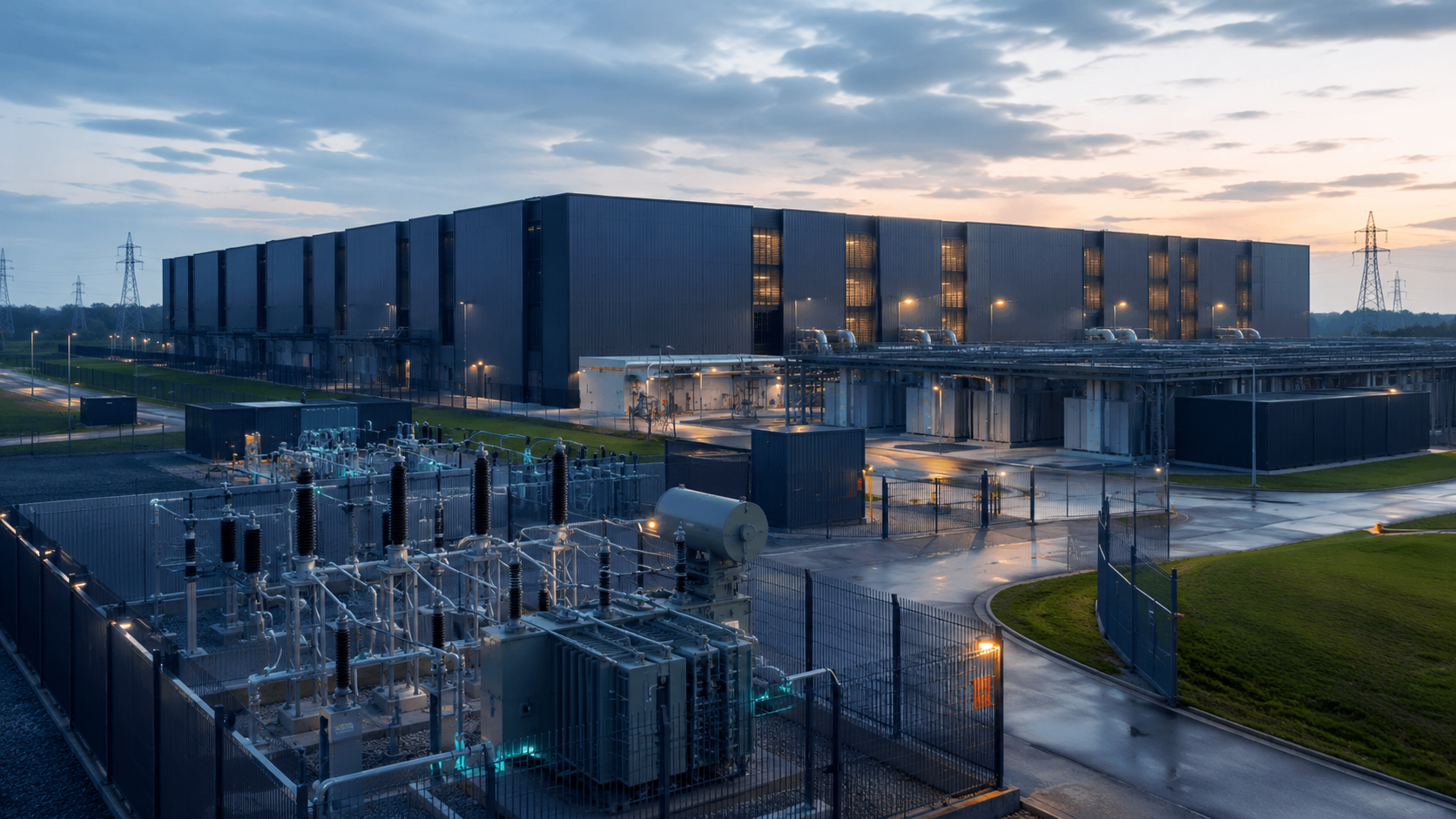
Era4 is planning a 13,000 sq ft AI data centre at the Shelford Farm Estate landfill and waste site near Canterbury, Kent, using private-wire power from nearby landfill methane generation.
The company, formerly known as Carbon3.ai, has filed plans with Kent County Council for the facility on Broad Oak Road. The proposal would connect to the Valencia Energy Centre’s landfill methane generation station, with rooftop solar and a cooling design based on closed-loop liquid cooling supported by adiabatic systems.
The scheme is small by hyperscale standards, but it provides a useful example of how UK developers are looking at brownfield and energy-adjacent sites to shorten delivery timelines. Era4 says its wider model is based on converting brownfield sites into lower-carbon, high-performance AI infrastructure, with more than 40 sites under development across the UK.
The Canterbury proposal has already attracted local opposition, with concerns focused on the suitability of an AI data centre near the city, the transparency of power and environmental claims, and further development at an existing waste and landfill location.
Behind-the-meter AI capacity
The attraction of a landfill-linked data centre is clear. Landfill gas generation is already local to the site, and a private-wire arrangement can give a developer a route to power that does not depend solely on a new grid import connection. For small and modular AI facilities, that can be commercially useful where the energy source is reliable, dispatchable, and acceptable to planners.
The model also raises hard technical and carbon-accounting questions. Landfill gas is a finite and declining resource as waste decomposes over time. The emissions profile depends on the baseline treatment of methane, the efficiency of power generation, the treatment of residual emissions, and the way any grid import or export is handled. It may perform better than venting or flaring methane, but it is not the same as zero-carbon electricity.
Cooling adds another layer of scrutiny. Closed-loop liquid cooling can reduce water demand compared with evaporative-heavy designs while supporting higher rack densities. Adiabatic systems can still involve water use during peak ambient conditions, so planning documents and operating controls will need to be clear about water consumption, noise, heat rejection, and coolant safeguards.
Era4’s proposal arrives as the UK government promotes data centre capacity as part of its wider AI and digital infrastructure agenda, while local communities have become more alert to land, grid, water, and noise impacts. Smaller energy-adjacent projects may avoid some of the scale problems of very large campuses, but they still need a detailed local account of what is being built and how it will run.
If approved and delivered, the Canterbury project would test whether UK landfill and waste sites can host modular AI capacity using existing energy assets. If it stalls, it will reinforce a familiar constraint: brownfield power is valuable, but local consent still has to be engineered through credible design, transparent evidence, and operational detail.

