
Summary
- The development opportunity occupies a three-acre plot at the entrance to Follingsby Park.
- The proposed 12MW facility would use an advertised 15MVA power allocation, with two- and three-storey designs being considered.
- Agents are seeking an occupier or purchaser, while the project remains at pre-application stage.
The owners of Follingsby Park in Gateshead are marketing a three-acre site for a proposed 12MW data centre, using an advertised 15MVA electricity supply opportunity to attract an occupier or development partner.
Joint agents HTA Real Estate, Avison Young, and Carter Jonas are promoting the scheme at the entrance to the established industrial estate.
The proposal could proceed as a bespoke development designed around the requirements of a future occupier, or through the disposal of a serviced plot to a purchaser intending to undertake its own construction programme.
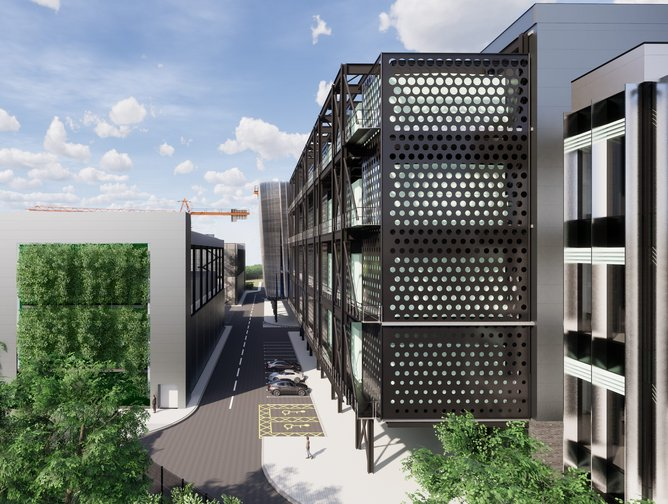
Two-storey and three-storey building configurations are being examined. Both would provide space for computing equipment, electrical and mechanical infrastructure, ancillary offices, a substation, and standby generators.
The project remains at pre-application stage, with the estate’s representatives indicating that discussions with Gateshead Council are progressing. No full planning permission or construction commencement has been established.
Follingsby Park extends across approximately 110 acres and contains around 1.1m sq ft of commercial buildings. More than 40 businesses operate from the estate, which supports industrial and logistics activities across the wider Tyne and Wear area.
Investment funds managed by Westbrook Partners acquired the estate from Legal & General in 2024. The proposed data centre would occupy a relatively small site within that wider commercial property holding.
The advertised electrical capacity is central to the opportunity because access to a suitable grid connection increasingly influences the location and timetable of new computing facilities.
The agents describe 15MVA of electricity as available at the site. That is a marketing statement rather than an independently examined connection agreement establishing every delivery condition.
Prospective developers would need to review the power allocation, any reinforcement obligations, connection costs, service restrictions, and the date on which the proposed electrical load could be supplied.
The distinction between megavolt-amperes and megawatts is also relevant to the design. MVA measures apparent electrical power, while MW measures active power, with the relationship determined by the installation’s power factor.
A 12MW data centre cannot automatically be assumed to provide 12MW of usable computing load simply because the associated electrical opportunity is advertised at 15MVA.
Computing equipment accounts for only part of the facility’s electricity consumption. Cooling systems, uninterruptible power supplies, electrical distribution losses, pumps, fans, and supporting plant contribute to the total operating demand.
Engineering work will therefore need to establish whether the proposed 12MW figure describes overall facility demand, installed IT capacity, or another project parameter.
The electrical allocation would then need to be reconciled with the intended cooling and redundancy arrangements, including allowances for operating conditions and maintenance.
Higher-density AI computing could place additional demands on rack power distribution and cooling infrastructure. Such installations may require direct liquid cooling, coolant distribution equipment, heat exchangers, and appropriate heat rejection plant.
Other computing workloads can operate within different electrical and thermal limits. The final design will depend on the equipment and services required by the future customer rather than the nominal size of the building alone.
Building height is another unresolved design choice. A two-storey configuration could concentrate plant and equipment differently from a three-storey arrangement, affecting internal circulation, structural loads, maintenance access, and the routes used to distribute electrical and mechanical services.
Servers, batteries, transformers, switchgear, and cooling equipment can be heavy or difficult to move through a completed building. Their installation and replacement must therefore be considered alongside the proposed structural and service layout.
Additional storeys may improve the use of limited land but introduce requirements for lifting equipment, vertical service distribution, and the separation of technical areas.
The standby generators identified in the proposal would provide resilience during interruptions to the normal electricity supply. Their design and operation would require suitable fuel arrangements, electrical switching, exhaust management, and provision for routine testing.
Noise from mechanical plant and generator operation would be relevant to the planning process, together with construction traffic, landscaping, and the effects of the proposed building on neighbouring industrial occupiers.
An established commercial estate may offer advantages in terms of road access and proximity to existing services. It does not remove the need to demonstrate that the proposed data centre can operate safely and within the planning requirements applicable to the site.
The estate is situated near major regional road connections, providing access to Gateshead, Newcastle, Sunderland, and South Tyneside.
Those connections may support construction logistics and equipment deliveries, although the suitability of specific routes for heavy electrical and mechanical plant would need to be assessed during detailed design.
The North East’s wider AI infrastructure ambitions provide a policy context for additional computing capacity. However, regional investment programmes and growth zone designations do not guarantee planning approval or electricity capacity for an individual development.
Commercial commitments remain another important distinction. Marketing a site for data centre use does not establish that a customer has agreed to lease the facility, purchase the land, or fund construction.
A developer considering the opportunity would need to evaluate potential revenue against land costs, building expenditure, electrical works, cooling infrastructure, financing, and the operating requirements of the proposed occupier.
The project could also proceed in stages if the final design and commercial arrangements allowed capacity to be delivered incrementally, although no such phased programme has been confirmed.
The immediate development is the identification and marketing of the site with two possible building configurations and an advertised power allocation.
Confirmation of a purchaser or occupier, a submitted planning application, and verified electrical connection terms would provide firmer evidence of whether the proposed facility is likely to proceed to construction.
Until those milestones are reached, the 12MW figure represents a proposed development opportunity rather than operating or committed data centre capacity in Gateshead.

