
Summary
- Google-linked Global Infrastructure UK is seeking permission for up to four data-centre buildings on the former Arena Essex site.
- Essex Wildlife Trust says the development would destroy rare brownfield habitat supporting nationally important invertebrates and Broad-leaved Cudweed.
- July mitigation submissions have not persuaded the trust to withdraw its objection.
Google’s proposed data-centre campus at the former Arena Essex Raceway is facing continued opposition from Essex Wildlife Trust, which says revised mitigation plans do not resolve the development’s effects on rare habitats and species.
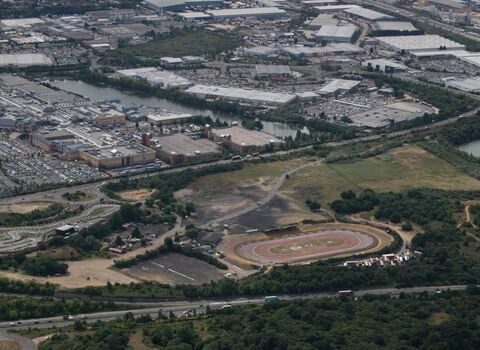
The planning application is being made by Global Infrastructure UK, a Google data-centre operating entity, for redevelopment of approximately 52 hectares at Arena Essex and the adjoining fishing lake in Thurrock.
The hybrid application allows for up to four data-centre buildings with a combined gross external area of 130,500 sq m, excluding external plant, alongside a separate office building of up to 4,000 sq m.
Supporting infrastructure includes substations, emergency backup generators, fuel tanks and/or battery storage, service yards, internal roads, security systems, and parking.
Essex Wildlife Trust says the site is a Local Wildlife Site containing open mosaic habitat on previously developed land and forming part of the Thames Estuary North Important Invertebrate Area.
The trust says surveys have identified a nationally important invertebrate assemblage and Broad-leaved Cudweed, an endangered plant protected under the Wildlife and Countryside Act.
Its latest position follows additional material submitted by the applicant in July 2026, including a revised mitigation strategy for the plant, a biodiversity net-gain strategy, assessment of gravel grassland, and an alternatives study.
The trust says those documents improve the evidence base but do not resolve its objections. It argues that around half of the Local Wildlife Site would be destroyed, including more than 80% of its most valuable brownfield habitat.
The dispute illustrates why previously developed land is not necessarily straightforward data-centre land. Brownfield sites can become ecologically important where low-intensity use or abandonment allows grassland, scrub, bare ground, and other habitats to develop over decades.
That can create a conflict between two planning objectives: reusing previously developed land for infrastructure and preserving habitats that have emerged precisely because a site has remained undeveloped.
Data centres amplify the land-use question because the building footprint is only one part of a campus. Substations, generators, energy storage, cooling equipment, security offsets, roads, drainage, and service areas can occupy significant additional space.
The Arena Essex application also proposes habitat creation, landscaping, and off-site measures. Essex Wildlife Trust argues that the proposed replacement habitat does not compensate adequately for the characteristics of the habitat that would be lost.
The trust has raised particular concerns around the suitability of a habitat bank at Fingringhoe and the proposed mitigation for Broad-leaved Cudweed. It also questions whether the applicant has demonstrated that no reasonable alternative location is available.
Those issues will form part of Thurrock Council’s assessment rather than being determined solely by the objector or applicant. Planning authorities have to weigh the ecological evidence, statutory biodiversity requirements, mitigation proposals, and wider development case.
The site’s power and resilience systems add another layer to that assessment. The application explicitly includes substations and emergency generators, although the public planning notice does not state the final IT load or grid connection capacity.
That information will be material to understanding the project’s wider infrastructure footprint. Building area alone provides only a limited guide to electricity demand because rack density can vary considerably between workloads.
The latest wildlife submission does not change the application itself, but it shows that environmental objections remain unresolved more than a year after the original planning filing.
For Google, the planning challenge is therefore not simply whether four data-centre buildings can fit on the site. The project must also demonstrate that loss of an unusually valuable brownfield ecosystem can be justified and mitigated alongside the power, resilience, access, and operational infrastructure required for the campus.

