
Summary
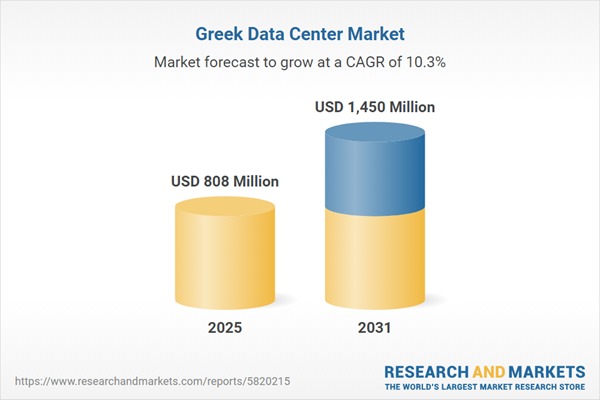
- Research and Markets forecasts Greece’s data centre market to grow from $808m in 2025 to $1.45bn by 2031.
- The report cites Amazon wind PPAs in Greece and Karatzis Group’s planned $278m data centre campus in Boeotia.
- Greece remains an emerging market where renewable power, subsea connectivity, colocation, and cloud demand are starting to converge.
Research and Markets has published a Greece data centre investment report pointing to market growth, renewable power procurement, and early campus-scale development in one of Europe’s smaller but increasingly watched digital infrastructure locations.
The report values the Greek data centre market at $808m in 2025 and forecasts growth to $1.45bn by 2031, equivalent to a compound annual growth rate of about 10.2%. It says Greece currently hosts 16 operational data centres, largely built to Tier III standards, with Athens acting as the main node for existing and planned capacity.
The market release cites two infrastructure signals: Amazon’s November 2024 power purchase agreements supporting four Greek wind projects with combined capacity of more than 109MW, and Karatzis Group’s March 2026 commitment to a $278m data centre campus in Boeotia.
A smaller market with useful geography
Greece is not yet comparable with Europe’s largest data centre hubs. Its current value lies in a different set of conditions: location, energy potential, regional connectivity, and demand from cloud and enterprise customers serving the Balkans, the Eastern Mediterranean, and routes towards the Middle East and North Africa. Those characteristics give the market a role beyond its current installed capacity.
The report identifies Athens and other cities as locations for both existing and upcoming facilities, while naming investors and market participants including CloudRock, Digital Realty, Synapsecom Telecom, Microsoft, Data4, and Serverfarm. That mix points to a market moving beyond small enterprise hosting into a broader combination of colocation, cloud, and wholesale demand.
Renewable power procurement is central to the investment case. Greece has strong solar and wind resources, but data centre growth still has to work through grid infrastructure, permitting, connection availability, and local market volatility. PPAs can support renewable generation and carbon-accounting goals, but they do not replace the need for substations, transmission access, backup systems, and firm delivery at site level.
Campus development changes the delivery chain
The Boeotia campus referenced in the report is worth watching because it points to larger sites emerging outside the most obvious metropolitan footprint. Campus development changes the infrastructure conversation. Land control, power availability, fibre routes, water strategy, heat rejection, environmental assessment, and long-term leasing demand all become more demanding than they are for smaller facilities.
The report also names AECOM, Hill International, and TERNA among construction contractors and subcontractors, and Schneider Electric and Vertiv among support infrastructure providers. Supplier detail is useful in emerging markets because data centre growth depends on the local and regional delivery chain, not only on developer intent. Permitting capability, MEP contracting, grid engineering, civil works, facilities staffing, and maintenance support decide whether capacity can move from plan to service.
Greece’s growth is likely to be incremental rather than explosive. Its advantages are location, renewable potential, improving connectivity, and a policy environment that has attracted cloud interest. Its constraints are familiar across Europe: grid capacity, planning timelines, build costs, cooling, water, and the ability to operate resilient facilities in a warming climate.
The market also sits inside the broader European sovereignty discussion. A more distributed data centre map could reduce reliance on a few congested hubs, improve regional latency, and support local industrial activity. It could also move large-load pressure into markets whose grids and planning systems have less experience with hyperscale development.
The Research and Markets release should be treated as market intelligence rather than a primary project filing. Its usefulness is in showing how Greek data centre growth is being framed: renewable procurement, connectivity, colocation investment, and construction supply-chain opportunity are starting to align.
Greece remains an emerging hub, but the direction is clear. Further growth will depend on whether power, land, permitting, and delivery capacity can keep pace with cloud, colocation, and regional enterprise demand.

