
Summary
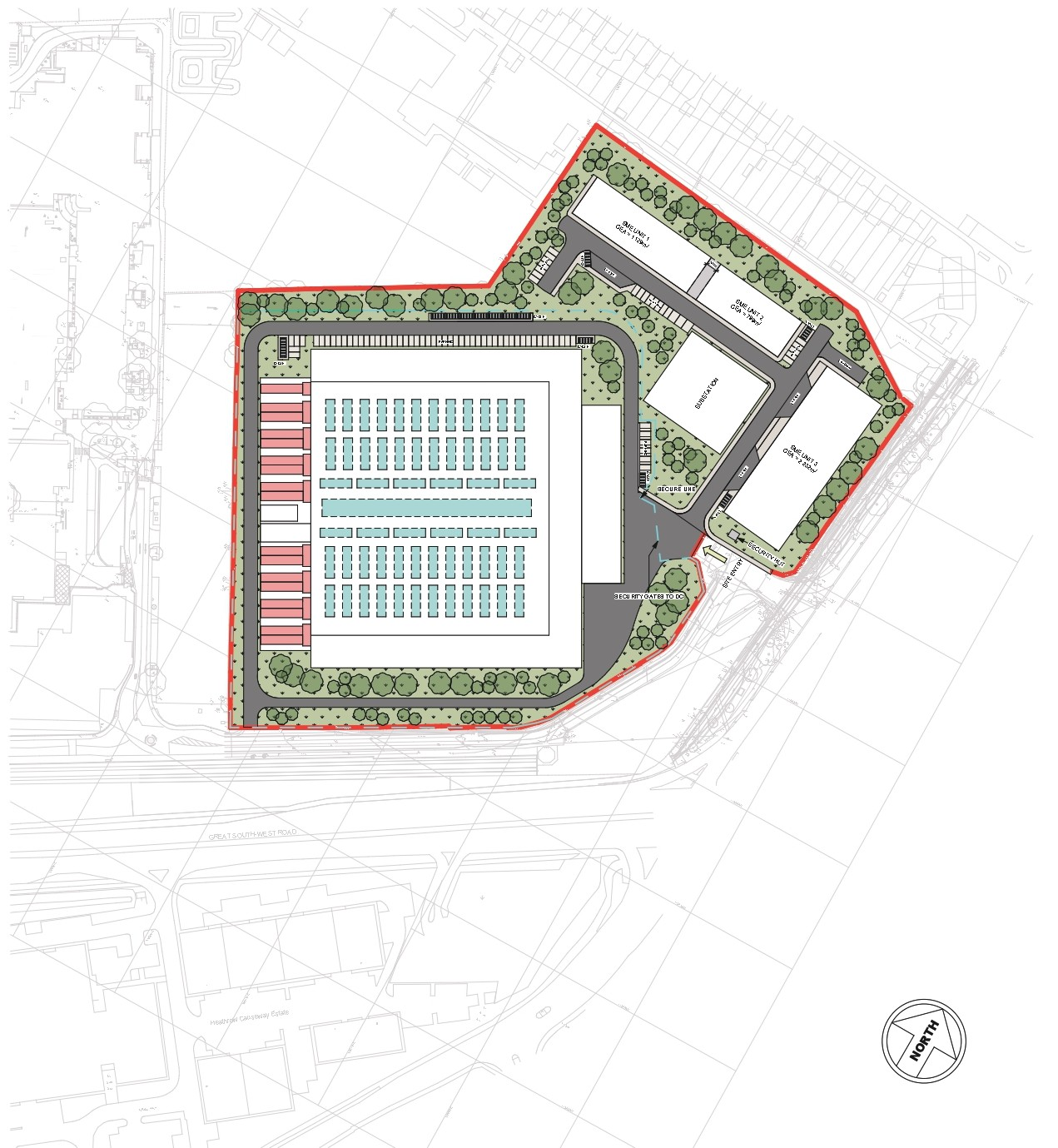
- The outline scheme allows up to 50,000 sq m of data centre space on the 12.2-acre Heathrow Estate alongside new SME accommodation.
- Planning material identifies an 80MVA electricity requirement, with supply intended to come from the Laleham Grid Supply Point.
- The project must still pass subsequent planning stages, while detailed cooling, water, and electrical design will determine its operational resource profile.
Hounslow councillors have backed redevelopment of Heathrow Estate for up to 50,000 sq m of data centre space, advancing another large electricity load inside west London’s already dense digital infrastructure market.
The outline proposal covers the 12.2-acre Haslemere Heathrow Estate on Silver Jubilee Way and includes demolition of existing industrial buildings followed by phased construction. Alongside the data centre, the scheme allows up to 4,150 sq m of new accommodation for small and medium-sized businesses.
Planning material identifies an 80MVA electricity requirement. During consideration of the application, the developer said power would be supplied from the Laleham Grid Supply Point outside Hounslow, rather than drawing on capacity allocated for other development within the borough.
An 80MVA connection sits behind the property decision
The committee vote advances the land use case, but the electrical connection remains the piece that will determine when the site can carry meaningful computing load. An 80MVA supply requires more than a reservation on a network diagram: cables, route permissions, substations, transformers, protection equipment, and the relevant upstream capacity all have to be available in the correct sequence.
West London has already experienced the collision between data centre demand and other development. Electricity constraints in the region have affected planning for housing, while data centre clusters around Slough, Hayes, and neighbouring districts continue to seek large new connections.
Bringing supply from outside the borough addresses one element of that political concern, but the physical demand still enters the wider regional power system. The connection has to be assessed against network capacity and reinforcement requirements at the point where the project actually connects.
Outline consent also leaves much of the internal electrical design for later stages. The final mix of data halls, transformers, UPS systems, standby generation, cooling plant, and redundancy will determine how the 80MVA supply translates into usable IT capacity.
That conversion is rarely one-to-one. Mechanical and electrical systems consume part of the incoming power, redundancy can leave some capacity intentionally unused, and phased occupation means the facility may operate well below its ultimate electrical envelope for years.
Water has become part of the planning conditions
The scheme must also produce a comprehensive water-minimisation strategy before construction. That requirement reflects a broader shift in planning scrutiny as data centre cooling moves into regions facing tighter long-term water balances.
No reliable project-specific consumption figure has been published, and the eventual profile depends on the cooling system selected. Evaporative systems can reduce electrical demand for heat rejection but consume make-up water, while dry systems reduce water use and can require more fan or chiller energy.
Liquid cooling at rack level would move heat more efficiently away from dense processors, but the secondary cooling loop still needs to reject that heat somewhere. The final plant design therefore determines both the water requirement and the electrical load associated with cooling.
The Heathrow Estate site is brownfield industrial land, which avoids opening a new greenfield location but does not remove construction impacts. Demolition, embodied carbon, construction traffic, acoustic treatment, backup generation, and major plant installations all remain part of the detailed development process.
Its location nevertheless has strong commercial logic. Heathrow and west London provide access to major fibre routes, logistics, customers, and a mature engineering supply chain, while neighbouring Slough remains one of Europe’s best-established data centre clusters.
That concentration is precisely why utility coordination is becoming harder. Each new project arrives into a region already carrying substantial digital load, so power, water, roads, and planning constraints increasingly have to be considered across the whole cluster rather than facility by facility.
The project website confirms that Hounslow’s planning committee approved application P/2025/3669 on 6 August. The scheme remains subject to subsequent planning steps, including the relevant Mayoral process and later detailed approvals.
Those stages will reveal whether the 80MVA connection, cooling strategy, and water commitments can be translated into a buildable design. The planning vote gives the site a route forward; the utility infrastructure will decide how quickly it becomes an operating data centre.

