
Summary
- The Zaltbommel site uses two 120kW phase-change cooling units, providing 240kW in total.
- The reported 5–8kW electricity reading is from the operating units; the 60–80kW conventional baseline is an estimate, not a parallel measured installation.
- The pilot reports zero water use for cooling, but wider performance depends on site conditions and system boundaries.
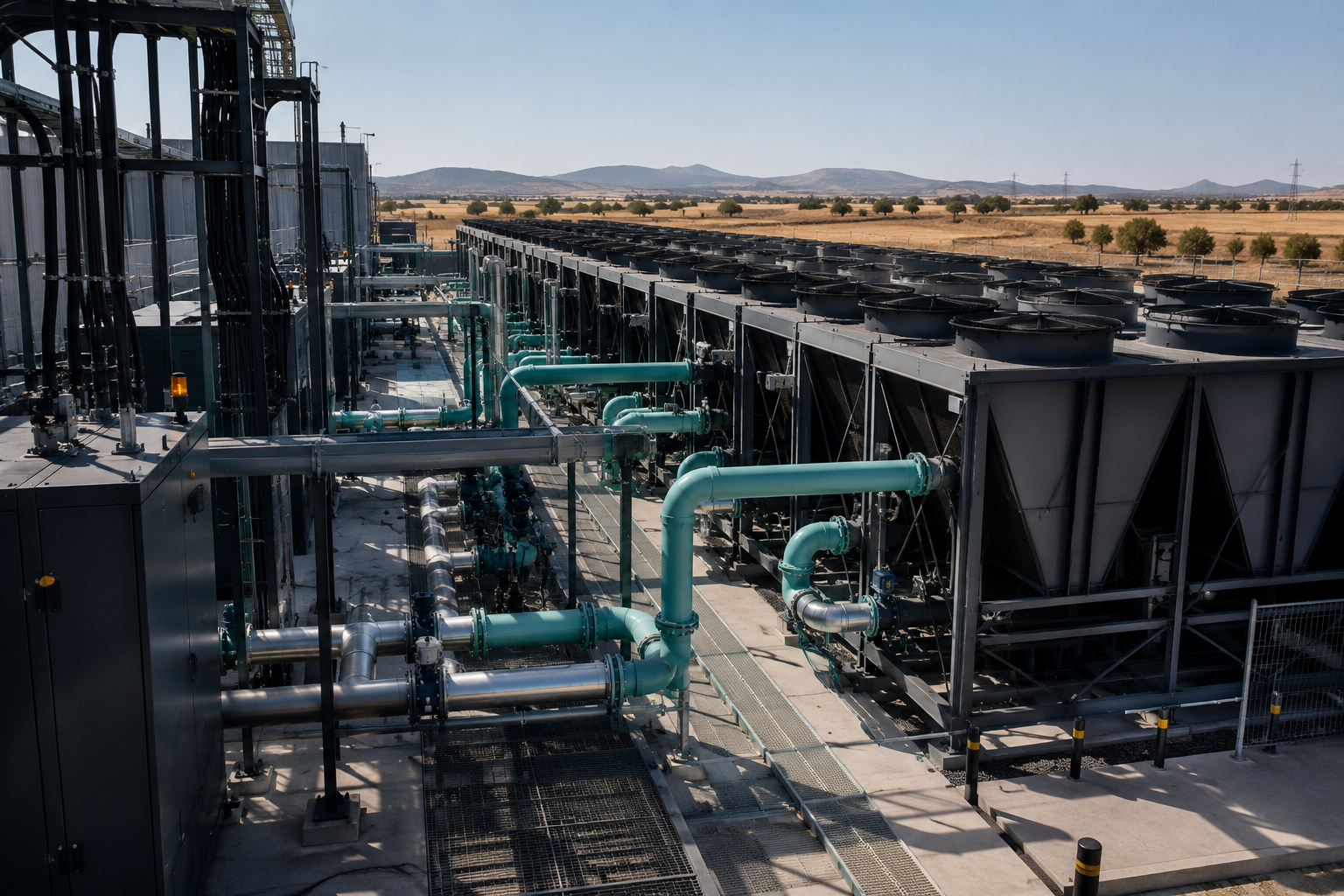
Hitachi Vantara has reported operating measurements from a 240kW phase-change cooling installation at its data centre in Zaltbommel, the Netherlands. The system, developed with Dutch thermal technology supplier Duraflow, uses two 120kW units and is being presented as a way to release more of a constrained electricity supply for computing.
According to Hitachi’s 27 October announcement, the two units together draw between 5kW and 8kW of electricity under the conditions monitored. The company compares that with an estimated 60kW to 80kW of compressor power for a conventional direct-expansion system supplying the same nominal 240kW of cooling.
The reported 5–8kW electricity consumption comes from monitoring the installed phase-change units, while the 60–80kW estimate describes a hypothetical conventional direct-expansion compressor system. Hitachi does not report a controlled side-by-side comparison of identically loaded installations in matched conditions. The difference illustrates a potential efficiency advantage but cannot establish annual savings on its own.
How the thermal system works
Phase-change materials absorb or release energy as their physical state changes at a designed temperature. In thermal-management systems, that stored energy can be used to buffer cooling demand and to move part of the heat-management duty away from periods when electricity is scarce or expensive.
Duraflow’s installation is described as storing thermal energy and releasing it in a controlled way when demand falls. The release does not provide the complete hydraulic schematic, thermal storage capacity in kilowatt-hours, operating temperatures or annual duty cycle. Those missing quantities limit how far the trial can be generalised to other buildings.
Rated cooling capacity is the rate at which equipment can remove or transfer heat at its design conditions. It does not describe how much thermal energy can be stored or how long a unit can maintain its output without regeneration. A 240kW cooling figure should therefore not be interpreted as proof of sustained operation for any particular number of hours.
Conventional refrigeration uses electrically driven compressors to transfer heat. A thermal-storage system may reduce the compressor electricity required during certain operating periods, but its whole-system performance also depends on pumps, controls, heat rejection, ambient conditions and how the storage medium is regenerated.
Electricity consumed by the installed units is only one part of a full-site energy assessment. Pumping, heat rejection, temperature conditions, and the method of regenerating thermal storage can change the comparison. Hitachi has not supplied full-year metering or a complete facility power usage effectiveness calculation attributable to this system.
Power constraints and water use
The work was undertaken at an operating data centre rather than being limited to a laboratory demonstration. That makes the reported figures useful as an initial operating reference, although the evidence remains a supplier account of its own deployment. Hitachi says phase-change systems may cut thermal-management electricity by up to 90% in some applications, not that every data centre should expect that reduction.
In a power-constrained facility, reducing the electrical load associated with cooling may allow a greater portion of the same connection capacity to support IT equipment. The possible gain is limited by the actual power and redundancy configuration, peak cooling duty and whether electrical infrastructure elsewhere in the building has sufficient headroom.
A smaller cooling electrical load cannot automatically be translated into an equal increase in commissioned GPU capacity. Server electrical distribution, UPS ratings, heat-removal performance, safety margins and customer deployment plans may impose separate limits. The company has not disclosed a measured increase in the site’s computing output caused by this installation.
Hitachi also says the installed approach uses no water for cooling. That statement concerns the cooling arrangement reported here and should not be extended to the entire data centre’s water footprint, including manufacturing, upstream electricity generation or other site services. Water demand also differs among dry heat rejection, evaporative cooling and hybrid architectures.
The Zaltbommel pilot leaves open how thermal storage and heat rejection can be integrated at other facilities while maintaining IT temperatures through changing workloads. Evidence of reliability, preventive maintenance and control behaviour is needed alongside the electrical measurements before the performance can be generalised.
Phase-change equipment adds its own commissioning and maintenance considerations, including the stability of storage media over repeated cycles, heat-exchanger fouling and the behaviour of the control system during transient loads. The available release does not report long-term service history or independent reliability results for the Zaltbommel installation.
Hitachi reports two operating 120kW phase-change units and collective measured electrical demand of 5–8kW, compared with an estimated 60–80kW conventional compressor baseline. Their performance across seasonal conditions, longer operating periods and other facility designs has not been independently established. Further metering would show whether similar savings can be reproduced beyond Zaltbommel.

