
Summary
- LG will supply chillers through AIR Control Concepts for US and Canadian data centre projects exceeding 5GW of aggregate capacity.
- The 5GW figure covers the data centre projects supported by the programme, not chiller output or a single facility.
- LG’s air-cooled centrifugal chiller uses refrigerant free cooling, while its reported 30% energy comparison is based on an internal simulation under stated conditions.
LG Electronics has signed a long-term supply agreement with AIR Control Concepts covering chillers for North American AI data centre projects representing more than 5GW of aggregate capacity.
The multi-year programme covers projects in the United States and Canada. The 5GW figure describes the combined data centre capacity supported by the agreement; it is not 5GW of chiller output and does not describe a single facility.
Neither company has published the individual sites, customers, guaranteed equipment volumes or annual delivery schedule that make up the programme. The agreement therefore indicates the scale of AIR’s project pipeline and LG’s supplier role without establishing that every associated megawatt is financed, connected or under construction.
The development is outside DataCentral’s core UK and European geography, so its value is as a cooling supply chain comparator. European developers draw on many of the same global compressor, heat exchanger, controls and manufacturing networks, and large North American framework agreements can influence factory investment and equipment availability elsewhere.
Chillers are being procured at portfolio scale
LG will supply advanced chillers through AIR rather than bidding separately for a single disclosed data centre. That model gives a manufacturer greater visibility over demand and allows a developer or delivery platform to standardise parts of its mechanical design across several projects.
Standardisation can reduce engineering repetition and make manufacturing easier to plan, but site conditions still matter. Ambient temperature, water availability, rack density, heat rejection limits and local electrical infrastructure can change the most efficient cooling configuration from one campus to another.
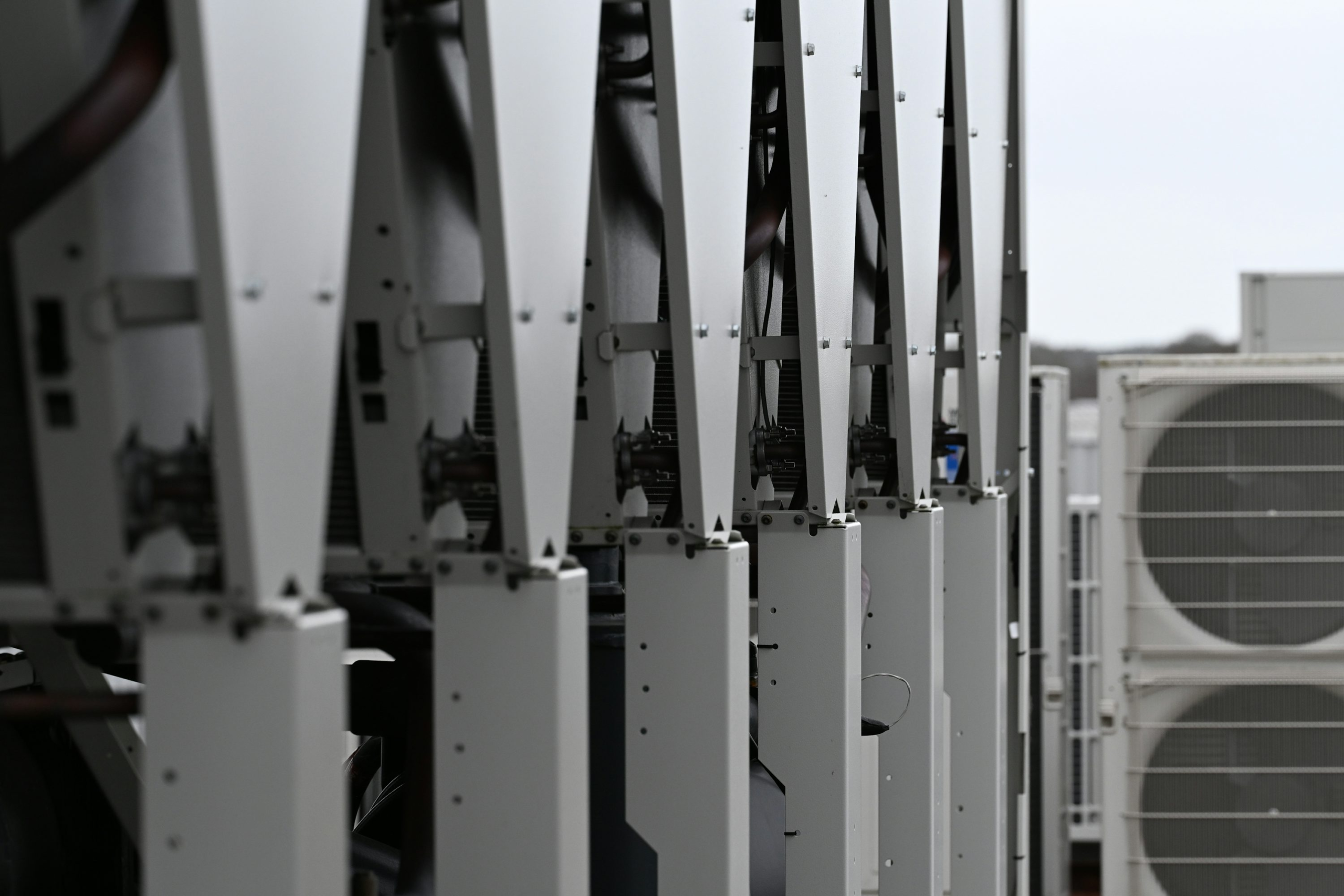
The agreement includes LG’s air-cooled centrifugal chiller designed for AI data centres. The product uses an oil-free magnetic-bearing compressor and refrigerant free cooling, which allows outdoor conditions to reduce the compressor load when temperatures are suitable.
LG says an internal simulation found that refrigerant free cooling could use about 30% less annual energy than the waterside free-cooling case it modelled. The comparison was based on one 1,750kW unit at full cooling capacity under Seoul metropolitan climate conditions, and the company states that actual consumption will vary with installation and operation.
That qualification is important because annual chiller efficiency cannot be reduced to one percentage across every data centre. Weather, supply temperatures, load factor, pump energy and the number of hours available for economiser operation all affect the result.
Higher rack density extends the cooling chain
AI infrastructure is also increasing the use of liquid cooling near processors. That does not make the central chiller unnecessary in every design; it changes the route by which heat moves from the chip to the outside environment.
A direct-to-chip system can transfer processor heat into a liquid loop, a coolant distribution unit can separate the technology loop from the facility loop, and chillers or dry coolers can then reject the heat outside the building. Each stage adds pumps, controls, heat exchangers and redundancy requirements that have to be sized for the final thermal load.
LG has been expanding manufacturing around that market. On 1 October the company announced a new chiller production facility in Virginia and increased production in South Korea, while its first-half 2026 orders for data centre cooling solutions exceeded $428m according to its 5 October announcement.
The AIR agreement gives that manufacturing expansion a visible demand channel. Large, multi-year commitments can justify capacity investment that would be harder to support through isolated project tenders, while buyers gain earlier access to production slots for equipment that can become a long lead item.
The same dynamic is relevant in Europe even where the specific LG equipment or AIR delivery model is not used. Data centre developers increasingly reserve transformers, switchgear, generators and cooling equipment early because a delayed mechanical package can prevent an otherwise powered building from accepting high-density IT load.
Cooling capacity also has to track the customer ramp rather than the ultimate campus headline. Installing every chiller years before the server halls fill can waste capital, while providing too little leaves connected electrical capacity unusable. Modular equipment and phased procurement are therefore becoming part of the commercial design as well as the engineering design.
LG and AIR have not disclosed the contract value or the amount of equipment committed for each year, so the 5GW figure should remain an envelope for the projects supported by the programme. It nevertheless demonstrates that thermal infrastructure is being purchased on a scale comparable with other strategic data centre components.
The European comparison is less about importing a North American chiller specification and more about the supply chain behaviour behind it. Cooling is moving from a building services package procured late in construction towards a capacity that large developers secure across portfolios well before the corresponding servers arrive.

