
Summary
- RETN has introduced a London–Brussels spectrum route outside the established paths through Amsterdam and Paris.
- The service uses new dark fibre between Rotterdam and Brussels and a separate landing arrangement from RETN’s existing CrossChannel route.
- Resilience depends on physical separation across ducts, landing points, buildings, power systems, active equipment, and customer premises.
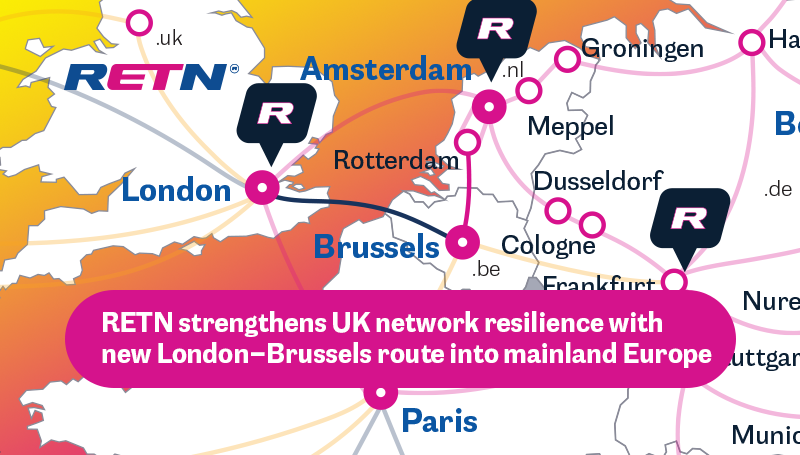
RETN has opened a London–Brussels optical route that avoids the established paths through Amsterdam and Paris, adding another physical option between the UK and mainland Europe.
The service uses newly built dark fibre between Rotterdam and Brussels and extends RETN’s dense wavelength-division multiplexing network into Belgium. On the UK side, the route leaves London away from the heavily used Docklands corridor.
A separate continental landing point distinguishes it from RETN’s existing CrossChannel route from Slough. The company’s route description presents the two services as a protected pairing for traffic moving between London, Belgium, and neighbouring European data centre markets.
Diversity must survive the whole journey
Two coloured lines on a network map can still share a duct, bridge, landing station, exchange building, power supply, or metropolitan entry point. End-to-end resilience depends on separation across the civil route, active optical equipment, regeneration sites, points of presence, building entries, and the customer’s own network.
Avoiding Docklands reduces exposure to one of London’s densest concentrations of carrier infrastructure. The area provides extensive connectivity, but the same density increases the number of services that may depend on common ducts, utility routes, access points, and operational teams.
Control of dark fibre between Rotterdam and Brussels gives RETN greater influence over capacity, maintenance, and fault localisation than a service assembled entirely from wavelengths supplied by other carriers. Cable damage, equipment faults, software errors, power incidents, and planned works remain capable of interrupting the path.
Landing-point diversity carries similar qualifications. Separate shore entries reduce exposure to a single coastal incident, although routes may still converge farther inland or inside a metropolitan network. Customers seeking protected services need detailed route records rather than relying solely on different product names.
Active optical equipment adds another dependency. Amplifiers and regeneration sites require resilient power, battery autonomy, monitoring, spares, and maintenance access, so a geographically separated cable can still fail if its powered components share weak supporting infrastructure.
Brussels gains another direct connection
European data centre traffic is growing between London, Paris, Amsterdam, Frankfurt, Brussels, and regional clusters as cloud, storage, content delivery, and AI systems spread across multiple facilities. Higher-capacity workloads increase the amount of east–west traffic between compute, data stores, cloud on-ramps, and customer networks.
Brussels has often sat behind Amsterdam, Paris, and Frankfurt in interconnection rankings, despite its concentration of public institutions, regulated organisations, enterprises, and cross-border networks. A more direct route can reduce dependence on detours through larger neighbouring hubs while improving options for Belgian data centres serving UK-linked customers.
The pairing with RETN’s existing Slough-based service offers a clearer resilience proposition than a single new cable. Its value will depend on where the paths converge at carrier hotels, customer sites, meet-me rooms, and downstream networks.
Building entries commonly undermine wider route design. Two continental systems can reach the same facility through one duct bank or meet inside a single communications room, leaving the last few hundred metres as the common failure point.
Customers will also need to examine restoration arrangements. Physical diversity reduces the chance of one event cutting both services, while rapid recovery still depends on spare equipment, field teams, traffic engineering, and contractual priorities during a wider network incident.
The additional route broadens the available paths between the UK and Benelux markets. Its resilience cannot be judged from geography alone, but the separate fibre, landing arrangement, and London approach provide the basis for a design that avoids some of Europe’s most heavily used corridors.

