
Summary
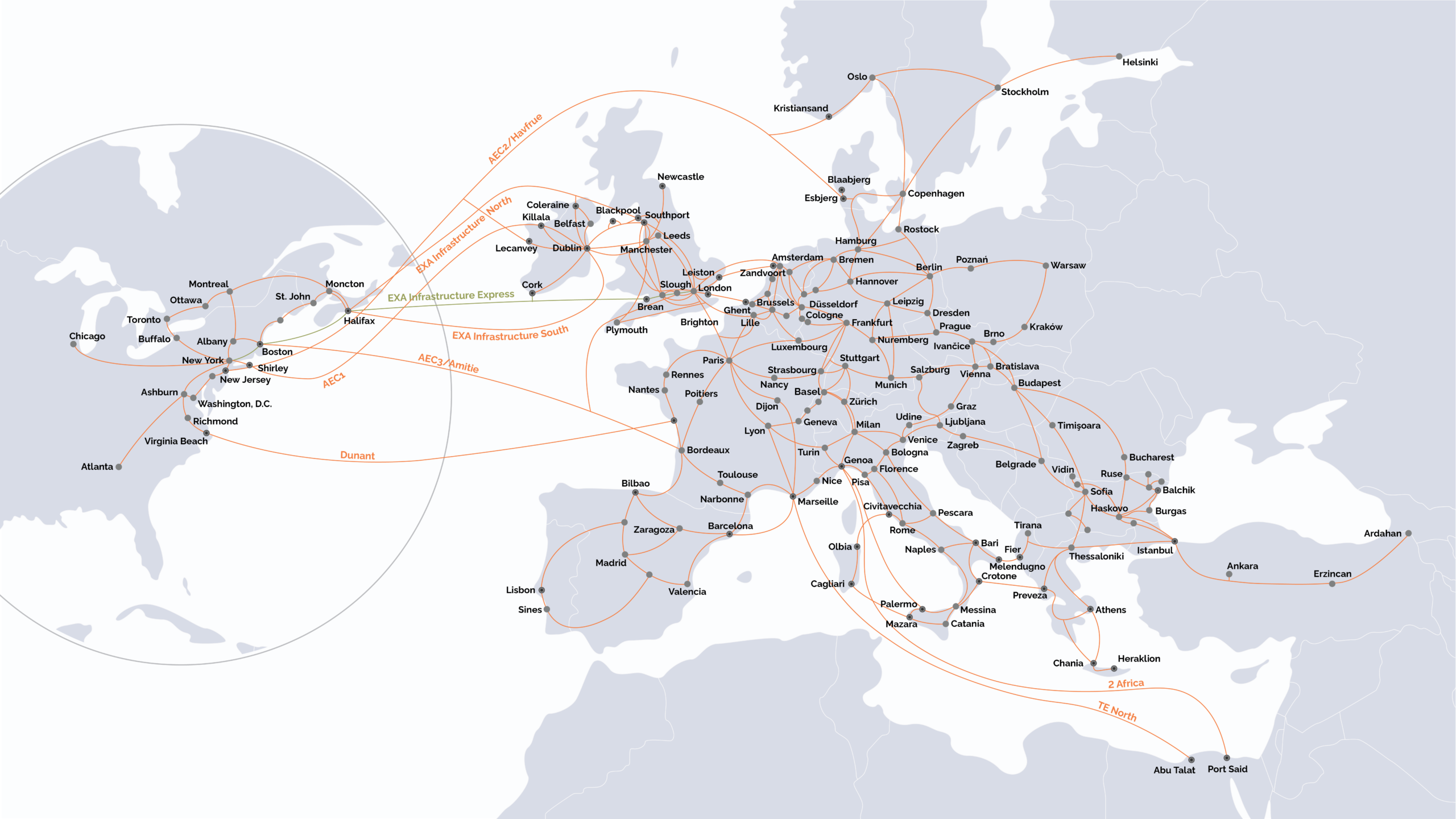
- The completed Milan–Zurich section measures 335km.
- It closes EXA’s approximately 1,050km Frankfurt–Zurich–Milan–Genoa corridor.
- Paris–Vienna expands a longer London-to-Balkans terrestrial route.
EXA Infrastructure has completed two high-capacity terrestrial fibre routes linking Milan with Zurich and Paris with Vienna, adding new owned network paths across European data centre markets. The company announced completion on 13 October, distinguishing the work from future route plans or a memorandum covering possible construction.
The 335km Milan–Zurich section closes a longer Frankfurt–Zurich–Milan–Genoa corridor of approximately 1,050km. The other completed connection extends EXA’s route between London and the Balkans, with Paris and Vienna as important points in the wider network. The route lengths describe cable corridors, not a guarantee of end-to-end latency for every customer service.
Linking inland campuses and subsea capacity
Genoa’s role in the first corridor is particularly relevant to operators moving traffic between Mediterranean subsea systems and European inland computing hubs. A route that reaches a landing ecosystem without depending on a single established inland path can expand procurement options for cloud, content and wholesale network customers.
The company says both links use low-loss G.652.D optical fibre, a conventional single-mode specification with well understood transmission behaviour. EXA is offering dark fibre, optical spectrum and managed wavelength services. Those are distinct commercial products: a dark-fibre customer operates its own transmission electronics, while spectrum and wavelength arrangements allocate different levels of the optical transport system to the customer.
Capacity available on any particular connection will depend on the equipment installed, available fibre pairs, optical engineering and the purchased service. EXA has not supplied a single new total throughput figure covering both routes. Describing the corridors as capable of supporting rising AI and cloud traffic therefore should not be read as a disclosed volume of contracted data centre demand.
Long-haul transport needs physical diversity as well as bandwidth. A second route may make it possible to separate two services geographically, but true resilience depends on shared bridges, ducts, exchange facilities and other common points of failure. Network operators will need route-level information when assessing protection designs instead of relying on two nominally different endpoint pairs.
Additional route choice could affect how operators distribute workloads between facilities. Operators can build inter-site connectivity with a wider selection of routes and service providers, although application latency is still affected by distance, routing, switching and the customer’s architecture. Remote replication, backup traffic and some distributed compute functions have different tolerance for delay and packet loss.
The corridor announcement does not specify whether every fibre pair along each section is newly installed or whether some route segments reuse existing assets. It also leaves unanswered how the company will manage faults across borders, where repair access, permits and spare-cable arrangements can vary. Service customers assessing resilience can ask for maps, splice locations, restoration commitments and independently verifiable route separation. Those operational details may be more useful than a single headline distance when assessing a multi-site architecture.
EXA’s announcement confirms that the underlying terrestrial infrastructure has been completed and is being offered commercially. It does not state that a particular data centre customer has switched live traffic onto either corridor, nor does it prove that all advertised commercial services have already been commissioned at every intermediate location.

