
Summary
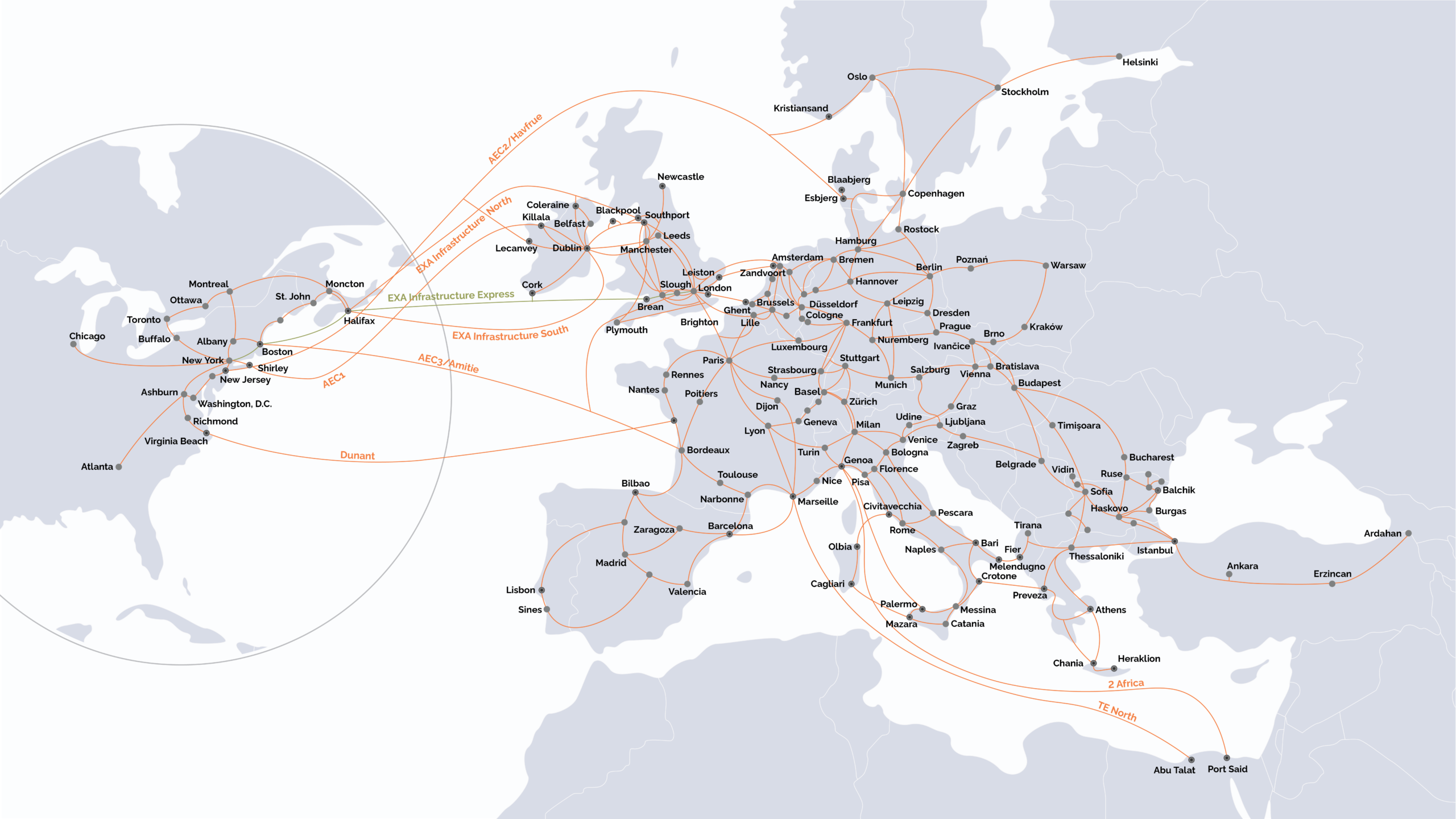
- EXA's new terrestrial route links Barcelona and Bilbao and also serves Zaragoza.
- The company says the route can reduce cross-Spain latency by 52%.
- The additional physical path is intended to reduce single points of failure between Mediterranean and Atlantic networks.
EXA Infrastructure has added a terrestrial fibre route linking Barcelona and Bilbao via Zaragoza to its live European network, providing another physical path between Mediterranean subsea systems and Atlantic connectivity.
EXA says the route shortens the path across Spain enough to reduce latency by 52%, while giving traffic landing in Barcelona a more direct route towards cable systems on the Atlantic side of the Iberian Peninsula.
The corridor itself has been part of EXA’s longer-term Spanish network plans for several years. The company previously identified the roughly 600km Barcelona–Zaragoza–Bilbao route as a planned investment, making the 2026 development the addition of that corridor to the operating network rather than the creation of a wholly new route concept.
The additional path is relevant to data centre resilience because network diversity depends on more than buying services from different carriers. If supposedly separate services ultimately share the same physical ducts or long-haul routes, a civil-engineering incident or fibre cut can still remove both paths.
A Barcelona–Bilbao connection gives operators and network customers another geographical route across the country, while Zaragoza provides a midpoint in a region that is attracting hyperscale and AI infrastructure development.
EXA says it already connects eight major data centres across Catalonia through a combination of its own fibre and presence inside facilities. Extending that footprint towards Bilbao links those sites more directly with Atlantic systems and creates an end-to-end route for traffic travelling between North America, Europe and markets further east and south.
The change is particularly relevant for large data centre clusters because connectivity requirements grow alongside compute capacity. A hyperscale campus may have adequate grid power and cooling but still needs resilient routes into cloud regions, internet exchanges, subsea landing stations and customer networks.
Route length also affects latency. The difference may be small for individual applications, but large cloud and AI platforms design networks around predictable performance at scale, particularly where datasets, model workloads or user traffic move between geographically separated sites.
Physical route diversity is equally important for operational resilience. The value of the Bilbao corridor will therefore depend not only on headline latency but on how independently it is engineered from existing Spanish routes, where it intersects other networks and how customers combine it with alternative paths.
EXA operates terrestrial and subsea fibre infrastructure as well as colocation sites across Europe and North America. Its network strategy is centred on high-capacity routes used by hyperscale platforms, which makes the growth of Spanish data centre clusters a natural driver for additional east-west capacity.
Barcelona is already an important Mediterranean cable-landing location, while Bilbao provides access towards the Atlantic. Connecting those two points more directly turns Iberia into more than an endpoint: it can also function as a transit corridor between subsea systems arriving on opposite coasts.
For data centre developers, the route adds another piece of enabling infrastructure rather than adding compute capacity itself. Grid connection and construction may determine whether a campus can be built, but redundant fibre routes determine how reliably that capacity can connect to the wider digital economy once it is operational.

