
Summary
- Landkreis Emsland is building a new data centre and office facility at the Meppen district administration site.
- The project includes UPS, backup generation, access controls, fire protection, and dedicated cooling.
- The municipal scheme shows resilience requirements reaching local public-sector digital infrastructure.
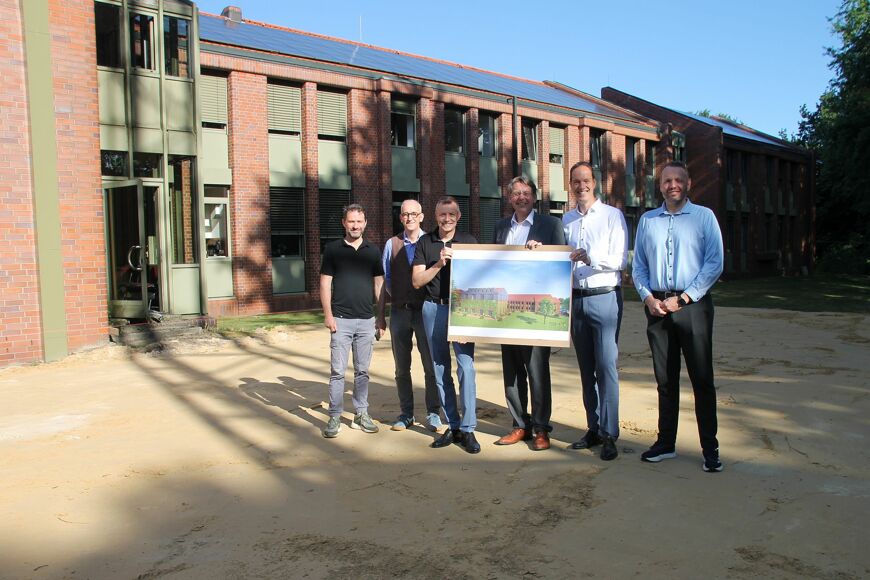
Landkreis Emsland has started construction of a new municipal data centre and office building at the Meppen district administration site, with the project designed to strengthen local government IT resilience under German critical infrastructure expectations.
The building is being developed behind the existing Kreishaus, which opened in December 1984 and now houses much of the district’s IT infrastructure. Landkreis Emsland says the site is classed as critical infrastructure because disruption could affect public safety and essential services.
The project has a total expected cost of about €3.4m, split between approximately €2.24m for the data centre and office building and around €1.2m for technical equipment. Construction began in mid-June and completion is scheduled for the end of 2027.
Resilience before scale
The facility is not a hyperscale or colocation project. Its importance sits in the operating standards being applied to public-sector digital infrastructure. The building will have a footprint of more than 656 square metres across three floors, with offices on two levels and the data centre on one level. The façade is expected to be partially greened.
Technical measures include a modern fire protection concept, a new cable and line network, dedicated access controls, and a power resilience strategy. The district says the facility will include an uninterruptible power supply and a 450kVA emergency generator, replacing the previous system and supporting higher availability.
Cooling will use side coolers and free coolers to remove heat from the IT equipment and maintain stable operating conditions. Access to the secured area will be monitored using two-factor authentication.
Those choices show how resilience design moves quickly from policy language into plant, cabling, controls, and building layout. Backup power, cooling, access systems, and fire protection are not secondary to digital continuity; they are the conditions that allow digital services to remain available during physical disruption.
Critical infrastructure reaches municipal sites
The Meppen project shows the resilience discussion moving beyond national cloud regions and hyperscale campuses. Local government operations depend on data, networks, storage, applications, and secure access to records. Those systems must remain available through power disruption, cyber incidents, physical damage, extreme weather, or failure of ageing building services.
Germany’s critical infrastructure debate has historically focused on sectors such as energy, transport, health, water, finance, and public administration. As public services digitise, the facilities supporting municipal IT become part of the continuity chain. An ageing server room inside a decades-old administrative building can become a material operational risk, even if the software stack has been modernised.
The decision to build a dedicated facility reflects a wider shift in how public authorities assess digital resilience. Cybersecurity cannot be separated from physical security, power quality, cooling reliability, cable routing, and the ability to maintain systems during an incident. A compromised building can undermine a well-secured application environment.
The availability target cited by the district, Verfügbarkeitsklasse 2, points to a defined reliability framework rather than a general office extension. That increases capital cost, but it also reduces exposure to public-service interruption caused by facility-level failure.
The broader data centre sector is already seeing the same direction of travel. Critical infrastructure status, NIS2 implementation, operational continuity requirements, and cyber-physical risk are pulling smaller and public-sector sites into a more demanding resilience regime.
The Meppen data centre will not add commercial capacity. It will harden the local authority’s own digital base, replacing fragmented and ageing infrastructure with a controlled environment built around power, cooling, access, and fire resilience. As public bodies review their IT estates, similar municipal projects are likely to follow.

