
Summary
- The 20kW reference design uses two 10kW modules to convert an 800V DC rack bus directly to a fixed 6V server rail.
- Microchip supplies digital control and a hardware root of trust, while Navitas supplies 650V GaN switching devices.
- The joint reference design targets 96% efficiency at approximately 1MHz; Navitas’s earlier standalone 800V-to-6V board carried a separate 97.5% peak efficiency target.
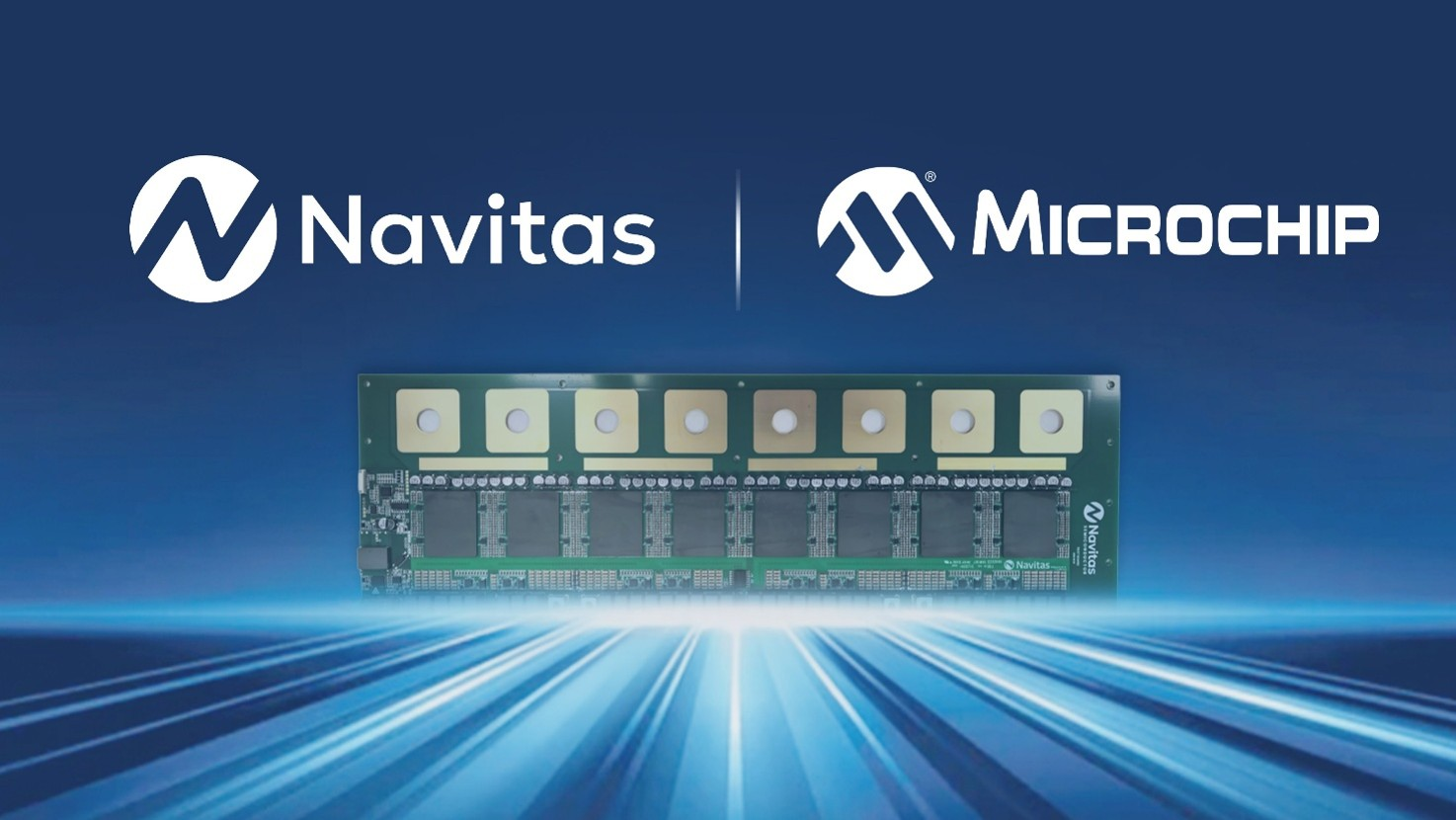
Microchip Technology and Navitas Semiconductor have released a 20kW reference design that converts an 800V DC rack bus directly to a fixed 6V server rail, combining gallium nitride switching, digital power control and a hardware root of trust in one development platform.
The new element is the implementation rather than the broader move towards 800V distribution. DataCentral covered QPT’s separate 800V-to-6V converter on 1 October, so the Microchip and Navitas design should be assessed as a specific reference architecture for power-supply developers rather than another generic account of the same industry transition.
Microchip’s product documentation says the platform uses two 10kW modules in an input-series, output-parallel configuration with a 128:1 full-bridge LLC topology. The company gives a target efficiency of 96% at approximately 1MHz and a board size of 400 by 60 by 6mm, with planar transformers and single-side liquid cooling supporting the compact form factor.
Navitas supplies NV6034 650V GaN devices for the power stage. The semiconductor company’s earlier standalone 20kW 800V-to-6V power delivery board was presented with a separate target of up to 97.5% peak efficiency at full load and 1MHz. That earlier figure belongs to a different published implementation and should not be substituted for the 96% target stated on the new joint Microchip reference design.
The reference platform packages more than the converter
Microchip’s dsPIC33AK256MPS306 digital signal controller manages resonant control, telemetry, thermal protection, PMBus and SPDM communication and live firmware updates. The controller therefore sits inside the power system as both a real-time control device and a communications endpoint.
That role explains why the design also incorporates Microchip’s TA100 CryptoAuthentication device. The security component provides a hardware root of trust, secure boot, authenticated firmware updates, secure debug and other cryptographic functions intended to reduce the risk of unauthorised code running on the controller.
Power electronics have traditionally been discussed mainly through efficiency, switching frequency and thermal performance. Digitally managed rack power changes that boundary because firmware updates and networked telemetry introduce software integrity into the availability model. A compromised or corrupted controller can affect a power stage even when the switching hardware itself remains healthy.
The TA100 does not secure the entire rack or the data centre. Its narrower function is to give the power controller a trusted mechanism for authenticating code and updates. Microchip also lists support for post-quantum-ready cryptography in the reference platform, while the supplied release says its software libraries support algorithms recommended under CNSA Suite 2.0.
The electrical architecture addresses a different constraint. Distributing power at 800V reduces current for a given power level compared with lower-voltage rack buses, allowing conductors and copper requirements to be reduced. The voltage still has to be stepped down near the computing equipment, so converter efficiency, volume and heat rejection become critical as rack power rises.
Higher frequency reduces size but raises design demands
Operating around 1MHz allows magnetic components to shrink, helping the converter fit closer to the server or GPU board. Higher switching frequency can also increase switching losses and electromagnetic design complexity, which is one reason GaN devices are being used in this class of converter.
Navitas describes the NV6034 as a 650V, 17mΩ GaNFast device in a dual-side-cooled package. The supplied release says 16 of the devices are used on the primary side. The reference design’s liquid-cooled board and compact profile show how power conversion and thermal engineering are being pushed into the same limited rack space as the computing hardware.
A reference design is not the same as a production power supply or a deployed rack architecture. It gives manufacturers working hardware, control software, models and documentation that can reduce development effort, but suppliers still have to qualify their own products and integrate them with the wider rack, protection and facility design.
Microchip lists PLECS models and controller-hardware-in-the-loop support as part of the development package. Those tools allow engineers to test control behaviour and integration before committing every iteration to physical hardware, which is particularly useful when power stages operate at high voltage and high switching frequency.
The companies plan to showcase the design at the OCP Global Summit in San Jose from 12 to 15 October. The next meaningful milestone will be adoption by power-supply or rack manufacturers rather than the demonstration itself.
Direct 800V-to-6V conversion is now attracting several engineering approaches, and DataCentral has already covered one of them. Microchip and Navitas add a reference platform distinguished by the combination of a 20kW converter, digital control, communications and hardware security. Its 96% target should remain attached to this design, while Navitas’s previously stated 97.5% figure should remain attached to the earlier standalone board from which it came.

