
Summary
- The new Switchtec device supports up to 64 PCIe Gen 6 lanes and 32 ports.
- Flashtec NVMe controller updates include CNSA 2.0 security support and redundant data paths.
- SmartRAID 4300 changes add security, management and resilience options; prices and availability vary.
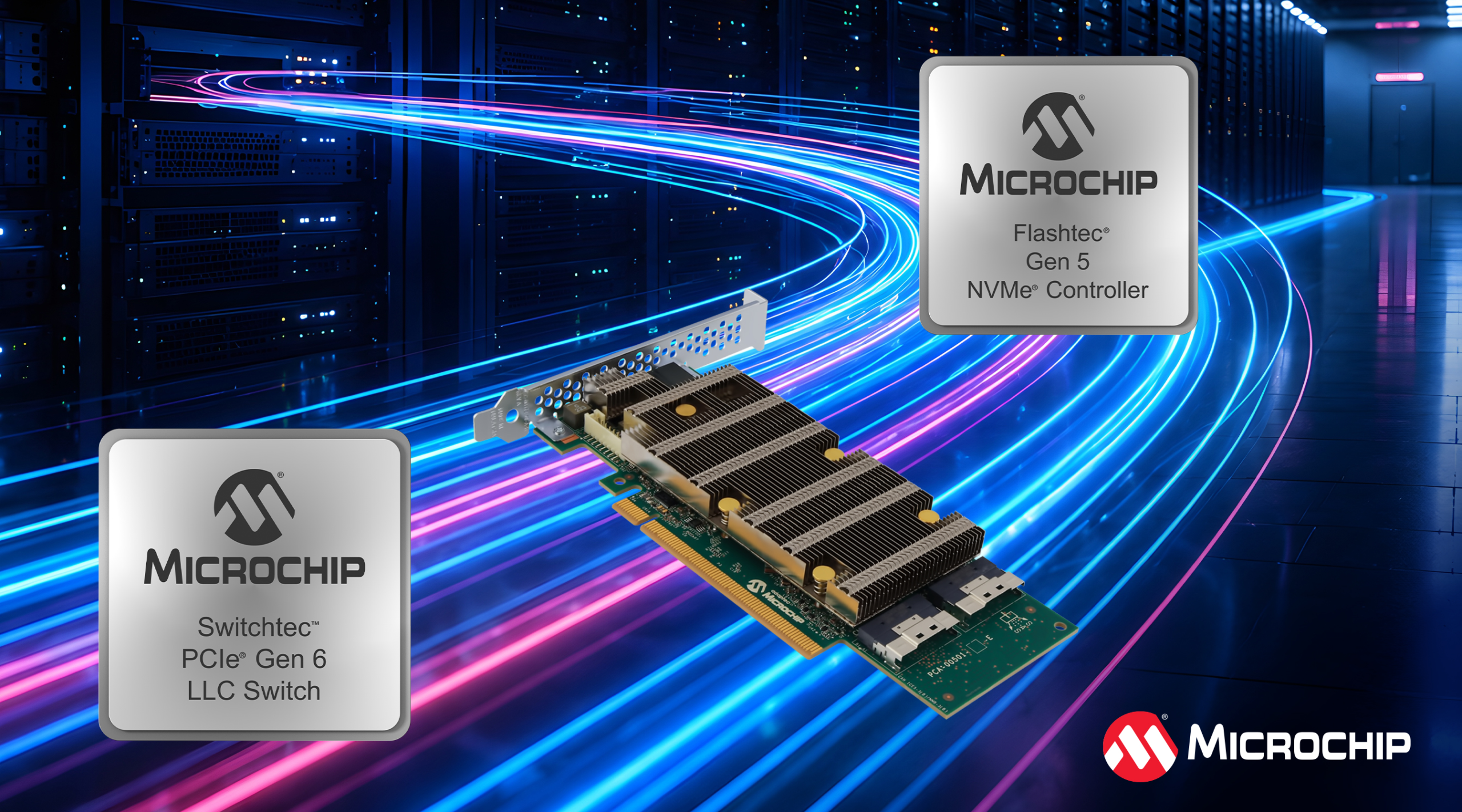
Microchip Technology has expanded its data centre component portfolio with a smaller PCIe Gen 6 switch, updated SSD controller functions and additional NVMe RAID capabilities. Its Switchtec low-lane-count device supports up to 64 PCIe Gen 6 lanes and 32 ports, with configurable bifurcation. The announcement is dated 12 October and concerns hardware design options for servers and storage systems rather than a new data centre opening.
PCIe switching provides paths between processors, storage and accelerators. As server platforms integrate more fast devices, a design can be limited by lane allocation, board area and electrical power consumption. A switch with flexible x2, x4, x8 and x16 configurations enables the manufacturer to divide available connectivity according to the installed components. Microchip also includes direct memory access and peer-to-peer data movement capabilities intended to reduce the need for host CPU involvement in some transfers.
The company says its updated Flashtec NVMe 5016 controller supports security features associated with the Commercial National Security Algorithm Suite 2.0. Such functionality is relevant to long-lived infrastructure procurement, particularly when customers evaluate how storage hardware protects data over time. A controller feature does not by itself guarantee that a full deployed system meets any specific regulation or cryptographic migration deadline; firmware configuration, key management and the rest of the storage architecture are equally important.
Dual-port capability gives storage designers options for redundant data paths, which can help protect access when one connection or controller path fails. Its usefulness depends on how the host, switch fabric and failover software are built. A dual-port SSD installed into a system without a properly configured alternative path would not deliver the same availability benefit. The release also describes management and quality-of-service functions designed to share storage resources across demanding workloads.
Microchip has expanded the Adaptec SmartRAID 4300 family with RAID 6 and RAID 60 support, self-encrypting drive management and tools for in-service configuration. These changes can make it easier to recover from certain disk or path faults and reduce operational intervention. Redundant layouts still incur overhead in usable storage space, rebuild time and controller processing, so the choice must reflect application requirements rather than a single vendor's capability list.
Other changes include persistent event logging, peer-to-peer rebuild support and interfaces for integration with management tools. Those features address a practical operating problem: diagnosis and maintenance can disrupt storage service if the system lacks visibility or if a rebuild consumes resources needed by production workloads. Their real value will be established by testing under simulated faults, heavy traffic and recovery conditions.
The low-lane-count positioning is relevant to designers building more varied server forms. Not every application needs the highest port-count PCIe switch, particularly when board space or power is restricted. Providing Gen 6 connectivity in a smaller component could make advanced devices accessible to edge and appliance systems as well as large servers. That said, lane flexibility creates configuration complexity, and the chosen topology still needs verification of throughput, latency and error recovery with the actual attached hardware.
Cryptographic readiness in storage requires a wider system decision than choosing one compatible controller. Keys must be generated, protected, rotated and retired, while firmware and management software must use the controller's capabilities correctly. A specification supporting CNSA 2.0 does not mean an organisation has completed its post-quantum migration. Buyers should review certified implementations, algorithms, interoperability and the lifecycle of data retained on the drives before attributing a compliance outcome to the hardware.
RAID resilience also has clear boundaries. RAID 6 and RAID 60 can preserve availability during certain drive failures, but they are not backups and do not prevent data loss from all logical or security incidents. Rebuild operations themselves create load and may encounter additional errors. Event logs and peer-to-peer rebuilding can aid operations, but the design should be evaluated through controlled failure tests and realistic maintenance procedures. Microchip has announced added capabilities rather than measured recovery improvements in a named customer deployment.
The company says pricing and availability vary by device, leaving procurement dates to be confirmed individually. The October release is separate from its earlier 800V power reference design and from existing PCIe retimer developments. Server builders can now evaluate this latest switching and storage combination, but performance, security compliance and downtime reduction still depend on completed system design and testing.

