
Summary
- MU4.3 has reached topping out, allowing internal mechanical, electrical, controls, and data hall work to advance.
- The development expands an operating Equinix campus through a phased construction and fit out programme.
- Live site interfaces, equipment lead times, commissioning, and compatibility with existing systems now dominate delivery risk.
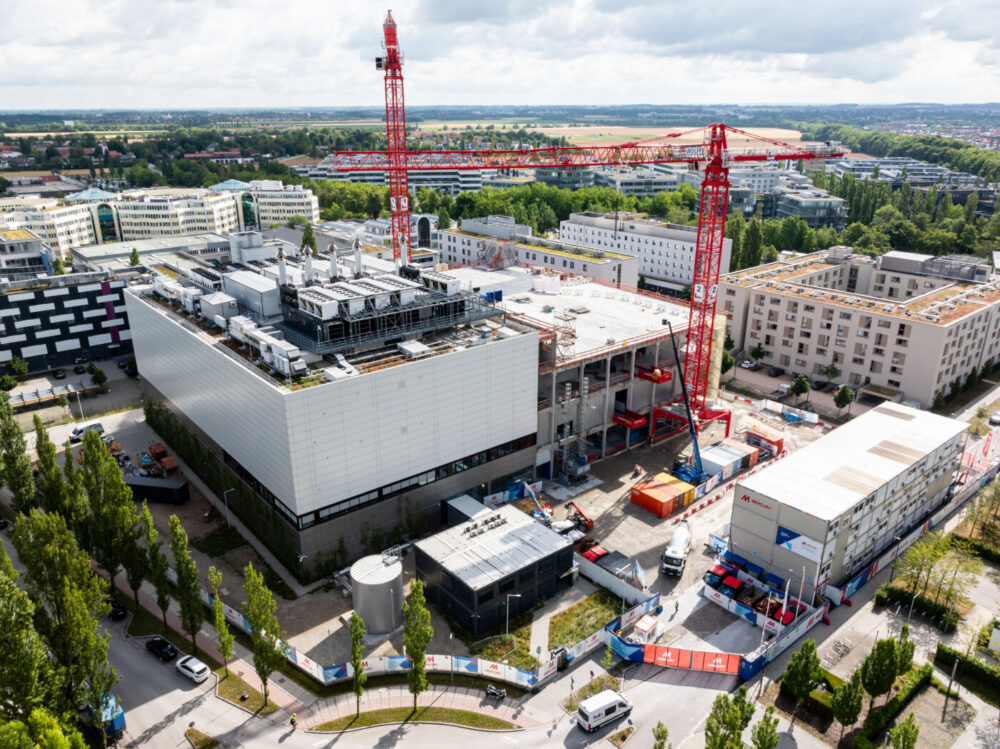
Equinix and main contractor Mercury have completed the main structure and roof of the MU4.3 data centre expansion in Aschheim, moving the Munich project from structural construction into internal fit out.
The building is being delivered as a phased extension of an operating Equinix campus, which requires construction teams to work around live electrical, mechanical, network, security, and customer systems. Mercury is responsible for the full construction scope and for coordinating the new work with existing assets.
Earlier MU4 phases opened in 2022 and 2024, initially providing about 950 racks and later adding another 750. Published facility information indicates that the wider owned campus is expected to provide 13,608 square metres across four storeys and space for a further 2,950 racks when fully developed.
MU4 complements Equinix’s leased MU1 and MU3 sites in the Munich market. The Aschheim campus gives the operator a larger owned platform through which new capacity can be released in stages rather than fitting out an entire masterplan before customer demand is secured.
The critical work now moves inside
Topping out closes a visible part of the programme, although most of the systems determining availability and efficiency have yet to be installed or fully integrated. Switchgear, transformers, UPS equipment, generators, cooling plant, pumps, controls, fire systems, busway, containment, and network infrastructure must all pass through installation and commissioning.
Each discipline competes for routes and access. Electrical busway, fibre containment, cooling pipework, fire services, and structural supports cannot occupy the same space, while maintenance clearances must remain usable after every system is installed.
Phased construction adds boundaries between old and new equipment. Different generations of controls, switchgear, monitoring, and cooling plant may need to operate together, creating interfaces that must be documented and tested rather than left to assumptions made during design.
Work on a live site also demands stricter control of dust, vibration, temporary power, lifting, access, and switching. A construction activity that would be routine in an empty shell can carry operational consequences when it takes place beside contracted customer capacity.
Mercury says the project includes a whole life carbon focus, with structural design, material selection, and coordination decisions intended to reduce embodied impact and support efficient operation. The eventual outcome will depend on material quantities, equipment choices, fit out density, operating load, and the energy performance achieved after handover.
Secondary markets inherit primary constraints
Munich is smaller than Frankfurt as a colocation market, but it serves demand from manufacturing, automotive, cloud, financial, research, and enterprise customers across southern Germany. Locating workloads closer to users and industrial operations can also reduce the need to place every German deployment in the Frankfurt region.
Power availability, equipment lead times, and skilled labour remain limiting factors regardless of market size. A structurally complete building cannot accept customer equipment until the utility connection, high voltage plant, cooling systems, and integrated controls are ready.
AI deployments create additional design pressure because rack densities and cooling requirements may rise during a project’s development. Even when the current phase is based mainly on air cooling, future adaptation may require space for coolant distribution units, treatment systems, larger pipework, heavier floor loads, and expanded heat rejection.
Those provisions have to be balanced against immediate capital efficiency. Installing unused plant too early ties up money, while leaving insufficient routes or structural allowance can make later conversion disruptive and expensive.
Procurement remains concentrated around equipment with long manufacturing periods, particularly transformers, switchgear, generators, and large cooling components. Structural completion provides weather protection and access for installation but cannot recover time lost before equipment reaches site.
The commissioning sequence will determine when MU4.3 becomes operational capacity. Factory testing, functional checks, integrated systems tests, failure simulations, and staged energisation must show that redundancy survives realistic faults and that the expansion does not introduce new common points of failure across the campus.
Once those tests are complete, Equinix can release the additional space in line with customer commitments. Until then, the project remains an operating campus under construction, with delivery governed by interfaces between people, equipment, controls, and live infrastructure rather than by the concrete shell now standing in Aschheim.

