
Summary
- The new architecture combines direct expansion cooling, dry condensers, variable speed compressors, and coordinated controls.
- Independent refrigerant circuits retain half of available cooling after a circuit loss, with automatic restart in under 40 seconds.
- The installation replaced critical thermal plant inside a live sovereign hosting facility without interrupting customer services.
NFrance has completed a cooling infrastructure replacement at its sovereign data centre in Toulouse, reporting an approximately 20% reduction in cooling power consumption and no operational water use from the new heat rejection system.
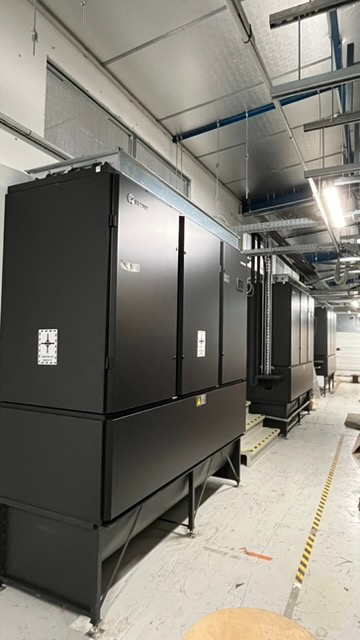
The French hosting, colocation, and managed services provider carried out the work with Vertiv while customer systems remained online. Existing thermal plant was replaced with an integrated direct expansion architecture designed to vary its output as the IT load changes.
Liebert PDX room cooling units use variable speed scroll compressors capable of modulating between 25% and 100% of output. Heat is rejected through Liebert HPA-HCR dry condensers fitted with electronically commutated fans, removing the evaporative water demand associated with cooling towers and other wetted systems.
Vertiv’s iCOM controls coordinate the installed units as one system rather than allowing each machine to respond independently. The controls are intended to reduce conflicting operation, limit unnecessary compressor and fan use, and maintain stable conditions as heat loads shift across the room.
Resilience extends beyond the unit count
The cooling architecture uses two refrigerant circuits with independent condensers and N+1 redundancy. NFrance says that the loss of one circuit leaves as much as half of the available cooling capacity in operation, while automatic restart logic can restore the affected system in less than 40 seconds.
A redundant unit count provides limited protection when plant shares refrigerant pipework, controls, electrical distribution, or heat rejection equipment. Separating the circuits and condensers reduces the size of the failure domain and gives the remaining equipment a clearer route to carry part of the load.
Control behaviour during the fault is equally important. Temperatures can rise quickly inside a loaded room, particularly where racks operate close to the upper limit of an air cooled design. Automatic response reduces reliance on manual intervention during the first minutes of an incident.
NFrance reports server availability of 99.99% and has set a PUE target of 1.3 for 2026, with consolidated data expected during 2027. The 20% figure applies to cooling power rather than total facility consumption, so seasonal measurements and changing IT load will determine the long term effect on site PUE.
The service arrangement includes continuous technical support, an eight hour on site intervention target, and a stock of critical spare parts intended to reduce restoration time after a fault. Vertiv’s project case study sets out the equipment, controls, commissioning, and maintenance measures used at the site.
The changeover carried the greatest immediate risk
Installing cooling equipment in an empty building is largely a construction problem, whereas replacing it around live customer workloads is an operational one. Temporary capacity, isolation, electrical work, controls integration, testing, and final changeover all have to be coordinated without removing the thermal conditions supporting the IT load.
The transition can expose a facility more than the completed design. Old and new plant may operate in parallel for a limited period, temporary hoses or power supplies may be required, and commissioning work can introduce untested controls into the live environment.
A successful programme therefore depends on method statements, staged isolation, monitoring, rollback procedures, and authority to stop work when conditions move outside agreed limits. The installation team must also account for external temperature and customer load, since the margin available for a changeover can vary sharply from one day to the next.
The project trades cooling water for a dry heat rejection system, reducing direct exposure to water availability and WUE reporting. Dry systems can require more electrical energy during warmer conditions, so their overall performance depends on condenser sizing, compressor efficiency, control logic, ambient temperature, and the environmental conditions maintained in the data hall.
Direct expansion remains practical for many existing enterprise and colocation rooms, even as higher rack densities push parts of the market towards direct liquid cooling. A future liquid cooled zone would still leave other loads, network rooms, storage, and support spaces requiring controlled air temperatures.
Sovereign hosting introduces little tolerance for disruption. NFrance supports sensitive and regulated workloads whose customers expect continuity, security, and local control, making a planned cooling outage difficult to accommodate even when the efficiency case is strong.
Metered results over a full year will show how the plant performs through seasonal changes and increasing compute demand. The completed project has already demonstrated a separate engineering outcome: critical thermal infrastructure can be replaced within a live facility while maintaining service and reducing both power and water exposure.

