
Summary
- NVIDIA's DSX reference designs combine closed-loop liquid cooling with dry coolers, with modelled water savings reaching 54 million litres daily at 2GW scale.
- DSX MaxLPS dynamically manages computing equipment within existing power budgets, with preliminary tests reporting greater throughput and managed GPU capacity.
- DSX Flex adjusts computing demand in response to grid conditions; a trial demonstrated load reductions during simulated events, not proven commercial grid connection savings.
NVIDIA has expanded its DSX data centre infrastructure framework with dry cooling designs and software intended to manage AI computing electricity demand, as European operators seek ways to accommodate more equipment within limited power and cooling resources.
The 21 October announcement at GTC Berlin covers three related engineering developments: cooling systems designed to minimise evaporative water consumption, dynamic allocation of electricity within computing clusters, and controls that adjust workloads in response to grid conditions.
NVIDIA is developing these capabilities through its DSX AI Factory Platform, which combines reference designs for computing, networking, electrical distribution, cooling, and facility management.
The latest developments concern how infrastructure performs once installed. They are separate from the company’s DSX POD architecture, which concentrates on factory integration and delivery of modular computing systems.
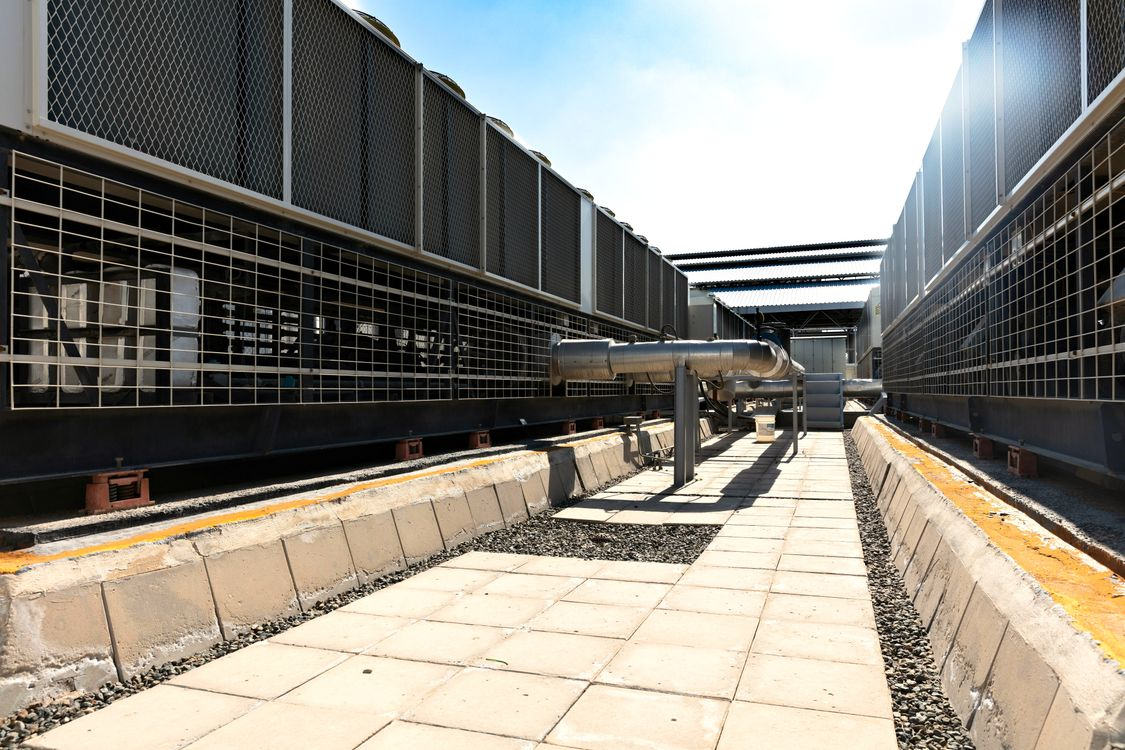
On cooling, NVIDIA has outlined a reference design using direct liquid cooling and outdoor dry coolers. Liquid circulating through computing equipment collects heat, which is then transferred through the cooling system and rejected into the surrounding air.
Dry coolers operate as large air-cooled heat exchangers. Unlike evaporative cooling towers, they do not normally need a continuous supply of replacement water to discharge heat, although pumps and fans still consume electricity.
The Vera Rubin computing architecture supports liquid cooling with coolant temperatures reaching 45°C. Higher coolant temperatures can make dry heat rejection practicable under a wider range of outdoor conditions, reducing the need for additional refrigeration equipment.
However, the suitability of this arrangement depends on local weather and the temperatures required by the installed computing equipment. NVIDIA acknowledges that supplemental mechanical cooling may be needed during the hottest periods.
The company estimates that its reference design could avoid 54 million litres of cooling water consumption each day at a hypothetical 2GW deployment, compared with a conventional cooling tower arrangement.
That estimate represents a modelled comparison at a specified scale. It is not a measured reduction at an operating European facility, and the actual result would depend on climate, equipment configuration, cooling operation, and the water consumption of the alternative system.
Reducing water consumption also requires consideration of electricity demand. A dry cooling system transfers heat into outdoor air using fans and heat exchangers, and its performance changes as the temperature difference between the coolant and ambient air narrows.
NVIDIA has therefore coupled its cooling designs with tools intended to improve the use of limited electrical capacity. DSX MaxLPS dynamically allocates power within an AI computing cluster rather than maintaining the same allowance for every processor regardless of its workload.
The software is designed to redistribute available power to equipment performing useful computation, while remaining within the installation’s provisioned electricity budget.
NVIDIA claims this can provide the same AI token output with up to 30% less power, or allow more work to be completed within an unchanged power allocation. That is a supplier performance claim whose applicability depends on the computing workload and configuration.
In a proof of concept using NVIDIA HGX B200 systems, cloud provider Lambda reported 24% greater cluster token throughput and 19% more GPU capacity within a fixed power budget.
Nscale separately evaluated MaxLPS at its AI facility in Iceland, using four NVIDIA GB300 NVL72 racks. NVIDIA reports 49% higher inference throughput and 37% more managed GPU capacity within the same provisioned 264kW power budget.
The tests were conducted in different environments and describe different performance measures. They do not establish that either facility reduced its total annual electricity consumption by the same percentage, since cooling, electrical distribution, and other supporting systems contribute to overall demand.
DSX Flex addresses another aspect of electricity management by adjusting computing workloads in response to network conditions, demand response requests, and energy prices. The system is intended to make some computing loads more flexible without necessarily interrupting every application.
In an early demonstration involving Emerald AI, EPRI, Nebius, the UK’s National Grid, and NVIDIA, a Blackwell Ultra GPU cluster reduced its power draw by up to 40% during simulated grid events while continuing workloads classified as critical.
The result demonstrates a technical response under trial conditions, rather than an approved electricity connection arrangement or verified performance across a large operating data centre. The amount of load that can be reduced depends on the applications being executed and their tolerance of changes in computing performance.
Batch processing and certain AI training tasks can offer different scheduling options from services with strict response time requirements. Operators therefore need to establish which workloads can be adjusted, how quickly power consumption changes, and whether service obligations remain satisfied.
Even where flexibility is demonstrated, the implications for grid access depend on the network operator’s technical requirements and the contractual arrangements governing maximum demand. Reducing load temporarily does not automatically release capacity for new development or eliminate reinforcement requirements.
NVIDIA is also extending its DSX simulation environment with models of electrical and thermal equipment supplied by engineering partners. These are intended to let design teams evaluate configurations before physical installation, although their usefulness depends on the accuracy of the models and operating assumptions.
Partners involved in the wider DSX programme include ABB, Eaton, Schneider Electric, Siemens, Trane Technologies, Vertiv, and several computing infrastructure operators.
The combination of cooling, power allocation, and grid response reflects a move towards coordinating facility engineering with the operation of computing equipment. Its practical performance will depend on the installed systems, local environmental conditions, workload characteristics, and electricity supply arrangements.
Further operating evidence will be needed to determine whether the modelled water savings, supplier efficiency claims, and simulated grid response results can be reproduced across commercial European data centres.

