
Summary
- Samsung is reportedly in discussions to acquire Modine, although no agreement or acquisition price has been confirmed.
- Modine reported 95% growth in quarterly data centre segment sales and has started producing large chillers at a new Texas facility.
- Samsung's completed acquisition of FläktGroup provides an existing European industrial HVAC business, but no integration with Modine has been agreed.
Samsung Electronics is reportedly considering an acquisition of US thermal management manufacturer Modine, a potential expansion of its data centre cooling business following last year’s purchase of European HVAC supplier FläktGroup.
The companies are in discussions about a possible transaction, according to Bloomberg, citing people familiar with the negotiations. No final decision has been made, an agreement could fail to materialise, and another interested buyer could emerge.
Reuters reported the discussions on 13 November but said it had not independently verified the information. Neither Samsung nor Modine has publicly confirmed an acquisition agreement, purchase price, or proposed completion timetable.
Modine shares rose approximately 29% in extended trading following the initial report. The company had an equity market value of around $5.6bn at the close of regular US trading on 12 November, according to market data cited by Reuters.
The reported interest follows substantial investment by both businesses in the equipment used to remove heat from large computing installations. Data centre cooling requirements are expanding as higher-density processors place greater demands on chillers, heat rejection systems, liquid cooling equipment, and controls.
Samsung completed its acquisition of FläktGroup on 6 November 2025, adding a European manufacturer of commercial and industrial ventilation, air handling, cooling, and related systems.
The company retained FläktGroup’s existing name, management, personnel, and facilities, with the business continuing to operate as an independent subsidiary. Samsung said it intended to expand research, production, and supply chain cooperation through the acquisition.
A separate purchase of Modine could bring additional manufacturing and thermal management capabilities into Samsung’s portfolio, although the commercial rationale and prospective integration arrangements have not been formally disclosed.
Modine expands cooling production
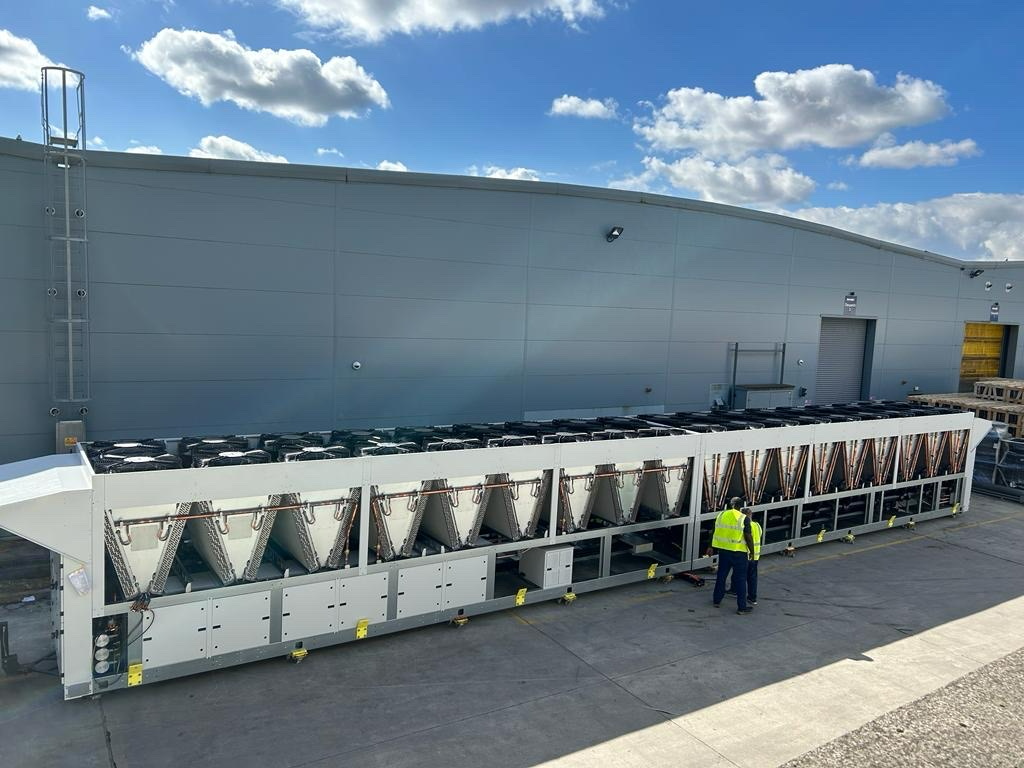
Modine manufactures thermal management equipment for data centres and other commercial and industrial applications. Its Airedale business supplies chillers, heat rejection systems, and equipment used in cooling infrastructure.
The company’s latest quarterly results illustrate the scale of demand from computing customers. For the three months ended 30 September 2026, Modine reported total net sales of $994.4m, up 35% year on year.
Revenue in its Data Centers segment increased by 95% to $439.7m, compared with $225m during the corresponding period of 2025. Growth was principally driven by sales to hyperscale customers in North America.
The same segment recorded operating income of $61.2m, an increase of 70%, although its gross margin declined amid higher material costs, supplier constraints, and operating pressures associated with rapid expansion.
Modine’s Commercial HVAC business recorded revenue growth of 23%, reflecting demand across its wider heating, ventilation, and heat transfer portfolio.
Production capacity has become a significant part of the company’s strategy. On 11 November, Modine confirmed that commercial manufacture of Airedale chillers had begun at a new facility in Grand Prairie, Texas.
The 682,000 sq ft factory is designed to produce 2MW and 3MW chillers incorporating free cooling capabilities for data centre applications. The company expects to expand production as additional manufacturing lines become available.
Free cooling allows a cooling system to use favourable outdoor conditions to reduce its dependence on mechanical refrigeration. The extent of the benefit depends on ambient temperatures, coolant conditions, equipment configuration, and the facility’s thermal requirements.
The technology is relevant to installations using either conventional air cooling or combinations of liquid cooling and building-level heat rejection equipment. Removing heat directly from processors does not eliminate the need to transfer that energy through the wider cooling infrastructure.
European manufacturing and infrastructure demand
Samsung’s ownership of FläktGroup provides an established European industrial HVAC business, with manufacturing, engineering, and service capabilities relevant to commercial buildings and data centres.
FläktGroup’s activities include air handling, ventilation, precision cooling, and controls. Its subsidiary businesses also supply equipment used in airflow management, fire safety, and building automation.
Modine’s portfolio could complement those capabilities through its Airedale cooling systems and associated heat transfer technologies. However, any operational combination would depend on a completed transaction and subsequent decisions about product development, manufacturing, and customer support.
There is no confirmed proposal to consolidate production facilities, transfer employees, discontinue product lines, or reorganise existing European operations.
Industrial cooling equipment also involves long procurement and qualification cycles. Chillers and heat rejection systems must be matched to a facility’s operating temperatures, required capacity, electrical systems, and resilience arrangements.
Integrating equipment portfolios therefore extends beyond offering a broader catalogue. Engineering compatibility, service coverage, controls integration, spare parts, and maintenance responsibilities can determine whether products are suitable for a particular data centre installation.
Modine has also been restructuring its corporate operations. It completed the separation of its Performance Technologies business on 1 October, concentrating the remaining company more directly on thermal management and HVAC activities.
That separation preceded the reported Samsung discussions and should not be treated as evidence that the businesses had already agreed a transaction.
The potential acquisition would require agreement on valuation, financing, and contractual terms, followed by any applicable corporate and regulatory procedures. International transactions involving industrial technology businesses may also require scrutiny in several jurisdictions, although no specific review process has been confirmed for the reported talks.
Until the companies make a formal disclosure, Modine remains an independent manufacturer and Samsung’s ownership of FläktGroup is its established acquisition in this market.
The reported negotiations nevertheless concern a manufacturer whose data centre business is expanding rapidly, supported by new production investment and sustained orders for cooling equipment. Whether those assets become part of Samsung’s industrial portfolio remains unresolved.

