
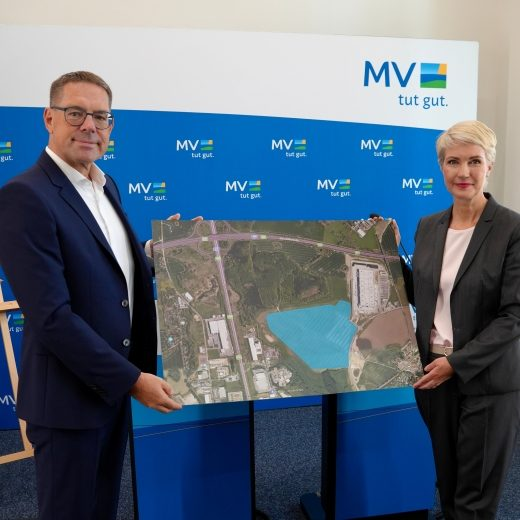
Summary
- Schwarz Group plans to invest up to €5.6bn in a data centre at Dummerstorf, with 240MW targeted by 2033.
- The proposed site can connect to Germany’s 380kV network, with a possible route to a 1GW grid connection by 2045.
- Plans include renewable electricity, ambient-air cooling, and waste-heat recovery for the Rostock district heating system.
Schwarz Group has formally confirmed plans to invest up to €5.6bn in a large data centre near Rostock, turning an earlier reported project into one of the more substantial committed digital infrastructure programmes in Germany.
The retail and technology group, which owns Lidl and Kaufland, said the proposed facility at Dummerstorf in Mecklenburg-Vorpommern is expected to reach 240MW of capacity by 2033, subject to standard approvals. Schwarz also sees a route towards a grid connection of as much as 1GW by 2045, although that figure describes the potential electrical connection rather than committed IT capacity.
The formal announcement adds considerably more detail to earlier reporting on the proposed Rostock development. Schwarz has now put a capital figure against the first 240MW phase, identified the intended site, and outlined how power, cooling, and heat reuse could be handled.
Dummerstorf’s location in northern Germany is central to the plan. Schwarz said the industrial park under consideration can connect to the 380kV extra-high-voltage network, while the wider region has access to substantial onshore and offshore wind generation. Regular data centre operations are intended to use renewable electricity.
The company also intends to use outside air as part of the cooling strategy, taking advantage of the northern German climate for free cooling. Schwarz’s own announcement describes state-of-the-art air cooling; detailed thermal specifications have not yet been finalised because the eventual cloud and AI hardware configuration remains under development.
That distinction is important at a project of this scale. Cooling architecture increasingly depends on the density and mix of the installed compute, with higher-power AI racks pushing operators towards liquid-assisted designs while conventional and lower-density loads can continue to rely heavily on air systems. Schwarz has not yet disclosed rack densities, chip platforms, water demand, or the final mechanical design.
Power and heat become part of the site plan
The project is also being tied into local energy infrastructure rather than treated solely as an electricity consumer. Schwarz said a letter of intent has been signed with Rostock’s public utility covering the use of waste heat from the facility, with the intention of feeding recovered heat into municipal heating planning.
Heat reuse is technically attractive at large campuses, but delivery depends on more than a connection at the data centre boundary. Temperature levels, distance to viable heat customers, seasonal demand, pipe infrastructure, and the economics of upgrading low-grade waste heat all affect how much recovered energy can ultimately be used. The Dummerstorf proposal is therefore at the beginning of that process rather than at the point of a completed heat-offtake scheme.
Schwarz is positioning the development as both infrastructure for its own digital operations and a sovereign European computing asset. The group said the 240MW capacity would support its own ecosystem while expanding cloud and AI services consolidated within Schwarz Digits, its IT and digital division.
The wider agreement with the state government includes public-sector digital projects using the STACKIT sovereign cloud platform. Planned applications include a digital building-permit system and the introduction of OpenDesk for parts of the education sector, linking the physical investment to Schwarz’s attempt to build a larger German-controlled cloud and software stack.
Construction is expected to begin in 2027, according to Reuters, while the 240MW target stretches to 2033. That timetable reflects the amount of infrastructure still required around the project: planning approval, grid works, the data centre buildings themselves, cooling plant, electrical distribution, and potentially the district-heating connection.
The longer-term 1GW ambition is even more dependent on the power system. A connection pathway extending to 2045 is not the same as having 1GW available today, but it demonstrates how large developers are increasingly securing future electricity options alongside land. In Germany, as elsewhere in Europe, the ability to establish credible access to high-voltage power is becoming one of the main determinants of where very large computing campuses can actually be built.
Schwarz’s decision also broadens the group’s role beyond retail and enterprise technology. At €5.6bn for the planned 240MW phase, the Dummerstorf project would put significant capital into grid-connected physical infrastructure whose delivery will depend as much on substations, permits, cooling, and heat networks as on the servers eventually installed inside it.

