
Summary
- Schwarz Digits is investing €11bn in a roughly 200MW data centre on a former power-station site in Lübbenau.
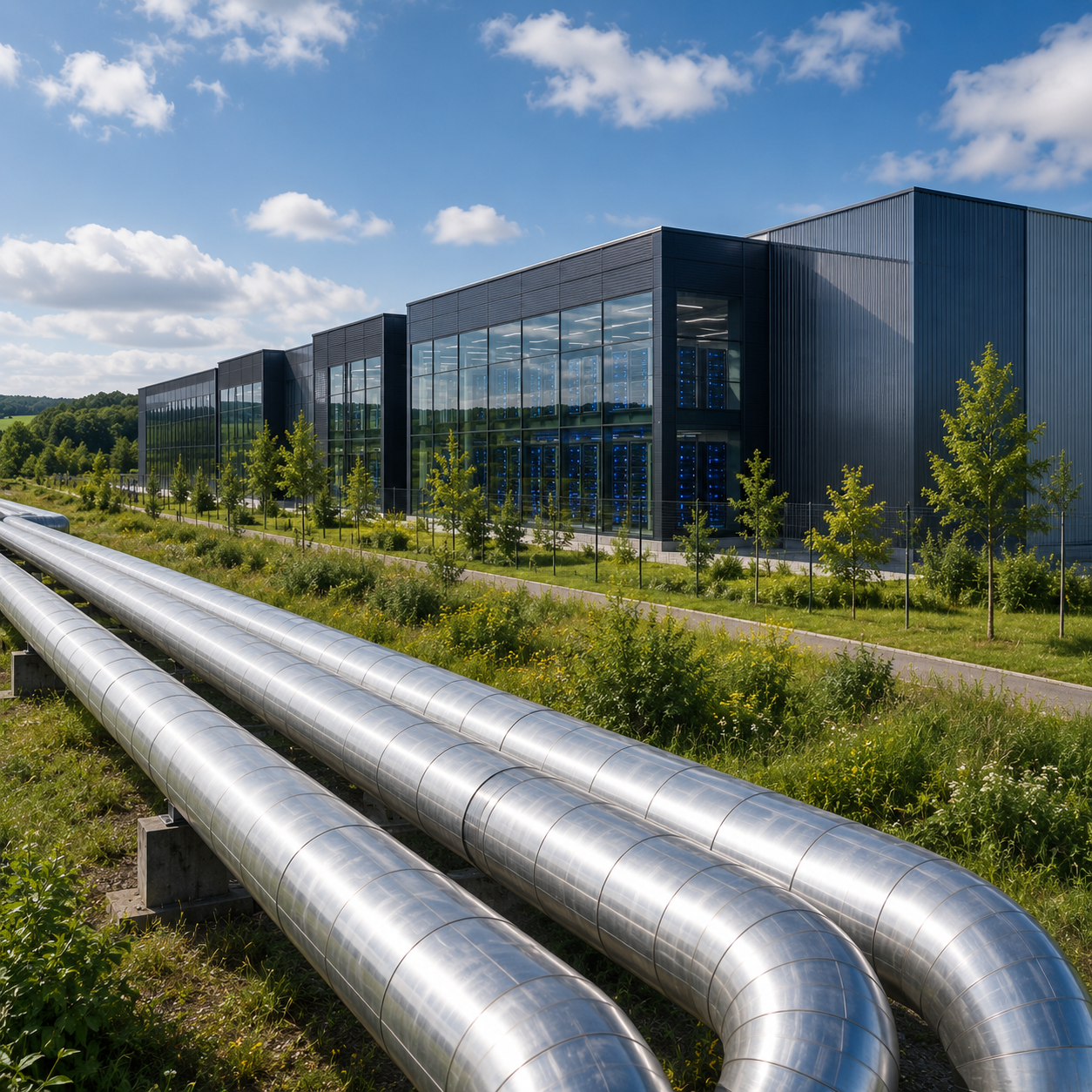
- Server heat is due to enter the local district-heating network from 2028, with the company claiming potential supply for up to 75,000 households.
- The project combines brownfield redevelopment, direct liquid cooling, heat reuse, and a substantial new German AI and cloud load.
Schwarz Digits is moving its €11bn Lübbenau data centre towards large-scale heat reuse, with server waste heat due to feed the German town’s district-heating network from 2028.
The data centre, being built on the site of a former power station in Brandenburg’s Lausitz region, is designed with an initial connection capacity of around 200MW. Schwarz Digits expects the facility to enter operation by the end of 2027, with the heat-reuse arrangement following the next year.
The company says the heat available from the campus could ultimately supply the equivalent of up to 75,000 households through the district-heating system. Its own administrative building is also intended to use surplus heat from the facility rather than a separate heating system.
Lübbenau is a particularly useful test of data centre heat reuse because the project combines a very large computing load with existing industrial infrastructure and a nearby heat network. The 13-hectare site formed part of a former power-generation complex, giving the development access to an established energy location rather than requiring an entirely new greenfield infrastructure corridor.
Schwarz Digits is planning the campus in two construction phases and says it could eventually accommodate as many as 100,000 GPUs. The facility is intended to support cloud and artificial-intelligence workloads as the company expands its STACKIT sovereign-cloud platform and related digital services.
The thermal design is important to the heat-reuse proposition. Schwarz Digits says the servers will use direct liquid cooling, which can recover heat at more useful temperatures than conventional room-level air cooling. Higher-temperature recovered heat can reduce the amount of additional energy needed to raise it to the temperature required by a district network, although the economics still depend on network design, heat-pump requirements, pipework, seasonal demand, and the commercial arrangements between the data centre and heat utility.
Heat reuse has become a recurring element of European data centre planning, but delivery is more complicated than the availability of waste heat alone. Large facilities reject substantial quantities of heat continuously, while residential heating demand is seasonal. An offtaker, suitable network, temperature regime, and infrastructure investment all have to be present at the same location.
Lübbenau starts from a stronger position than a greenfield scheme with no established heat customer. The Stadt- und Überlandwerke Luckau-Lübbenau utility already operates locally, and the proximity of heating infrastructure was identified as an advantage when the data centre project was launched.
The site also illustrates how former energy assets are being reconsidered for digital infrastructure. Large data centres require grid capacity, utility corridors, transport access, fibre, cooling systems, and enough land for electrical and mechanical plant. Brownfield power sites can offer parts of that infrastructure base, although the transition from electricity generation to a large electricity-consuming load still requires substantial new engineering.
Schwarz Digits says the facility will operate using renewable electricity and has incorporated onsite photovoltaic generation, rainwater management, recycled construction materials, and heat recovery into the development. Those measures do not remove the significance of a 200MW load, but they make the engineering around that load more visible than a conventional renewable-power procurement claim alone.
The next delivery milestones will be completion and commissioning of the first data centre capacity, followed by the heat-network connection needed for the 2028 reuse target. The scale claimed for the heat output means the district-heating infrastructure will be almost as important to the sustainability case as the cooling plant inside the data halls.

