
Summary
- The proposed campus could contain up to three hyperscale buildings with approximately 300MW of combined IT load.
- Current plans assume up to 216 backup generators across the campus as part of the resilience design.
- Stage-two consultation runs until 27 October ahead of an intended Development Consent Order application in spring 2027.
SDC M40 Campus has opened a second stage of public consultation on plans for a Buckinghamshire data centre development designed to accommodate approximately 300MW of IT load across as many as three hyperscale buildings.
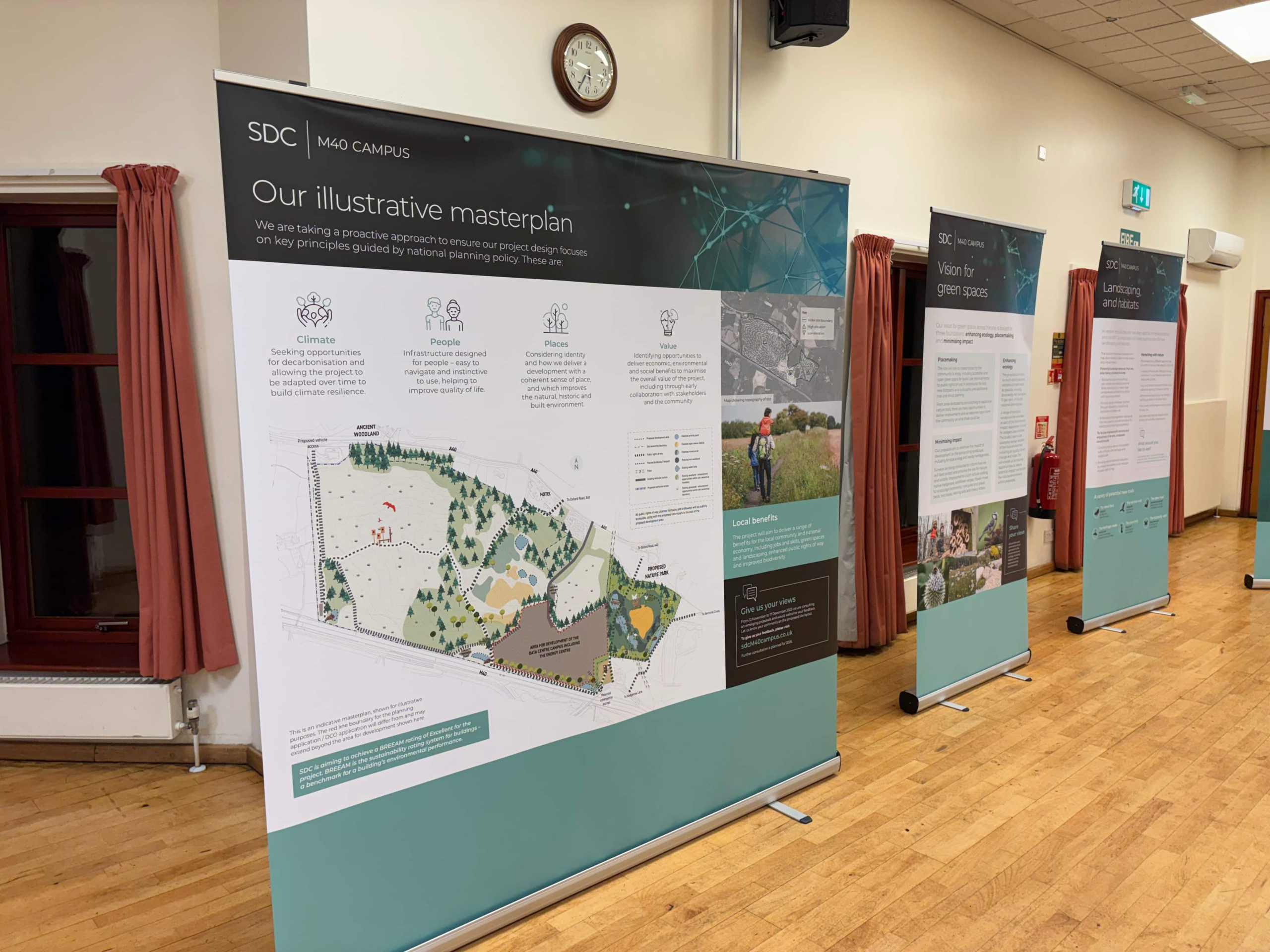
The consultation, which runs from 15 September to 27 October, provides substantially more detail on the physical scale of the scheme near the M40. SDC Capital Partners is proposing a data centre campus, an integrated on-site energy centre, landscaping, access works, and associated infrastructure.
Current plans envisage up to three data centre buildings with a combined maximum footprint of approximately 65,000 square metres and heights of up to around 40 metres. Each would contain a central data hall flanked by gantries housing backup generation.
The design currently assumes as many as 72 backup generators for each data centre building, or up to 216 across the full campus. SDC says those numbers may change as the engineering develops.
The generator count provides one of the clearest indications yet of the scale of resilience infrastructure associated with the project. A 300MW IT load requires considerably more supporting electrical capacity once cooling, distribution losses, ancillary systems, and redundancy are included, while standby generation has to be arranged so critical loads remain available during utility outages.
The project also includes an integrated energy centre, although the consultation process remains part of the design and planning stage rather than construction approval. SDC says feedback will inform the scheme before it submits a Development Consent Order application, currently targeted for spring 2027.
That route reflects the increasing scale of UK data centre proposals. Projects with very large electricity requirements have moved beyond the footprint of conventional industrial developments and into planning questions involving grid infrastructure, landscape impact, transport, air quality, noise, and national digital policy.
SDC held its first consultation between November 2025 and January 2026. The current stage includes further information on the data centre buildings and supporting energy infrastructure as well as responses to issues raised during the earlier process.
Public events are scheduled across Beaconsfield, Chalfont St Peter, Gerrards Cross, and Hedgerley, alongside an online session. Written feedback remains open until 27 October.
The 300MW figure refers to intended IT load rather than the site’s total grid demand. IT load measures electricity delivered to computing equipment, while a complete data centre also consumes power through cooling, pumps, electrical conversion, controls, lighting, security, and other supporting systems.
That distinction becomes material at campus scale. Even comparatively efficient facilities need electrical infrastructure above the nominal IT load, and the relationship between grid connection, on-site generation, standby systems, and future phases can determine how quickly capacity can actually be commissioned.
SDC’s proposal arrives as the UK attempts to reconcile growing data centre demand with constrained electricity networks, particularly around existing clusters in London and the South East. Large projects increasingly depend on securing power years before commissioning, while developers are examining on-site generation and more complex energy arrangements to reduce exposure to grid connection schedules.
The M40 location also sits in a planning environment that is changing as data centres are treated more explicitly as nationally significant infrastructure. That does not remove local environmental assessment or consultation requirements; in practice, it raises the amount of technical evidence expected around projects whose power demand can be measured in hundreds of megawatts.
The generator design is likely to attract particular examination as the scheme progresses. Backup systems are normally used only during outages and testing, but the number, fuel type, operating hours, emissions controls, and maintenance regime affect local air-quality and noise assessments even where generators are not intended to provide routine power.
For now, SDC is still refining those details. The second consultation establishes the intended scale much more clearly: this is not a small regional facility but a three-building hyperscale campus with an IT load approaching the output of a large power station unit.
The next substantive milestone will be the DCO application in spring 2027, when the engineering assumptions outlined during consultation will have to be translated into a formal planning case and supporting environmental assessments.

